
The '1011' Curse and Beyond: Reflections on a Market Anniversary
Exactly one year after the '1011' crash, the crypto market displays unexpected resilience. From whale accumulation to the lessons of the Papertrade de…
The '1011' Curse and Reflections: Moving Forward on a Market Anniversary
Today is October 11, 2026—a date that still quickens the pulse of veteran crypto traders. Exactly one year ago, the market suffered an epic "1011" crash. Bitcoin experienced violent volatility within a 30-minute window, with single-minute drops exceeding 4%, ultimately leading to the liquidation of approximately $19 billion in leveraged long positions across the network. Yet, on this anniversary, market sentiment has not spiraled into panic; instead, it exhibits a strange sense of resilience. Whales have consistently accumulated roughly 15,000 BTC and 166,000 ETH over the past 72 hours. This "anti-fragile" accumulation provides a compelling footnote to the current volatile landscape.
Anniversary Review: From Epic Liquidation to Rational Defense
A year ago today, Bitcoin was trading at a then-historic high of $126,000 before plummeting to $105,000, a 12% drop in a single day. This liquidity tsunami, triggered by geopolitical turbulence (Donald Trump's announcement of a renewed trade war), left deep scars on the market.
Looking back at the past year, while risk appetite remains high, both institutions and retail investors have developed a newfound respect for leverage. This shift is evident in the crypto asset custody guide recently released by Changpeng Zhao: he explicitly advises users to choose self-custody strategies tailored to their personal holdings and technical proficiency to mitigate the risks of theft and accidental loss. From the "pursuit of 100x leverage" to "how to securely store assets," the industry narrative has shifted from pure financial speculation to the stability and security of underlying infrastructure.
STRK's Counter-Trend Surge and the 'Loss-as-Mining' Game
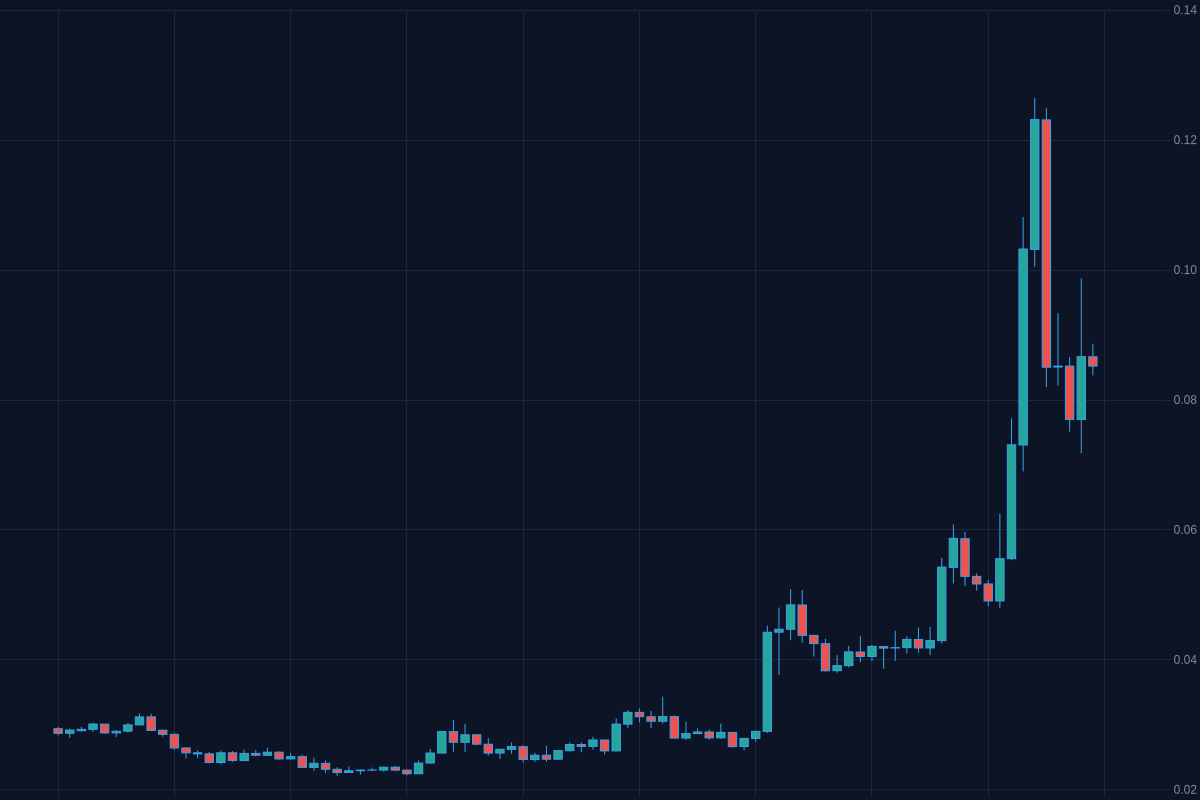
Amidst a generally sideways market, STRK's performance is undoubtedly the focal point today. According to market data from Gate and HTX, STRK broke through the $0.1 mark today, hitting a year-to-date high with a 24-hour gain peaking at 40.8%. Such extreme, independent price action is often accompanied by intense market maneuvering.
In stark contrast is the chaos following the launch of the Papertrade platform yesterday. As a perpetual contract exchange deployed on HyperEVM, it recorded over $80 billion in nominal trading volume in its first hour. However, this prosperity is built on a twisted incentive mechanism: the platform issues PAPER tokens through a "loss-for-tokens" model, resulting in cumulative user losses of $4.73 million. This is more than just a technical test; it is an experiment in human greed—traders generated massive nominal volume in a very short time just to farm token emissions. As PAPER token emissions enter a decay phase, the speed at which this artificial prosperity recedes is equally alarming.
From Macro to Micro: Key Industry Shifts
Beyond market speculation, several industry developments warrant attention today:
- Policy and Compliance: The CPC Central Committee and the State Council issued opinions proposing the construction of a national blockchain network, promoting the institutionalization of the data element market. This is not only a top-level plan for the domestic blockchain industry but also signals that blockchain technology will be further integrated with the real economy.
- Institutional Moves: U.S. spot Ethereum ETFs saw a net outflow of $542.1 million last week, the worst performance since January, while Solana ETFs ended their 14-week inflow streak. This short-term capital flight reflects a defensive stance among institutions regarding the uncertain macro environment.
- Security Alert: Fake Ledger phishing websites have recorded over 1 million visits in the past 30 days and have topped Google search results. In the realm of asset security, technical defenses can never keep pace with the frequency of social engineering attacks; investors must remain vigilant at all times.
- Industry Anxiety: Binance co-founder He Yi recently admitted that the core challenge for leading crypto firms is the talent gap. Even with ample cash and users, retaining top-tier innovators remains a difficult puzzle for the entire industry.
Upcoming Points to Watch
The market is far from calm following the "1011" anniversary. For the coming week, we suggest focusing on these three dimensions:
- Macro-Geopolitical Window: According to CCTV News on October 11, U.S. envoys Witkoff and Kushner may visit Moscow within two weeks. The easing or escalation of geopolitical tensions will directly impact the liquidity of global risk assets.
- Ethereum's Cyclical Support: Tom Lee predicts Ethereum could break through $5,000 by the end of the year. As a vital component of this cycle's logic, ETH holding its current consolidation range near $2,500 will be key to the market regaining upward momentum.
- Tech Stocks and Crypto Correlation: Hedge fund net exposure to the "Magnificent Seven" tech stocks has risen to a record high of 22%. As crowding in traditional tech stocks reaches an extreme, whether capital will spill over into the crypto market in search of new growth points will be a core focus for Q4 capital flows.
The Nature of 'Stock-Market Games' in a Liquidity Trap
STRK's single-day surge is not an isolated event; it reflects the extreme scarcity of liquidity in the current crypto market. When the broader market lacks a clear narrative, capital tends to "vampirize" profits through high-volatility assets within a narrow range. After long-term selling pressure, STRK's chip distribution has become concentrated, creating low-cost conditions for whales to push the price. However, for retail investors, such gains often come with high liquidity traps: when you see a 40% gain and chase the rally, you are likely entering the market makers' exit zone.
If STRK represents the short-term impulse of speculative capital, then the chaos on the Papertrade platform is an extreme satire on the industry's current "DeFi mining" model. Actively incurring high losses to obtain governance tokens is a logic completely different from early liquidity mining; it has evolved into a tragic game of "who is more willing to pay for the system." The fragility of this mechanism lies in its total reliance on subsequent capital inflows. Once the token emission rate can no longer cover the cost of losses, liquidity will evaporate instantly, serving as a warning to all projects using such high-frequency incentive mechanisms.
The Logic of Policy Dividends vs. Institutional Defense
Recent domestic policy guidance on building a national blockchain network creates an interesting disconnect with the "institutional retreat" observed in global crypto markets. Domestic policy focuses on the "tool attributes" of blockchain as a foundation for data elements, emphasizing compliance and real-economy empowerment. Meanwhile, overseas institutional capital, as seen in Ethereum ETF outflows, reflects a defensive posture as global capital faces shifting Fed rate expectations.
This disconnect implies that the value growth of blockchain technology will follow a "dual-track" system: on one hand, the penetration of compliant blockchain in infrastructure construction will bring long-term technical dividends; on the other hand, as a risk asset, cryptocurrency pricing will continue to be heavily constrained by the global financial environment (specifically U.S. Treasury yields and tech stock performance). Investors need to shed the illusion that "all blockchain projects will benefit from policy tailwinds," because in a macro tightening cycle, purely financial assets still face the severe test of deleveraging.
Security Narrative: The Underrated 'Industry Ceiling'
While discussing market volatility, one cannot ignore the deep concerns behind the million-plus visits to phishing Ledger sites. Security is not an accessory to the crypto industry; it is its cornerstone. When 1 million visits target a phishing site, it means that both newcomers and veterans still face massive "security black holes" in their asset management habits.
The "talent gap" and "security risks" mentioned by He Yi are two sides of the same coin: the industry lacks not just engineers who can write code, but top talent capable of building rigorous security defense systems. The current crypto market is in the painful transition period from "barbaric growth" to "professional operation." Projects that can solve private key management and asset theft issues through technology may hold more long-term moat value than simple DeFi protocols.
Conclusion: How to Navigate the Upcoming Market Changes
The market is far from calm following the "1011" anniversary. For the coming week, we suggest focusing on these three dimensions:
- Macro-Geopolitical Window: CCTV News reported on October 11 that U.S. envoys Witkoff and Kushner may visit Moscow within two weeks. Geopolitical shifts will directly affect the liquidity of global risk assets, and risk-off sentiment could trigger sharp volatility in the crypto market at any time.
- Ethereum's Cyclical Support: Tom Lee predicts Ethereum could break through $5,000 by year-end. As a key component of this cycle, ETH holding its current $2,500 consolidation range is crucial for regaining momentum; a break below this could trigger a second bottoming attempt.
- Tech Stocks and Crypto Correlation: Hedge fund net exposure to the "Magnificent Seven" is at a record high of 22%. As tech stock crowding peaks, whether capital spills over into crypto in search of new growth will be a core focus for Q4.
Risk Notice: Crypto assets are highly volatile. This article is for informational purposes and sharing of viewpoints only, and does not constitute investment advice.