
Solana Enters Shanghai: Lujiazui Office, Bund Light Show, CZ Expresses Envy
On Oct 14, Solana opened an office in Shanghai Tower, Lujiazui. The Bund Citigroup Tower displayed SOLANA on its LED facade, drawing praise from CZ. S…
On the evening of October 14, the riverside LED facade of the Citigroup Tower in Lujiazui, Shanghai, lit up with a purple-blue animation. Seconds later, six massive vertical English letters appeared in the Bund's night sky: SOLANA. The official Solana account immediately posted a video of the scene with a caption consisting of just one phrase: "ni hao shanghai".
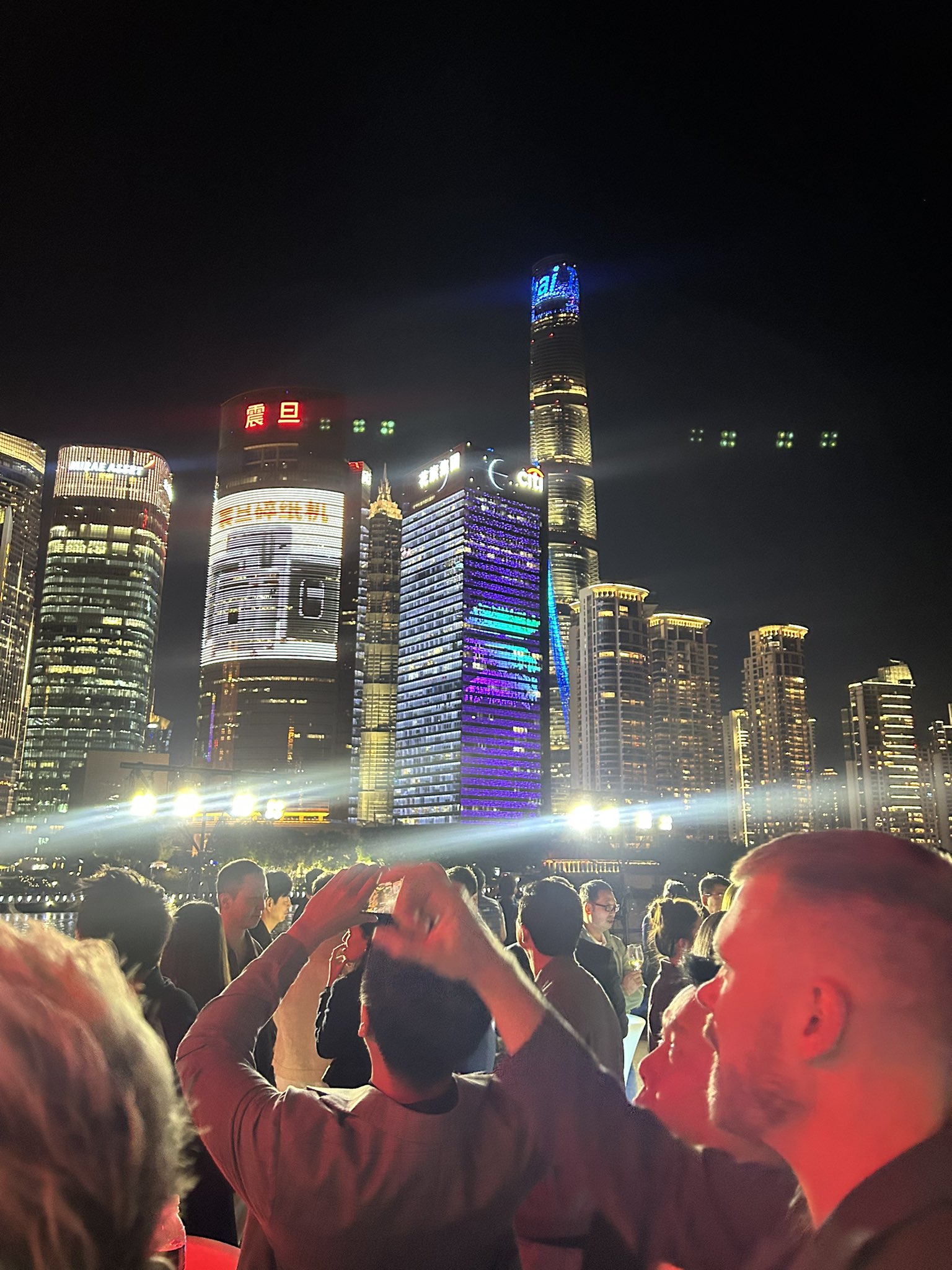
The lighting scene in Lujiazui across from the Bund, with the Shanghai Tower displaying SOLANA (Source: Rachel Conlan / X)
Almost simultaneously, Solana Chief Product Officer Vibhu posted another video overlooking the Huangpu River—showing their newly completed office located in the Shanghai Tower. In the caption, he claimed that Solana had moved into the "highest commercially available office space in the world." Solana Foundation Chair Lily Liu retweeted to confirm: "It's true."
CZ Tweets: BNB Chain still can't do this
After the lighting video was posted, Binance founder CZ retweeted a photo of the scene from Solana Foundation Chief Strategy Officer Rachel Conlan on X, publicly commenting: "Amazing to see Solana being able to advertise in China, and even set up an office. BNB Chain can't do that yet. Hope, it's good for one player in the industry, it's good for others too."
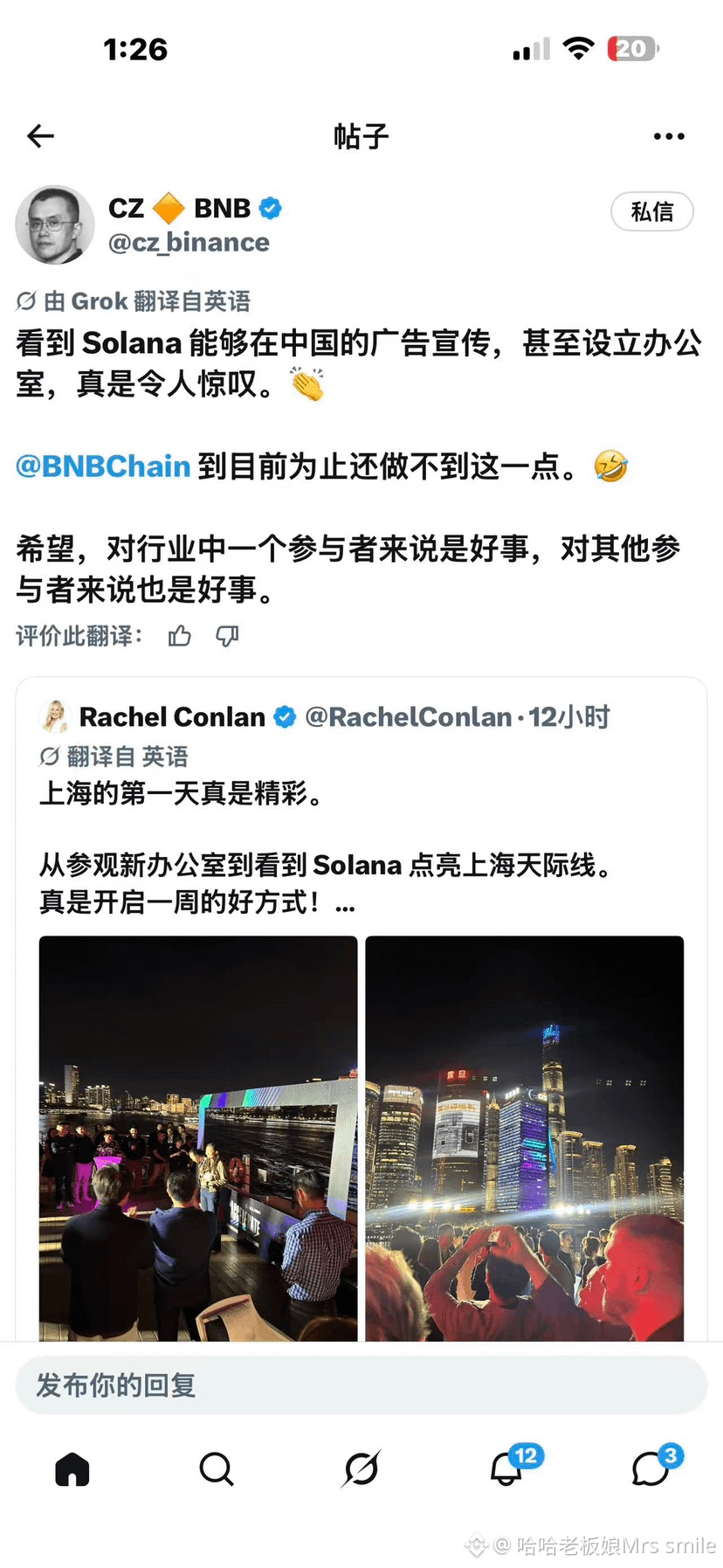
CZ publicly expressing "envy" on X regarding Solana's landing in Shanghai (Screenshot: X / @cz_binance)
In response to netizens joking that he was "too kind to a competitor," CZ added: "It's not competition. Whoever helps the industry expand benefits the whole industry, you don't have to do everything yourself." Even more intriguing is that Rachel Conlan only joined the Solana Foundation as Chief Strategy Officer this September; prior to that, she was the Chief Marketing Officer at Binance. It is rare in the crypto industry to see a former Binance executive personally promoting a "competitor's" landing in Shanghai. She wrote in her tweet: "Incredible first day in Shanghai. From visiting the new office to seeing Solana light up the Shanghai skyline, what a way to start the week. The energy from the community is unbelievable."
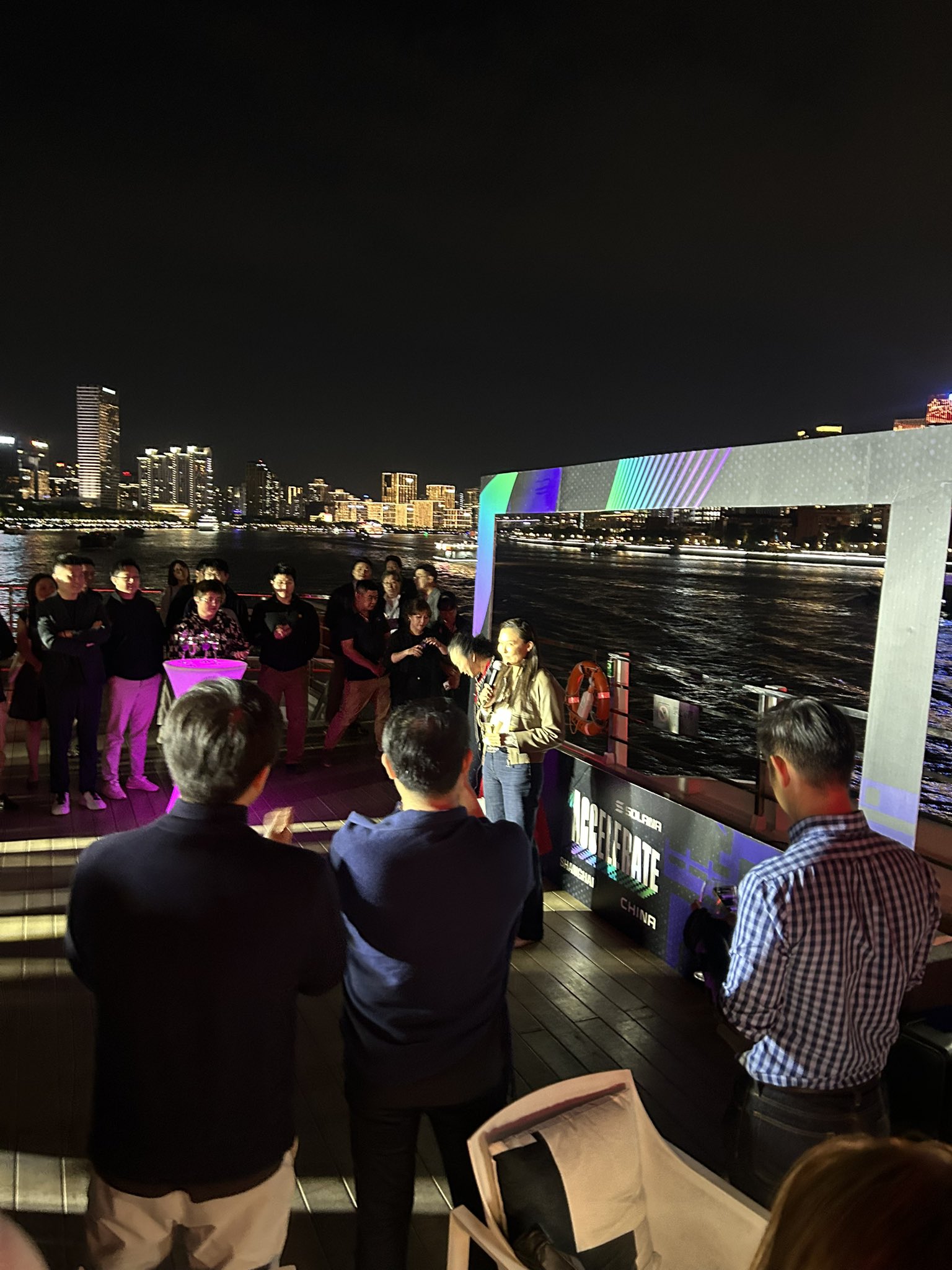
The Accelerate China welcome event on a Bund cruise on the night of October 14 (Source: Rachel Conlan / X)
The "Emergency Brake" seven months ago
This is not Solana's first attempt to land in Shanghai. In March of this year, Solana announced a partnership with the Shanghai Hongqiao Ali Center to establish a Builder Station for Chinese developers. Promotional materials once mentioned support from relevant government units in Minhang District and stated that government officials would attend to give opening remarks. Once the news broke, interpretations that "the tide has turned" spread everywhere.
A few days later, on March 13, the scheduled opening ceremony was abruptly halted, and official preview content was deleted. The team's explanation was quite restrained: after a comprehensive assessment of market sentiment and external factors, they decided to cancel the opening event. This lesson helped the team map out the boundaries—in China, developer communities can be built and office spaces can be rented, but once an "overseas public chain" is tied to "government endorsement" in promotions, it easily triggers over-interpretation by the secondary market.
Talk AI, not coins
After figuring out the boundaries, Solana's progress in Shanghai has become significantly smoother. Starting October 16, the "Solana Accelerate China" four-city tour will cover Shanghai, Hangzhou, Shenzhen, and Beijing within a week. Looking at the official agenda, there are no terms related to token issuance, Meme speculation, or secondary markets. Instead, the keywords are AI Agent, Robotics, Embodied AI (Physical AI), and high-performance underlying infrastructure. The Shanghai opening roundtable even invited the head of Alibaba's Qwen and scholars from Fudan University to discuss "What the world can learn from China."
This is precisely the safest entry point Solana found after paying its dues: Chinese regulators maintain high pressure on virtual currency trading and financial speculation targeting domestic residents, but the doors remain open for hardcore developers, AI applications, and hardware infrastructure. Compared to exchange-affiliated public chains that carry an inherent exchange label and cannot escape the "financial trading" context no matter how they explain it, the Silicon Valley-born Solana Foundation lands as a "multinational open-source technology organization," making every move logical and compliant.
A more realistic calculation is that Solana isn't coming to China to find retail investors to buy coins. The world's densest concentration of AI application developers, the most cost-effective STEM engineers, and the most mature smart hardware and robotics supply chain—these are the true attractions of these four cities. Silicon Valley holds the power over capital and narrative pricing, while China possesses the world's largest engineer dividend and hardware manufacturing ecosystem. Setting up an office in the Shanghai Tower targets this group of technologists and entrepreneurs looking for global expansion channels.
Why Lily Liu?
How can a pure Silicon Valley public chain handle industrial park landings, university collaborations, and compliance boundaries so skillfully? Part of the answer lies in the resume of Foundation Chair Lily Liu: a Stanford undergraduate with a background in East Asian Studies from Harvard, she previously worked at McKinsey's Beijing office and later served as CFO of a Chinese healthcare group, personally leading the approval and construction of a 500-bed private hospital in China. Someone who has built a physical hospital in China naturally understands what local industries welcome and what they avoid.
Even more interesting is that Shanghai was the starting point of her crypto career. In 2013, while living in Shanghai, Lily Liu first heard about Bitcoin and entered the industry through an introduction by Stanford alumnus and Bitcoin China co-founder Bobby Lee. Twelve years later, this former finance executive who listened to people talk about Bitcoin on the Bund has returned to the starting point with a Silicon Valley public chain valued at tens of billions of dollars.
Lighting up doesn't mean loosening up
After the Bund lighting, some in the community excitedly speculated that "policies are loosening." However, it was soon discovered that short videos of the Bund light show are difficult to find directly on mainstream Chinese platforms like Douyin. This constitutes the most realistic business sample at present: renting an office in Lujiazui's tallest building and discussing underlying technology with big tech and university experts is a completely feasible compliant path; once it leaves the context of technology and industry and enters mass entertainment platforms, existing content risk control mechanisms still operate as usual. The logic of "encouraging hardcore technology while strictly controlling mass speculation" has not changed.
For ordinary users, this round of lighting does not signify any change at the trading level. Users who wish to participate in mainstream currency trading in a compliant environment still need to do so through offshore licensed platforms, such as Binance, OKX, and Gate.io. The true significance of Solana's landing this time lies in keeping financial trading in offshore markets while landing the technology ecosystem and AI narrative in Lujiazui—this localization path may be referenced by more overseas public chains.