
Bitcoin Google Searches Hit Six-Year Low: Willy Woo Calls It a Buy Signal
On 15 October 2026, on-chain analyst Willy Woo published a long-range Google Trends chart showing worldwide search interest in "bitcoin" falling to ab…
Bitcoin's Google search interest has fallen to a six-year low
On 15 October 2026, on-chain analyst Willy Woo posted a long-range chart on X: worldwide search interest in both "bitcoin" and "BTCUSD" has cooled sharply, with the generic term "bitcoin" dropping to roughly 14 out of 100 — its lowest reading in about six years.
The number does not stand alone. Bitcoin is currently trading near $82,000, about 35% below its all-time high of $126,080 set in October 2025, and down roughly 4% since the start of this month. The widely anticipated "Uptober" rally has yet to materialise. Price is falling, and so is the conversation — the chart puts the two side by side.
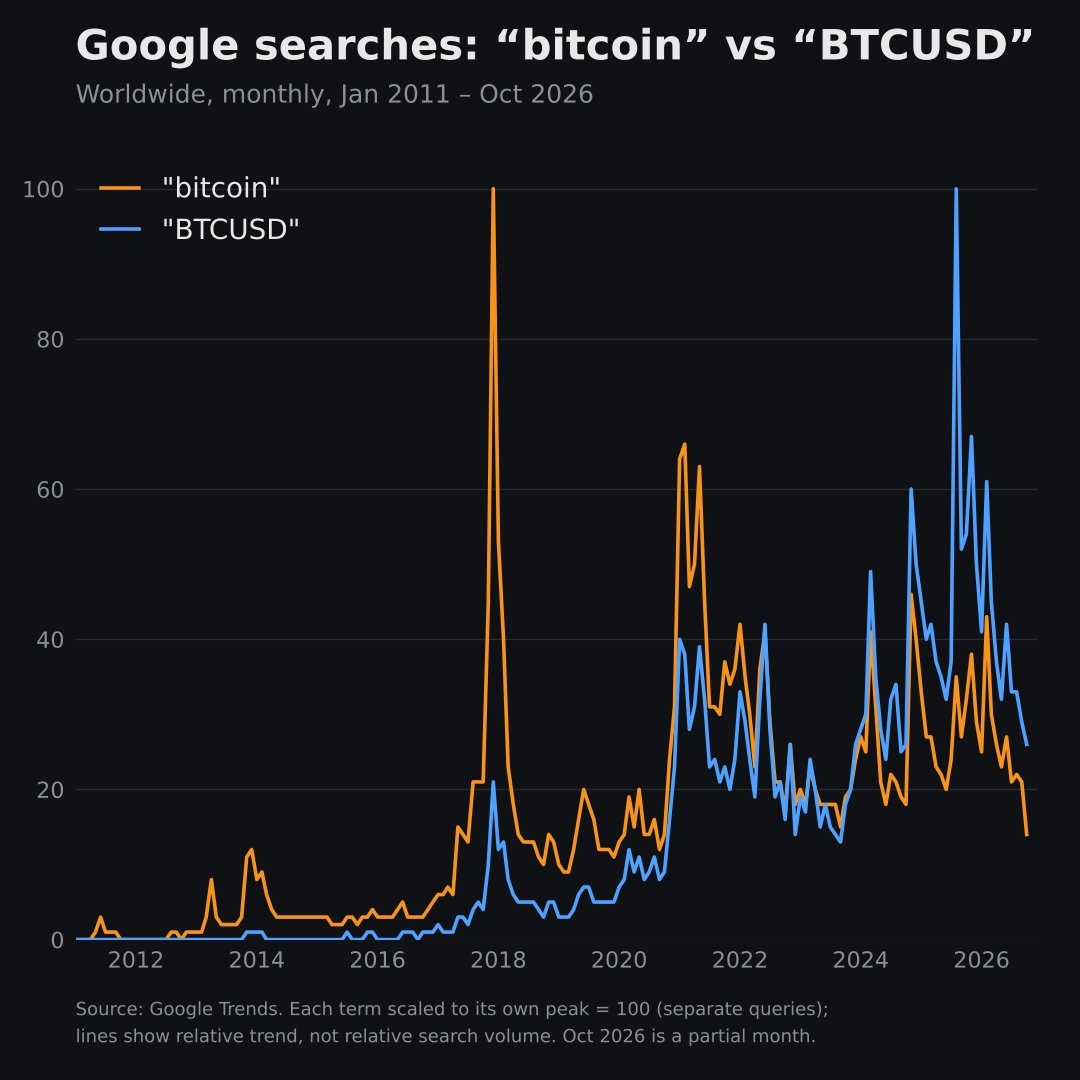
Before reading the chart, note its methodology: each term is scaled to its own historical peak, which equals 100. The orange line ("bitcoin") hit 100 in December 2017, while the blue line ("BTCUSD") hit 100 in 2025. The two series are scaled independently, so they show where each term sits relative to its own peak — not absolute search volume. The chart also flags that October 2026 is a partial month.
One chart, three cycles: search interest peaks after price, not before
Stack this chart against bitcoin's previous market cycles and a pattern repeats: search interest almost always peaks after the price peak, never before it.
| Period | Search interest (own peak = 100) | BTC price at the time | What happened next |
|---|---|---|---|
| December 2017 | 100 — the all-time high for "bitcoin" | First approach of $20,000 | A steep decline through 2018; during the 2018–2019 bear-market accumulation phase, search interest fell to around 10 |
| May 2021 | About 66 — the second peak | Price had already topped out near $64,000 in mid-April | A sharp May drawdown; when BTC pushed to a new $69,000 high in November, search interest did not follow |
| 2024–2025 cycle | "bitcoin" never exceeded 45 at any point | A record $126,080 in October 2025 | Price made new highs while the generic term never caught up — the biggest anomaly of this cycle |
| 2025 | "BTCUSD" reached 100, its own record | Just before BTC's peak | Interest in the professional ticker spiked at the top, typically the most crowded phase for leverage and trading demand |
| October 2026 | About 14 — a six-year low | Roughly $82,000, about −35% from the high | Interest and price cool together, leaving the market in a "nobody is talking about it" state |
Two details deserve attention:
- Price peaks first; search peaks later. In 2017 the price topped in mid-December while search interest only peaked at the end of December. In 2021 the price topped in mid-April while search interest did not spike until early May. Search interest is better understood as retroactive confirmation — those who chase it tend to buy into a local top.
- This cycle, the generic term never broke into the mainstream. Search interest for "bitcoin" never cleared 45, compared with 100 in 2017 and 66 in 2021. There was no retail mania this time, which fits the view that the 2024–2025 advance was driven mainly by ETFs and institutional flows.
Why "bitcoin" cooled while "BTCUSD" hit a record high in 2025
The real story here is not how far interest fell but the divergence between the two lines. Ordinary people search for "bitcoin"; traders and professional desks pull up "BTCUSD" to check prices. A record high in one and a muted reading in the other says the composition of market participants has changed.
- Institutions don't use Google. Spot bitcoin ETFs, hedge funds, market makers and OTC desks route orders through brokerage terminals, execution systems and APIs — they don't need a search engine to find the front door. The more institutional the flow, the weaker the link between search interest and price.
- Attention is rotating, not leaving. In contrast to the "bitcoin" cooldown, searches such as "buy crypto" reportedly hit new highs for the year in October 2026. Retail hasn't abandoned the market; it simply is not fixated on that one word.
- Capital is consolidating into bitcoin. Bitcoin dominance rose to about 60%, its highest in roughly a month, while altcoins came under pressure. The market did not break — it retreated from broad speculation to holding the most established asset.
Willy Woo's read: the best time to buy is when nobody cares
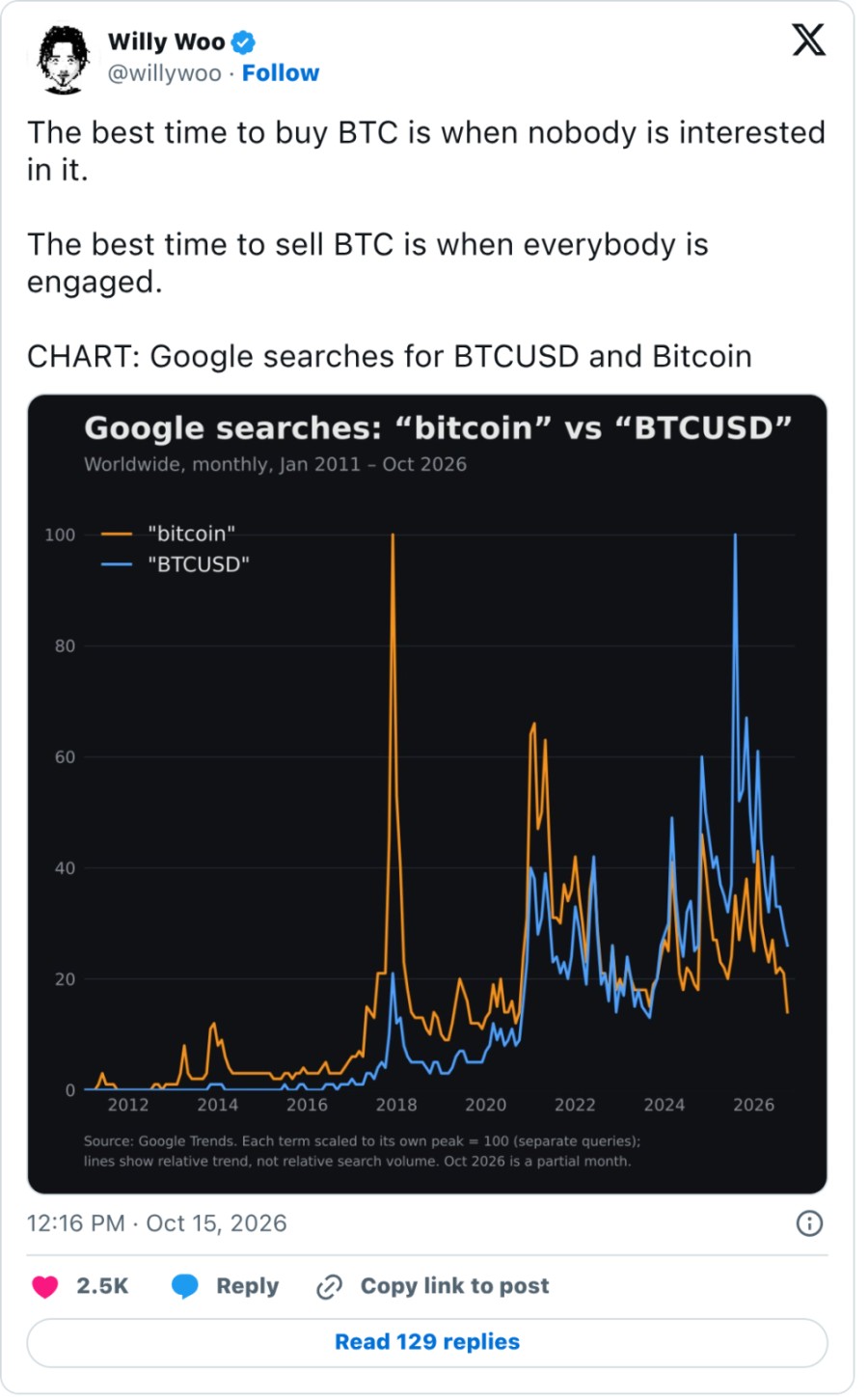
Woo's caption is two sentences long and unambiguous — "The best time to buy BTC is when nobody is interested in it. The best time to sell BTC is when everybody is engaged." His historical evidence: during the 2018–2019 accumulation phase, search interest also sank to roughly 10.
That said, "low search interest equals a bottom" is not a rule you can use on its own. Several analysts covering the data have cautioned that falling search interest cuts both ways: it signals that FOMO and speculative froth are draining away, but it also means fresh capital and fresh attention are drying up, a phase in which price swings can be amplified. A low reading is decent evidence that the market is no longer euphoric; it is not a standalone bottom signal.
Woo also makes a longer-horizon argument: bitcoin may be drifting away from its traditional four-year halving cycle and towards longer traditional-finance market cycles. If that is right, predicting this cycle with the old toolkit of "halving cycle plus retail interest" is itself a distortion.
A quick valuation yardstick: bitcoin is one-eighteenth the size of gold
Discussion under Woo's post also turned to relative scale: bitcoin's total market value is roughly $1.65 trillion, against about $29.3 trillion for gold on World Gold Council figures and about $157.8 trillion for global equities at the end of 2025, per the World Federation of Exchanges. Optimists read those numbers as headroom; sceptics argue that the larger and more mature the asset becomes, the more it behaves like any other risk asset, and the less of its valuation rests on narrative. The two readings map neatly onto the disagreement that emerges as search interest hits a six-year low.
What it means for ordinary investors
- Interest is not price, and the two are not synchronised. Search interest is a proxy for retail sentiment, not a leading indicator for price. It is better at telling you whether the market is euphoric or indifferent than at timing entries.
- The "Uptober" expectation has missed. October has historically been a strong month for bitcoin; this year BTC is down about 4% so far, and price weakness itself is eroding faith in seasonal patterns.
- Don't treat "nobody is talking about it" as an alarm clock to buy. What actually sets the medium-term direction is on-chain data, capital flows, the pace of institutional allocation and your own position sizing — not a search-interest curve.
- This is a global story. After the data circulated, outlets including Crypto News, EconoTimes, BeInCrypto, DiarioBitcoin and U.Today followed up on the same day, moving the discussion from "are retail investors leaving?" to "are institutions taking over?" — the cooling interest itself became the hot topic.
If you want a more systematic view of bitcoin and the major trading venues — pricing, fees and capital flows — read it alongside our 2026 crypto market recap, and compare the public data and compliance disclosures of platforms such as Binance and OKX before making any decision based on your own risk tolerance.
Data and sources
The search-interest data cited here comes from Google Trends, worldwide, monthly, covering January 2011 to October 2026. Each keyword is normalised to its own historical peak, which equals 100; the series are scaled independently, so the lines show relative trends rather than absolute search volumes, and October 2026 is a partial month. Price and market-value figures reflect public market levels in mid-October 2026. Every chart and screenshot in this article is credited to its original source and has not been redrawn.
Risk notice and affiliate disclosure: Crypto asset prices are highly volatile. This article organises and interprets publicly available information and third-party data and is not investment advice. The search-trend, price and market-value figures cited come from third-party public sources and may vary with methodology and timing; please defer to official data. This article may contain affiliate links, and we may earn a commission if you register through them. That does not increase your cost or affect the independence of our judgement. Assess the risks yourself and only invest what you can afford to lose.