
EU Orders USDT Delisting: ESMA Sets a Hard Deadline of 8 January 2027
On 8 October 2026, ESMA published an opinion requiring MiCA-authorised platforms to stop offering services tied to unauthorised stablecoins to EU clie…
Europe sets a hard deadline for unauthorised stablecoins: 8 January 2027
On 8 October 2026, the European Securities and Markets Authority (ESMA) published an opinion requiring every crypto-asset service provider authorised under MiCA to stop providing services related to non-MiCA-compliant stablecoins to clients in the European Union. In practice, that means Tether's USDT and similar tokens are being cleared out of EU-regulated venues.
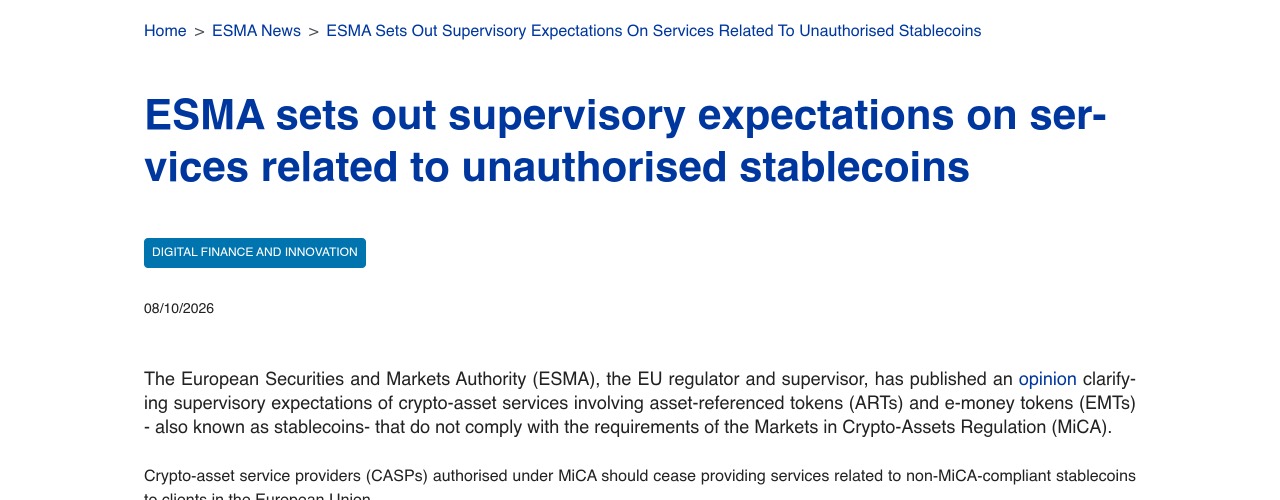
Source: ESMA official press page, published 8 October 2026. Screenshot unmodified.
The document is not merely advice: it sets out supervisory expectations for national competent authorities (NCAs). ESMA also asks NCAs to ensure that market participants no longer maintain, introduce or facilitate access to such stablecoins, and that providers put in place appropriate technical, contractual and organisational controls.
What ESMA actually requires: what still works, what stops now
Notably, ESMA has not ordered a blanket freeze on user assets. It allows a transitional arrangement — but the permitted functions are narrow:
| Still permitted during the transition (to 8 Jan 2027) | Must stop immediately |
|---|---|
| Limited services to handle existing holdings: sell, convert, withdraw, transfer, custody | Buying (letting clients add exposure) |
| Helping clients unwind positions | Promotion and marketing of those stablecoins |
| — | Trading, and maintaining continuous market availability |
| — | Investment advice, order execution, reception and transmission of orders — the full range of MiCA-covered services |
In short: you can still sell, convert and withdraw your USDT, but you can no longer buy or trade it. The transition exists to allow an orderly exit, not to trigger a run.
Timeline: this was a slow-closing gate, not a sudden event
| Date | What happened |
|---|---|
| 31 Mar 2025 | Binance delisted nine stablecoins — including USDT, TUSD and DAI — for EEA users; Crypto.com and Coinbase followed with similar moves |
| 1 Jul 2026 | MiCA's grandfathering period expired, clearing unauthorised stablecoins out of regulated venues |
| 8 Oct 2026 | ESMA publishes this opinion, ordering licensed EU platforms to cease related services and allowing three months to remediate |
| 30 Oct 2026 | Coinbase's client-side deadline (see below) |
| 8 Jan 2027 | Final deadline, three months after the opinion — residual holdings must be resolved by then |
Exchanges are already moving: Coinbase clears positions on 30 October
Platforms began acting well before the supervisory expectation landed. According to public notices, Coinbase has told EEA clients holding USDT, PYUSD or DAI to move those balances out by 30 October 2026; anything left will be converted into USDC automatically, and tokens arriving after the cut-off will not be credited at all. Kraken and others had already delisted USDT, TUSD, USDD and EURT for EEA clients.
One easily missed detail: an automatic conversion into USDC is not a forced liquidation — it is a like-for-like swap, but what you hold afterwards is no longer USDT. For anyone using USDT as a unit of account or settlement, that creates knock-on effects for bookkeeping, tax and operations.
Why USDT fails and USDC passes
MiCA imposes explicit authorisation and reserve requirements on stablecoin issuers: an EU licence plus conditions on reserve assets, redemption and governance. Tether has not obtained that authorisation, so its tokens are treated as unauthorised on EU-regulated venues. Circle's USDC and EURC are authorised, which is why they are explicitly cleared in this cleanup.
The practical result is a redistribution of liquidity: stablecoin trading and settlement on EU-regulated platforms is consolidating towards USDC, EURC and new euro-denominated tokens.
If you hold USDT in Europe, here is what to do
- Confirm your platform and jurisdiction first. This applies to EU/EEA regulated platforms and clients, and cut-off dates differ by venue.
- Read the platform's formal notice, not social media chatter. Pay particular attention to automatic-conversion and no-credit clauses.
- If you need stablecoin exposure, consider an authorised token such as USDC or EURC, or move USDT to venues or self-custody wallets outside the rule's reach. Double-check the destination address and network first — on-chain transfers are irreversible.
- Watch tax and bookkeeping. Stablecoin-to-stablecoin conversions are taxable events in many jurisdictions; keep records.
- Do not rush funds to an unknown platform. Regulatory transitions are peak season for phishing and fake "official swap" schemes.
If you are not in Europe, does it matter?
Yes, in two ways. First, liquidity redistribution: fewer USDT pairs on European order books can affect depth and spreads for certain assets, which feeds through to global pricing. Second, the demonstration effect: the EU framework is widely referenced by other jurisdictions, so if your market is drafting stablecoin rules, delistings often show up first as platform-initiated removals.
To compare how platforms differ on compliance track record, read this alongside our Kraken vs Coinbase comparison and Binance security review, and check the compliance and reserve disclosures published by major venues such as Binance and OKX before deciding where to hold assets.
Risk notice
Implementation of the MiCA rules is ongoing, and platform handling, deadlines and applicable regions differ. This article summarises public information available as of October 2026; defer to ESMA's official documents and the formal announcements of the platforms you use. Nothing here is investment, tax or legal advice.
Risk notice and affiliate disclosure: Crypto asset trading carries the risk of losing your principal, and stablecoins carry issuer credit and redemption risk. This article organises and interprets publicly available information and is not investment, tax or legal advice. This article may contain affiliate links, and we may earn a commission if you register through them. That does not increase your cost or affect the independence of our judgement. The regulatory requirements, effective dates and platform policies described here are subject to ESMA's official documents and platform announcements, and reflect information available as of October 2026.