
AI Agents Made 138 Million Crypto Payments in a Year - 87% Under 10 Cents
Chainalysis data shows cumulative transactions settled through Coinbase x402 protocol on Base grew from about 1,500 in mid-2025 to more than 138 milli…
AI agents made 138 million crypto payments in a year — but 87% were under 10 cents
On 14 October 2026, data from Chainalysis showed that cumulative transactions settled through x402 — the on-chain payment protocol published by Coinbase — on the Base network had grown from roughly 1,500 in mid-2025 to more than 138 million by the third quarter of 2026. The figure has been widely cited as proof that an "AI agent economy" has arrived.
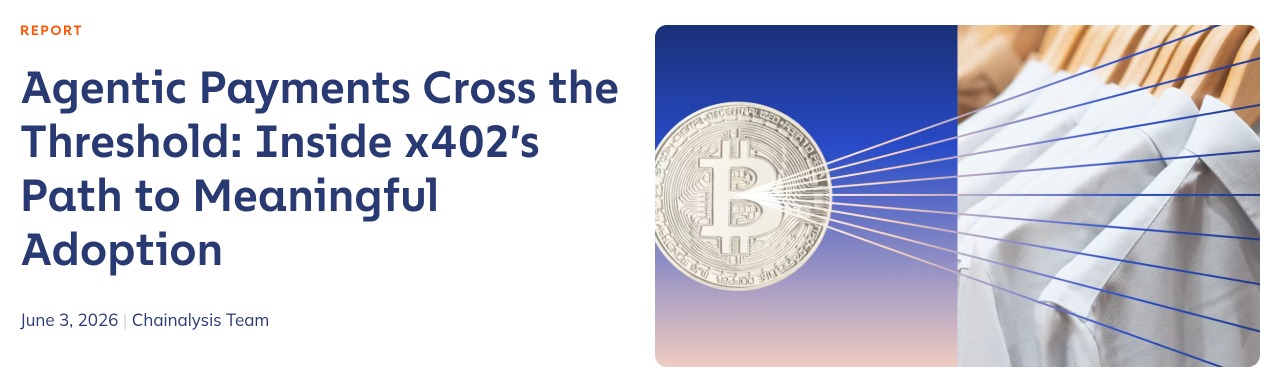
Source: Chainalysis official report page. That page dates from June 2026; the 138 million figure reported on 14 October comes from the same firm's latest tracking.
Break the numbers down, though, and the picture gets considerably more complicated — which is exactly why this story is worth reading properly.
Unpacked: an enormous number of transactions, each worth very little
| Metric | Figure |
|---|---|
| Cumulative transactions | About 1,500 in mid-2025 → more than 138 million by Q3 2026 |
| Payment size by count | Over 87% of payments fell between a hundredth of a cent and 10 cents; the most common band was 1–10 cents |
| Change in value mix | Transactions of $1+ rose from 49% of volume in early 2025 to 95% by early 2026, while the 10-cent to $1 band collapsed from 46% to 4% |
| Source of growth | Chainalysis noted in an earlier report that much of the early growth was driven by meme coin farming activity |
| Direction of travel | The protocol is extending from pure micropayments towards larger transfers |
The two apparently contradictory findings are not actually in conflict: by count, the overwhelming majority are sub-cent settlements between machines; by value, a small number of larger transactions dominate. That is precisely the point of on-chain payment rails relative to traditional ones — a card network cannot sensibly settle a 0.1-cent charge, and that is exactly what AI agents most often need to do: pay for one API call, one dataset, or a slice of compute.
Why this has anything to do with crypto
The logic of x402 is straightforward: it turns "paying" into an on-chain stablecoin settlement, so software can transact with no human approval, no credit card and no account system. If AI agents are going to spend money on their own, they need a rail like this.
That explains the pace of industry activity this year:
- Exchanges are opening up to agents. Binance launched Agent OS in August 2026, letting tools such as ChatGPT and Claude Code execute trades inside a user's account, with the user setting each agent's access level and risk allowance — but with no loss cap provided by the platform.
- Tooling is expanding. Bitget upgraded GetAgent to 2.0, widening its research scope from crypto to equities, gold, oil, CFDs and on-chain data.
- Infrastructure is filling in. On 15 October 2026, Tether announced an investment in AIsa, aimed at letting AI agents access — and pay for — data, software and compute.
Some cold water on the 138 million figure
Two important qualifiers tend to get dropped when that number is repeated:
- A meaningful share may not be "autonomous economy" at all. Chainalysis itself attributes much of the early growth to meme coin farming. To anyone familiar with crypto, that looks less like AI paying for genuine demand and more like incentivised batch activity.
- Academia has already challenged the metric. A paper titled How Agentic Is Agentic Commerce? measures x402 adoption at population scale and concludes that the count cannot simply be read as proof that an autonomous agent economy exists.
In other words, the quantity is large; the quality is unproven. Treating it as a leading indicator of a trend is reasonable. Treating it as an established business model is optimistic.
Two things that actually matter for ordinary users
- What happens once an agent has permissions. When AI can place orders in your account, the questions are not only "will it judge badly?" but "how much can it spend?" and "is there a loss limit?" In the arrangements described above, users set the risk allowance — but the platform does not backstop losses.
- Wallet and approval risk rises alongside. On 8 October 2026, Ethereum Foundation researcher Justin Drake publicly warned that AI-assisted techniques could pose a new threat to wallet security. Automation amplifies efficiency and, with it, the room for abuse.
For earlier context on this thread, read our piece on the AI payments race and Coinbase's agent wallets. If you plan to try agent-driven trading features, start with small permissions, and review the security and risk-control documentation published by venues such as Binance and OKX.
Risk notice
The transaction counts and payment-size distributions cited here come from third-party tracking such as Chainalysis; methodology and measurement windows may change over time, so defer to the original reports. Agent-related trading features involve automated execution and authorisation risk — assess them yourself before enabling anything. Nothing here is investment advice.
Risk notice and affiliate disclosure: Crypto asset trading carries the risk of losing your principal, and granting account permissions to automated tools amplifies that risk further. This article organises and interprets publicly available information and third-party data and is not investment advice. The figures cited come from third-party public sources; defer to the original reports. This article may contain affiliate links, and we may earn a commission if you register through them. That does not increase your cost or affect the independence of our judgement. Assess the risks yourself and only invest what you can afford to lose.