
Binance vs Bybit: Futures Fees, Leverage & Security Compared (2026)
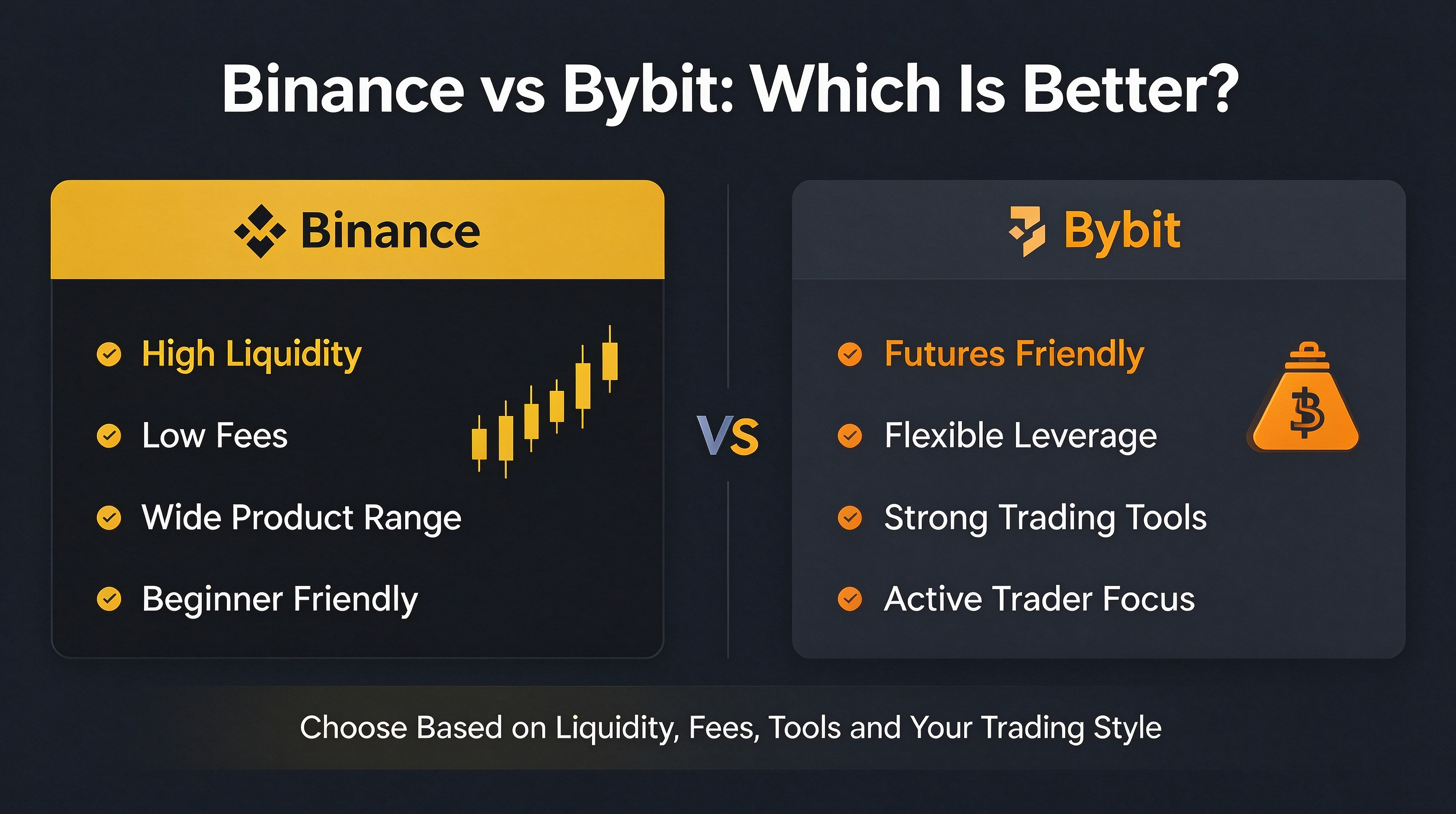
Big size in BTC/ETH perps points to Binance; a unified margin account and copy trading point to Bybit. We compare fee tiers, leverage, margin systems,…
The short answer: Binance for size, Bybit for the unified account
Trade big size in BTC and ETH perpetuals? Go with Binance — order-book depth and its insurance fund are the strongest in the industry. Want one account where every coin you hold works as shared margin, plus a polished interface and mature copy trading? Go with Bybit. Both are top-tier derivatives venues with near-identical fee tiers; the real separation is depth, account architecture, and what each did when things went wrong.
| Dimension | Binance | Bybit |
|---|---|---|
| Positioning | Largest all-in-one exchange; futures are one piece of it | Derivatives-first; futures are the core business |
| Futures fees (base tier) | 0.02% maker / 0.05% taker, cheaper with BNB | Low entry tier, same ballpark |
| Max leverage | Up to 125x on major pairs | Up to 100x, higher on select pairs |
| Margin system | USDT-margined and coin-margined, accounted separately | Unified Trading Account (UTA), cross-asset shared margin |
| Major-pair depth | Best in class | Top three globally, a notch behind |
| Safety backstop | ~$1B SAFU fund + monthly PoR | 2025 hack fully covered, reserves back to 1:1 |
| Best for | Large size, majors, conservative risk | UTA fans, copy traders, UX sticklers |
Background: the supermarket vs the futures specialist
Binance started in spot in 2017 and only launched futures in 2019. It's now the highest-volume crypto platform on earth, and futures are just one department in a very large store. Bybit went the opposite way: it opened in 2018 as a pure perpetuals venue and built its name on matching-engine stability and depth, adding spot, earn products, and copy trading years later. That origin story still shows — Binance wins on breadth, Bybit on focus.
| Item | Binance | Bybit |
|---|---|---|
| Founded | 2017 | 2018 |
| Headquarters | Globally distributed, no single HQ | Dubai (moved 2022, licensed by VARA among others) |
| Derivatives since | Futures launched 2019 | Futures from day one, 2018 |
| Futures lineup | USDT-margined and coin-margined perpetuals & delivery, options | USDT / USDC / inverse perpetuals & delivery, options |
The core futures dimensions, one by one
Fees: same tier, differences live in discounts and VIP levels
Binance's base tier is 0.02% maker / 0.05% taker, cut further by paying fees in BNB; VIP levels step down with 30-day volume, and Bybit's ladder works the same way. At retail size the fee gap won't buy you lunch — the costs that actually separate traders are funding rates and slippage. Compare VIP tiers line by line once you're at seven figures a month, not before.
Leverage and margin: two philosophies
Binance offers up to 125x on major pairs and keeps USDT-margined and coin-margined accounts separate. Bybit caps at 100x, and its signature feature is the Unified Trading Account: BTC, ETH, and USDT become one shared margin pool, so a position in one coin can be collateralized by another's value without shuffling funds between sub-accounts. Capital efficiency is noticeably better.
The trade-off deserves plain language: shared margin means one blown position can drag the whole account down, while Binance's separation acts as a natural firewall. Neither model saves you at high leverage — it only changes whether you lose one position's money or the entire account's.
Depth and slippage: where big orders tell the truth
On BTC/USDT and ETH/USDT, Binance's book depth is best in class; a mid-six-figure market order usually clears with minimal slippage. Bybit sits comfortably in the global top three and handles five-figure orders all day, but push the same million-dollar market order through both and the difference shows. The bigger your clip, the more this row matters.
Liquidation and the insurance fund
Both use tiered liquidation — positions are partially closed to reduce risk before a full wipeout — and both maintain public insurance funds to absorb clawback losses. Be clear on one thing: the fund protects the platform from bad debt, not your position. The realistic danger for most traders was never platform insolvency; it's getting wicked out at full leverage.
Copy trading
Bybit built copy trading early and well: plenty of lead traders, complete track records, a mature profit-share setup. Binance has it too, but the depth and culture lag behind. One warning: copy trading isn't free money — you eat every drawdown the lead trader takes. Filter by max drawdown, never by the returns leaderboard.
Security track records: one exam, two answer sheets
There's no honest version of this comparison that skips February 21, 2025. That day, an ETH cold-wallet environment at Bybit was compromised for roughly $1.46 billion — the largest theft in crypto history. The root cause wasn't Bybit's own systems: attackers tampered with the signing interface of its multisig provider, Safe{Wallet}, so signers saw a routine transfer on screen while actually signing a malicious transaction that handed over wallet control. The FBI later attributed the attack to North Korea's Lazarus Group.
The response was textbook: the CEO went live that same night, withdrawals never paused even through the bank rush, and the gap was plugged with company funds plus bridge loans — users lost nothing. About a week later, a third-party audit confirmed client assets were back to 1:1. My read: a platform that's been tested and paid out in full tells you more than one that's merely never been hit.
Binance has no comparable loss on record. Its two safety cards are the SAFU user-protection fund — roughly $1 billion in publicly verifiable on-chain addresses — and monthly proof-of-reserves reporting. In 2019 a 7,000 BTC hot-wallet theft was covered entirely by SAFU; users lost nothing. That episode is why the fund exists.
Who each one is for
- Binance: traders running large clips in BTC/ETH perps who care about slippage; conservative types who want the SAFU fund and years of PoR history; anyone already using it for spot who wants one roof.
- Bybit: traders juggling margin across coins who hate sub-account transfers; copy traders; people picky about interface. Derivatives is its home turf and the polish shows.
Practical advice before you commit
- Open accounts on both, deposit a few hundred dollars in each, and run the full loop — open, set a stop-loss, withdraw. Which feels right beats reading ten more reviews;
- If your bankroll allows, split it: core size on Binance for the depth, a working balance on Bybit for the UTA and copy trading. Any single-platform incident then stays contained;
- Start at 5x or below. Both platforms happily let you crank past 100x, but extreme leverage is the number-one way retail traders get wiped out — a trap, not a perk;
- Want a third opinion? OKX is in the same futures league, and Gate.io lists far more small-cap contracts. Both are worth a small test deposit.
Getting started: Binance registration, plus Bybit (find the official domain yourself and double-check it). Accounts are free — test with a small deposit first.
FAQ
Which one should a futures beginner pick?
Either works, but I'd nudge a true beginner toward Bybit: cleaner interface, no sub-account shuffling, and copy trading to learn from. Keep leverage at 5x or under and master stop-losses first. Once your size grows, move the core book to Binance for the deeper liquidity.
Is Bybit still safe to use after the hack?
My answer is yes, and the reasoning is the response itself: withdrawals never stopped, users were made whole, and reserves were verified back at 1:1 within about a week. The root cause sat in a third-party signing interface, not Bybit's own stack. Still, the lesson stands — even top-tier platforms have supply-chain blind spots, so don't park everything on one venue.
Which has lower fees, really?
Base tiers are effectively the same — the 0.02% maker / 0.05% taker neighborhood — with differences in discounts and VIP ladders: Binance has the BNB discount, Bybit starts low and scales with volume. At retail size the difference is noise. The costs that actually hurt are funding rates and slippage at high leverage, not the headline fee.
Is higher leverage better?
The opposite. At 125x, a move of less than 1% against you zeroes the margin. Leverage tells you the maximum you can borrow, never what you should borrow. Among futures traders who survive for years, far more run 3–10x than 50x and up.
Risk disclosure and affiliate notice: Futures trading involves leverage and can lose your entire principal. Nothing here is investment advice. This article contains affiliate links; registering through them may earn us a commission at no extra cost to you, and it does not affect our conclusions. Fees, leverage limits, and policies are current as of October 2026 — verify on the official Binance and Bybit pages.