Bitcoin Below $60K, ETFs Lose $4.7B: Run or Buy?
Bitcoin fell below $60,000 on 24 November. In 24 hours, 291,972 traders were liquidated for $1.893 billion, 91% of it longs. U.S. spot Bitcoin ETFs ha…
Introduction: This time, the selling is visible
Bitcoin fell below $60,000 on 24 November. By the end of the U.S. session, BTC was at $59,718.51, down 2.44% in 24 hours and 6.2% over seven days. Ether traded at $1,673.50 (-2.07%), Solana at $69.20 (-3.86%), and HYPE was down 11.9% on the week.
The leverage data is worse: in the past 24 hours, 291,972 traders were liquidated for $1.893 billion, and 91% of that was longs.
The overlooked line is ETFs. U.S. spot Bitcoin ETFs have recorded $4.71 billion of net outflows in November, surpassing June's $4.51 billion to set a monthly record.
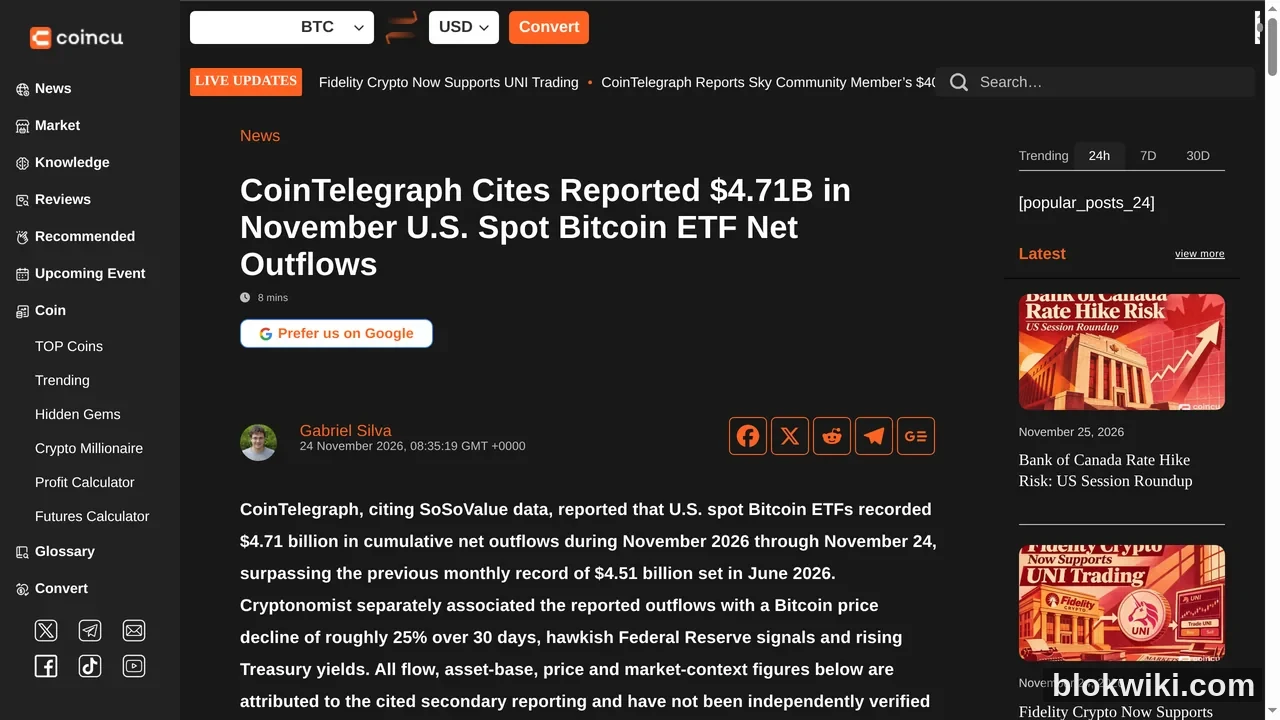
Source: Coincu, citing CoinTelegraph and SoSoValue data, 24 November 2026.
1. Separate the three flows
A falling price is an outcome, not a cause. Split the selling into three flows and it becomes clear who is actually selling:
| Source of funds | Latest data | What it means |
|---|---|---|
| U.S. spot Bitcoin ETFs | $4.71 billion of net outflows in November through 24 November — a monthly record, above June's $4.51 billion | Allocation money is cutting exposure, and the selling is reported daily |
| Stablecoins | Market value shrank by $14.2 billion in 30 days as of 13 November | The dry powder sitting outside exchanges is shrinking |
| Leveraged longs | $1.893 billion liquidated in 24 hours, 91% longs | Forced selling: the faster prices fall, the more gets liquidated |
Start with ETFs. A net outflow means authorized participants redeemed shares, so the fund had to sell or deliver the underlying BTC. If an institution was running a basis trade — long the ETF, short futures — unwinding it also shows up as an outflow. So this is not the same as institutions collectively turning bearish, but it does remove a slice of demand that had to be there every day.
Then stablecoins. In our 13 November piece on stablecoin market value shrinking by $14.2 billion, we noted that a falling stablecoin supply usually means outside money is not coming in — or is converting back to fiat. Without new stablecoins, a rally has little "new money" to run on.
Finally, leverage. With 91% of liquidations being longs, this leg down has been driven by forced long unwinds. Forced selling ignores price and amplifies declines, but it is also one-time: once the positions are gone, that pressure stops.
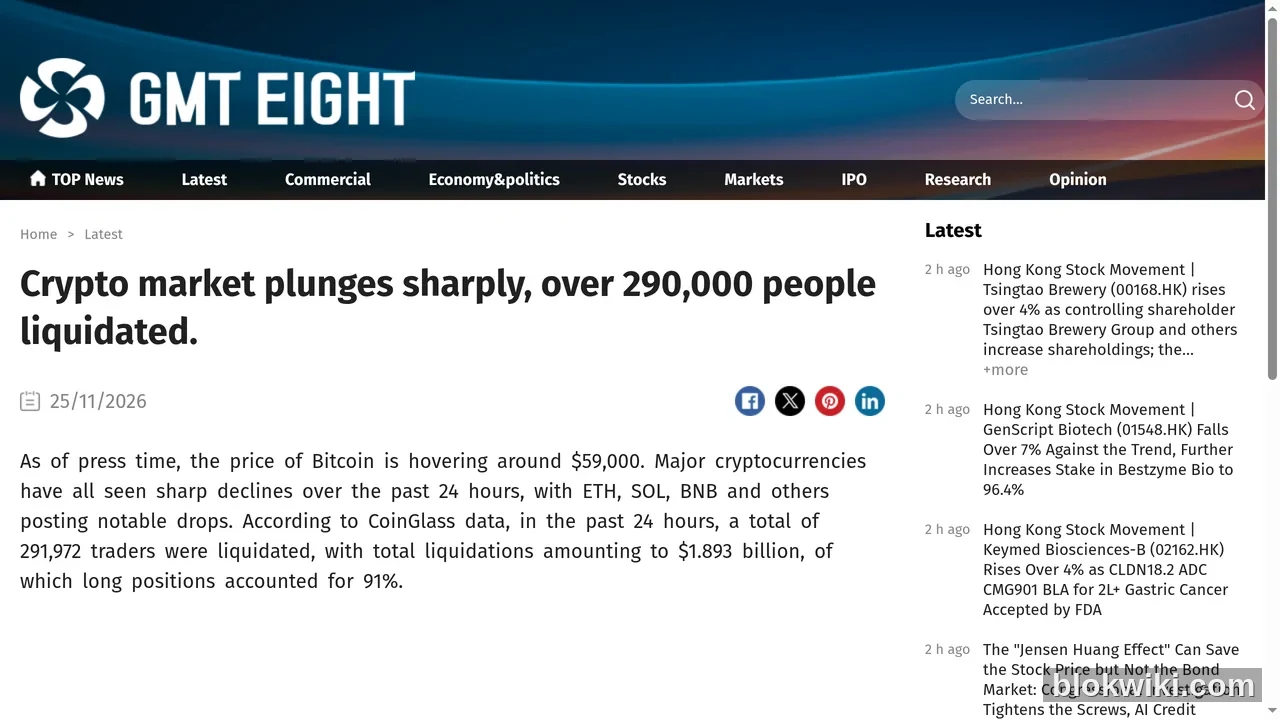
Source: GMT EIGHT, "Crypto market plunges sharply, over 290,000 people liquidated", 25 November 2026, citing CoinGlass.
2. The key difference from 2022
2022 was a credit-chain failure: LUNA went to zero, Three Arrows Capital blew up, FTX collapsed — one after another. Bitcoin fell from about $69,000 in November 2021 to roughly $16,000 in November 2022, a drawdown of about 77%.
This cycle is different. U.S. spot Bitcoin ETFs only launched in 2024, so the selling now runs through regulated products with daily disclosure. At least so far, there has been no repeat of 2022's sudden exchange withdrawal freezes. The trade-off is a slower, more grinding decline: without a single forced flush, a V-shaped bottom is much harder to produce.
In one sentence: in 2022 you did not know who would fail next; in 2026 you can watch the money leave every day, but you cannot tell when it will stop.
3. Three signals that decide whether to buy now
| Signal | Where it stands | What a turn looks like |
|---|---|---|
| ETF flows | $4.71 billion of net outflows in November | Three consecutive trading days of net inflows |
| Stablecoin market value | Down $14.2 billion in 30 days as of 13 November | Two consecutive weeks of stabilization and recovery |
| Leverage structure | 91% of liquidations are longs | Funding rates turn positive; open interest stops making new lows |
Until these turn, replace "catching the bottom" with "building a position": not refusing to buy, but refusing to buy all at once.
4. Three actions for a first-time buyer
- Set up the account before the market moves, not after. Pick an exchange with reliable deposits and withdrawals and transparent fees, complete KYC, fund $50–100, and run through the full deposit-buy-withdraw loop. Exchange pages: Binance, OKX, Gate.io, HTX.
- Spot only, limit orders only, three tranches. With $600 as an example: place $200 at 0.5%–1% below the current price today; another $200 near $58,000 on a pullback; keep the last $200 until ETFs turn consistently positive or BTC holds above $62,500. Keep first-day exposure below 10% of investable capital.
- Write down one rule: do not accelerate buying below $55,000. The most common loss in a crash is not picking the wrong direction — it is buying every dip until there is no cash left.
For the withdrawal walkthrough, see How to withdraw from an exchange to your own wallet. If you are still unsure about timing, start with the three confirmation signals in "$160M of shorts liquidated — should you chase the BTC bounce?".
5. Three reasons to keep waiting
- ETF weekly outflows hit a new high and not a single day turns positive;
- Stablecoin market value keeps falling, meaning outside money is still leaving;
- BTC closes below $58,000 on the daily chart and fails to reclaim it within three sessions.
Waiting is not missing out. For someone who has not opened an account yet, missing part of a bounce is far cheaper than losing the capital on the way down.
6. FAQ
Q1: If I buy now, am I catching a falling knife? Possibly. None of the three signals has turned, so size small, split the order, and use limit orders. You cannot control price, but you can control position size.
Q2: Is the $4.7 billion ETF outflow institutions dumping? A more accurate description is allocation money reducing exposure. Some of it is genuine bearishness; some is basis-trade unwinding, year-end rebalancing, and redemptions. It does not predict a bottom, but it does cap how far rallies can run.
Q3: Is $60,000 the bottom? Nobody knows. On the downside, watch $58,000 and $55,000; on the upside, $70,000–$75,000 is a dense zone of trapped buyers. Replace "guess the bottom" with "split the order" and no single call can ruin you.
Q4: I only have $100. How do I start? Finish account opening and KYC, buy $20–30 of BTC to complete the process, and wait for signals with the rest. At this stage the goal is learning to avoid mistakes, not maximizing profit.
7. What is still unconfirmed
- Monthly ETF outflow figures differ by provider ($4.71B / $4.14B / $3.47B). This article uses the $4.71B CoinTelegraph figure citing SoSoValue, through 24 November.
- Liquidation data comes from CoinGlass and covers a rolling 24-hour window, so it changes over time.
- The stablecoin contraction figure is our own count as of 13 November and may have changed since.
- Macro data and Federal Reserve comments this week could still change the direction of flows. This article makes no directional forecast.
Data as of 25 November 2026, 12:00 Beijing time. BTC around $59,700 (post-U.S.-close quote on 24 November); 24-hour liquidations of 291,972 traders and $1.893 billion.
Main sources: The Motley Fool / Nasdaq (24 Nov 2026), CoinTelegraph citing SoSoValue / Coincu (24 Nov 2026), GMT EIGHT citing CoinGlass (25 Nov 2026).
Risk notice and affiliate disclosure: This article summarizes public information and explains a process; it is not investment advice. Crypto assets are highly volatile and you may lose your entire principal. Prices, liquidation data and fees change over time — always check the official pages. This article contains affiliate links; we may earn a commission if you register through them, at no extra cost to you, and it does not affect our judgment. Do not buy with leverage or borrowed money, and never share your seed phrase, private key, verification code or password with anyone.