Mercado Bitcoin $49M Hack, Bithumb Data Leak 2026
Two exchange security incidents landed within days: Brazil's Mercado Bitcoin lost roughly $49 million across 17 blockchains, while South Korea's Bithu…
Introduction: one week, two very different losses
Crypto exchange security incidents landed back-to-back in late October and early November 2026. On October 29, Binance disclosed a roughly $6.3 billion hot-wallet theft and is still restoring withdrawals in stages. On November 2, Brazil's largest exchange, Mercado Bitcoin, lost about $49 million across 17 blockchains. The same day, South Korea's Financial Services Commission (FSC) held an emergency inspection meeting in response to the Binance breach. And before that, on October 27, Bithumb — South Korea's second-largest exchange — suffered an intrusion into its internal mobile groupware system, affecting 6,444 customers, including 844 whose ID copies and resident registration numbers were directly exposed.
These two incidents deserve to be read together. Mercado Bitcoin lost coins from platform wallets; Bithumb lost identity data. The first tests an exchange's reserves and reimbursement capacity. The second tests whether a user can spot a fake "support agent" email or a "compensation registration" link. In both cases, the last line of defense is not the exchange — it is the user's own operating habits.
1. Mercado Bitcoin: 17 chains, about $49 million — and why a freeze is not a repayment
Mercado Bitcoin is Brazil's largest crypto exchange, with 4.5 million users as of July 2026. In the early hours of November 2, an attacker began moving assets out of exchange wallets. Chainalysis estimates the loss at about $49 million across 17 blockchains, with the largest tranches in Bitcoin and Ethereum; assets on smaller chains such as Base, Tron, and Polygon were also swept.
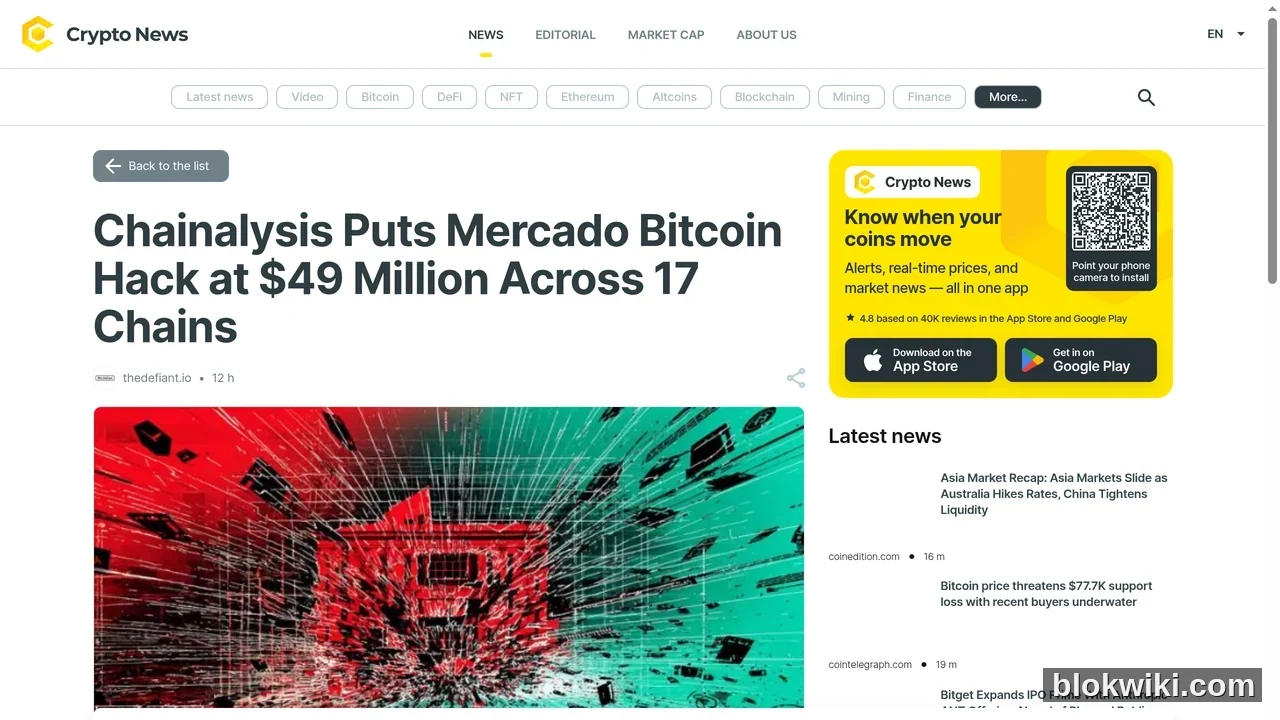
Source: CryptoNews, republishing The Defiant, November 2, 2026. The headline and body explicitly cite $49 million and 17 chains.
Mercado Bitcoin's own figures differ. The exchange said about $38 million in "assets involved" and about $11 million blocked through partners including Tether, Circle, Paxos, BRL1, and Chainalysis. Chainalysis said it helped freeze nearly $10 million, including more than $9 million in USDT frozen by Tether. Tether CEO Paolo Ardoino had earlier cited more than $4.5 million and the figure kept rising. Different firms counted at different times and prices, so a spread of several million dollars is expected. What matters is the distinction:
| Source | Figure | What it means |
|---|---|---|
| Chainalysis | ~$49 million | Estimated loss across 17 chains |
| Mercado Bitcoin | ~$38 million "assets involved" | Exchange figure; unclear whether blocked funds are included |
| Mercado Bitcoin | ~$11 million blocked | Frozen with Tether, Circle, and other partners |
| Chainalysis | Nearly $10 million frozen | Includes over $9 million in USDT frozen by Tether |
A freeze is not a repayment. When a stablecoin issuer blacklists an address, the funds cannot move — but they remain in the attacker's wallet and do not automatically return to the exchange. For Mercado Bitcoin to make customers whole, it still needs to use its own funds, reserves, or insurance. The exchange said customers "will not suffer any loss of assets" and that no data was leaked, but that claim has not been independently verified, and no reopening timetable has been published.
The mechanics also matter. CertiK's Dickson Wu said in a preliminary review that the attacker "picked at eight small chains for four hours," then sent tiny amounts of ETH from 27,160 separate addresses to the main hot wallets before sweeping old deposit addresses. Multiple reports say the theft used ordinary transfers rather than a smart-contract exploit, but the exchange has not explained how the attacker obtained signing authority, or why funds kept arriving after the incident was declared contained. The practical takeaway for users: a hot-wallet breach is rarely limited to one wallet — old deposit addresses can be swept too.
2. Bithumb: no coins lost, but 844 customers had ID data exposed
Bithumb's incident is a different story. According to Yonhap Infomax and Korean media, an unauthorized outsider accessed Bithumb's internal mobile groupware "Daou Office" between 11:28 and 12:27 on October 27, 2026. Bithumb detected abnormal access at 12:14, blocked the attacker's path, and suspended use of the groupware. The affected total was 7,159 people: 6,444 customers and 715 employees.
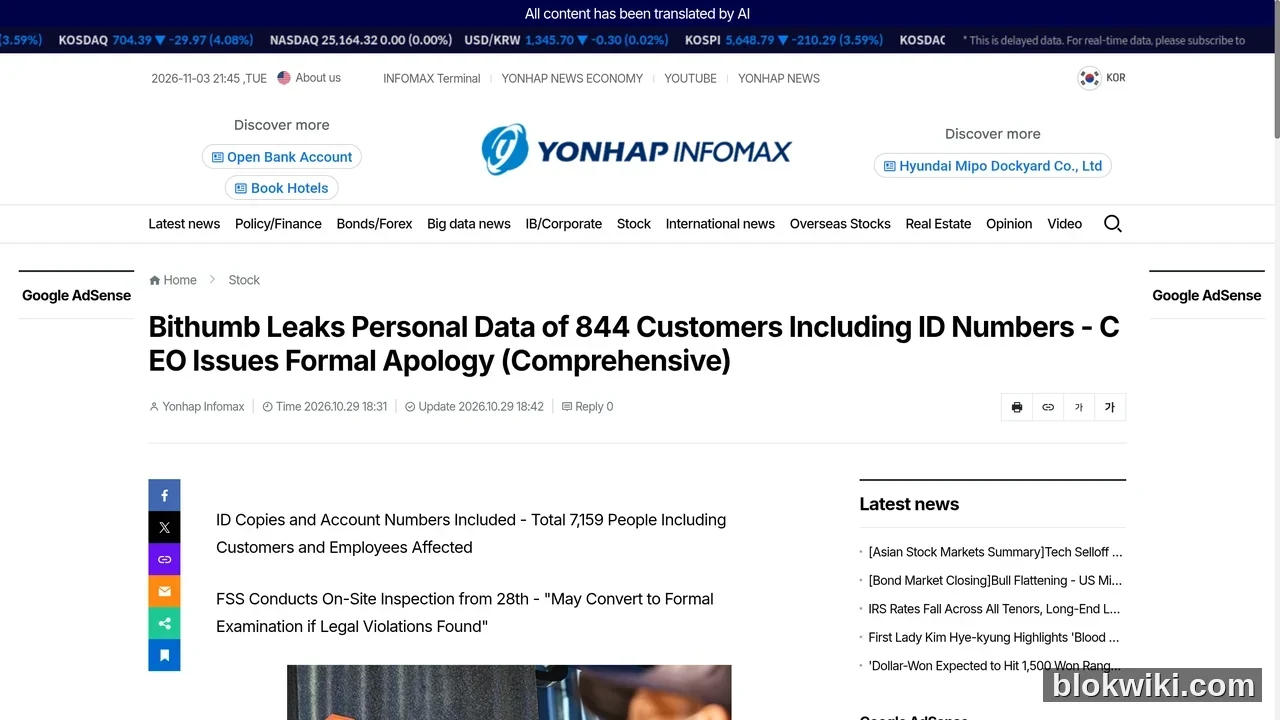
Source: Yonhap Infomax, October 29, 2026. Headline: "Bithumb Leaks Personal Data of 844 Customers Including ID Numbers."
The most sensitive group is the 844 customers whose data was not protected by encryption and was directly exposed. The leaked items vary by customer and can include names, mobile numbers, email addresses, resident registration numbers, driver's license numbers, account numbers, and ID copies. Another 5,600 customers' records sat inside files protected by DRM encryption that could not be read externally, so they were not counted as actual exposure. Employee data for 715 people was also leaked.
Bithumb stressed that the affected groupware is separate from customer trading accounts and asset systems, that no evidence has been found of a direct compromise of the exchange service or customer database, and that no crypto was lost. That distinction is important, but it does not remove the second-order risk: once ID copies, resident registration numbers, and account numbers are out, they can be used to open non-face-to-face accounts, apply for loans, or run phishing and voice-phishing scams impersonating exchanges, banks, or investigators. Professor Hwang Seok-jin of Dongguk University put it bluntly: "Upbit was like taking money from a safe; this time they took the list of people who open the safe, plus copies of their IDs."
Bithumb reported the incident to the Korea Internet & Security Agency (KISA) and the Personal Information Protection Commission. The Financial Supervisory Service (FSS) began an on-site inspection on October 28. CEO Lee Jae-won publicly apologized and said the company would do its utmost to relieve and compensate customers if secondary damages are confirmed. But compensation comes after the fact; identity theft and phishing often arrive within days.
3. Korea's response: an 80% cold-wallet floor is a minimum, not a safety guarantee
After the Binance breach, Korea's FSC convened an emergency inspection meeting on November 2 with the FSS, the Financial Security Institute, DAXA, and major virtual-asset service providers. The meeting focused on access controls for internal systems, withdrawal approval and signing systems for hot wallets, and administrator permissions. Regulators told the industry to take four immediate steps: raise the share of assets held in cold wallets, monitor deposits and withdrawals 24/7 with additional response staff, establish rapid reporting and information-sharing for suspicious access, and add reserve funds.
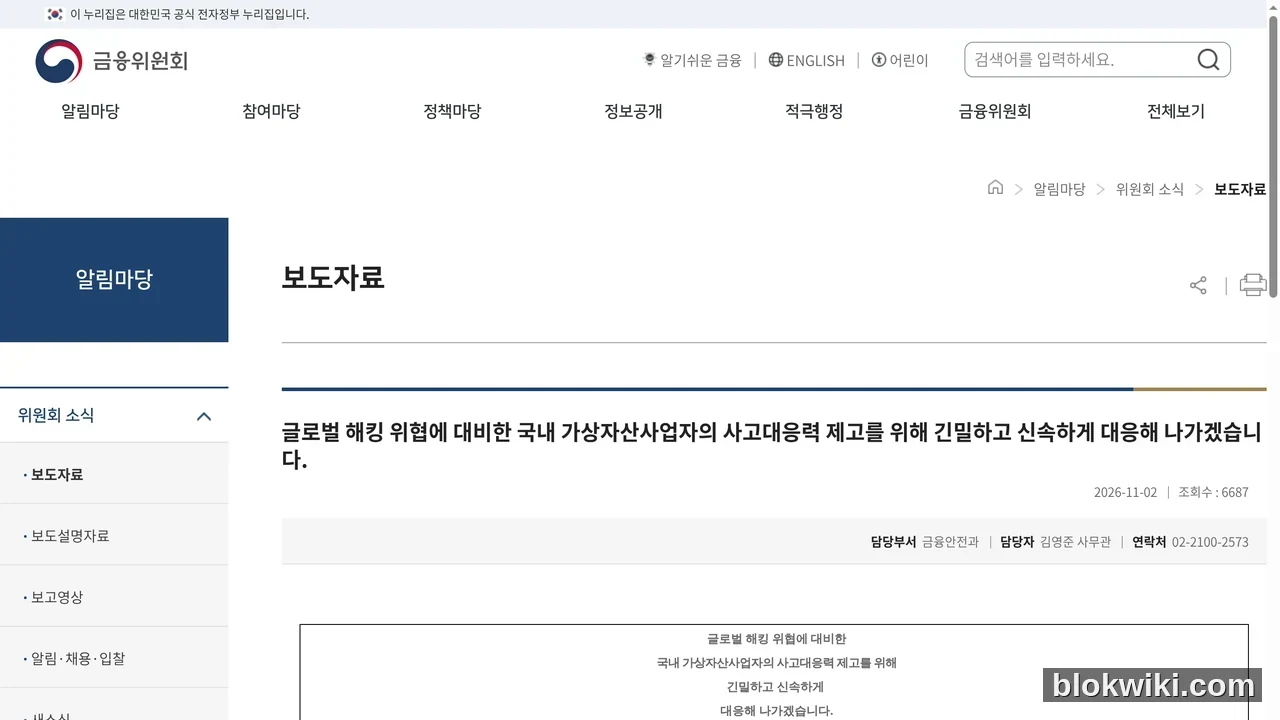
Source: Financial Services Commission (FSC) press release, November 2, 2026. The text lists "콜드월렛 비중 상향" (raise the cold-wallet share) among the required measures.
Korea's Virtual Asset User Protection Act already requires exchanges to keep more than 80% of user virtual assets in cold wallets. In other words, 80% is the legal floor, not a synonym for safety. At the end of September 2026, the reported ratios among major Korean exchanges were:
| Exchange | Cold-wallet share (end-Sept 2026) |
|---|---|
| Upbit | 99.17% |
| Bithumb | 94.76% |
| Coinone | 85% |
| Korbit (now Digital X) | 82.79% |
| GOPAX | 80.54% |
Two conclusions follow. First, "compliant" exchanges can differ enormously in actual cold-storage practice — GOPAX cleared the legal floor by just 0.54 percentage points. Second, cold wallets reduce the chance of a hot wallet being drained outright, but they do not solve signing-authority hijacks, insider abuse, or compromises of third-party office systems. Binance's breach centered on signing and withdrawal workflows; Bithumb's breach centered on an office system separate from asset custody.
4. Three things users should do within 72 hours
1. Verify incidents only through official channels. After an exchange breach, the first pages to appear are often not official notices but phishing pages promising "compensation registration," "asset verification," or "support-assisted withdrawals." Type the exchange's domain manually or enter through the in-app announcement. Official support will never DM you for verification codes, seed phrases, or passwords, and will never ask you to install remote-access software. Treat any "claim your hack compensation" message as a scam until proven otherwise.
2. Follow a 72-hour checklist after a data breach. If you receive a breach notice from Bithumb or a similar platform: change your exchange password and the password on your linked email; reset 2FA, preferring an authenticator app over SMS; review API keys and authorized devices and revoke anything you do not recognize; enable withdrawal address whitelists; and for the next two weeks be highly skeptical of calls from "support," "police," or "bank risk control" asking you to transfer funds or share your screen. Korean users can also check Bithumb's website to see whether their data was in the leaked set, and should rely only on the official support center.
3. Layer your assets; do not leave everything on an exchange. Keep only what you need for trading on exchanges, and move long-term holdings to a hardware wallet where you control the keys. When withdrawing, send a small test transaction first and verify the full address, not just the first and last few characters. The Mercado Bitcoin case — where old deposit addresses were swept — is a reminder that addresses generated on an exchange and contracts you have approved can both become attack surfaces.
5. Four metrics worth checking before choosing an exchange
If these incidents have you thinking about switching platforms, break "security" into verifiable metrics rather than marketing slogans: cold-wallet share and custody architecture, whether proof-of-reserves (PoR) is updated monthly and independently verifiable, the record of reimbursing users after past breaches, and licensing plus data-security incident history. The first two determine whether assets are actually there when trouble hits; the last two determine who bears the loss afterward. We compared these metrics across major exchanges in "North Korean Hackers Stole $6.3B from Binance — 5 Security Metrics to Check Before Registering"; for how private-key custody differs, see "MPC Key Sharding vs Exchange Hot Wallets"; and if you plan to move coins off an exchange, follow the three-step process in "Withdrawing from an Exchange to Your Own Wallet: Address-Poisoning Defense" to avoid the most common mistakes.
There is no "perfectly safe" exchange. The largest platform in the world can be breached, and the Korean exchange with one of the highest cold-wallet ratios can still be compromised through an office system. What actually reduces the odds of loss is spreading assets across platforms, layering custody, using only official channels, and treating every "support call" and "compensation link" as a scam by default.
6. What is still unconfirmed
- Mercado Bitcoin's final loss figure: Chainalysis says about $49 million, the exchange says about $38 million in "assets involved," and an early Arkham estimate was about $46 million. The numbers are still moving.
- Whether customers truly lost nothing: the exchange says customers "will not suffer any loss of assets" but has not explained the source of the funds or how the gap will be filled, and the claim has not been independently audited.
- How the attacker obtained signing authority: neither the exchange nor security firms have published a complete technical conclusion. Whether insiders, a third-party service, or permissions tied to old deposit addresses were involved remains unknown.
- Whether Mercado Bitcoin suffered a data breach: the exchange says no, but has not addressed questions about Brazil's data-protection notification obligations.
- The final scope of the Bithumb leak and secondary harm: 844 is the confirmed directly exposed group; whether more people were indirectly exposed, or whether identity-theft cases have appeared, is still under investigation.
- Korea's new cold-wallet standard: the FSC asked exchanges to raise the share but has not announced whether the 80% legal floor will be increased.
Data cutoff: November 3, 2026, 21:00 Beijing time. Both incidents remain under investigation, and figures and official statements may change.
Main sources: Chainalysis blog (November 2, 2026), CoinDesk CC incident review (November 2, 2026), Yonhap Infomax (October 29, 2026), and the FSC press release (November 2, 2026).
Risk notice and promotion disclosure: This article is a summary of public information and is not investment advice. The exchange breach and data-leak incidents are still under investigation, and figures, affected-person counts, and official statements may change; items marked UNCONFIRMED are not speculation. This article contains promotional links, and we may earn a commission if you register through them. This does not increase your fees or affect our judgment. Use only official exchange websites or apps, and never share your seed phrase, private keys, verification codes, or passwords with anyone.