EIP-7702 Safety Guide: 5 Deadly Blind Spots Exposed by Binance's $6.3B Hack
When Binance disclosed on October 30 that $6.3 billion had been hijacked, the crypto world didn't ju
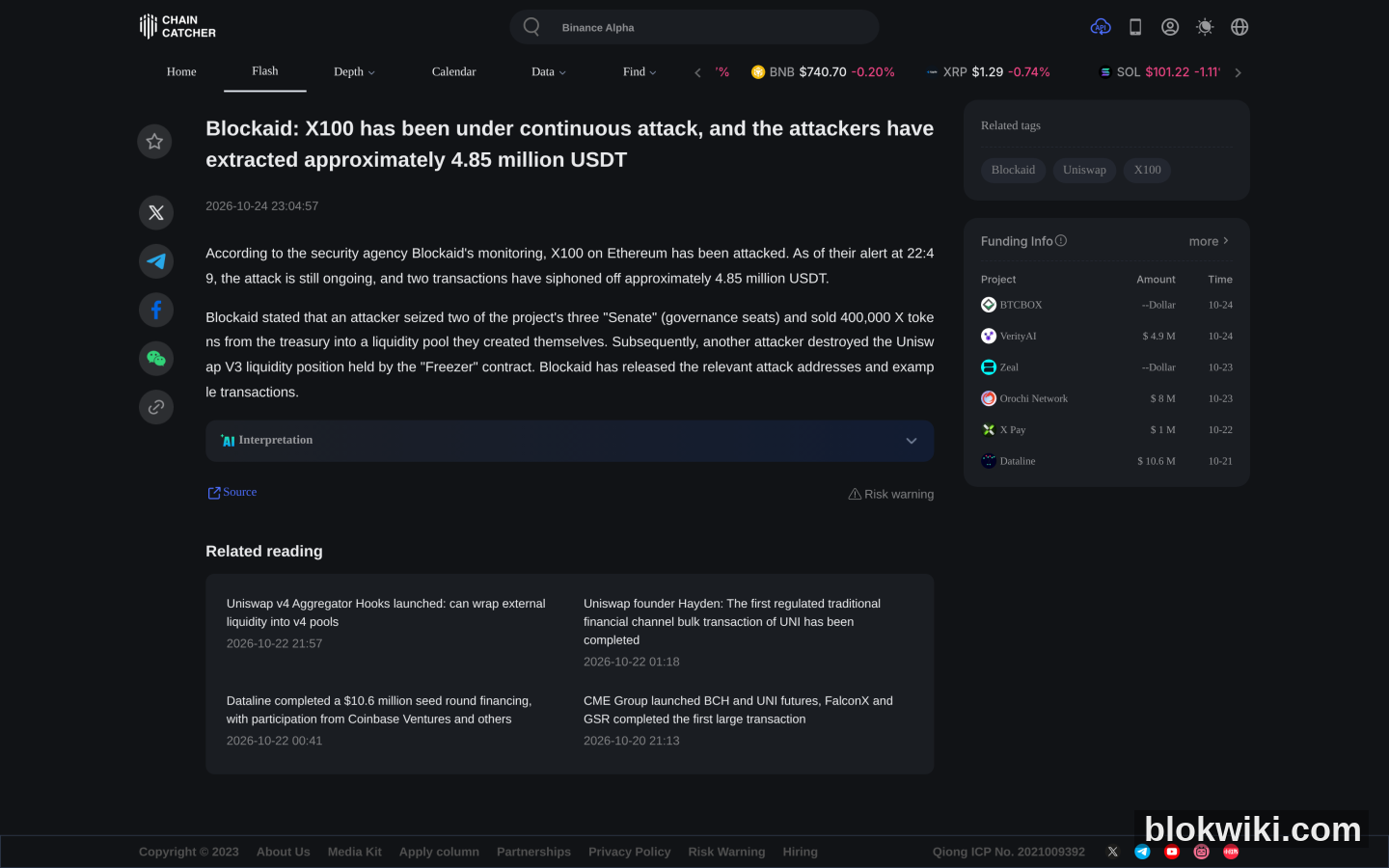
When Binance disclosed on October 30 that $6.3 billion had been hijacked, the crypto world didn't just see another hack — it saw an entire category of protocol-level blind spots suddenly exposed. The attacker didn't steal private keys. They exploited EIP-7702 delegation, an Ethereum mechanism activated just this year. This wasn't a "zero-day" or a clever exploit — it was a design assumption clashing head-on with human security habits. Regular users and developers alike are vulnerable. This article breaks down the full attack chain, explains EIP-7702 in plain language, and delivers a practical 5-item checklist for everyone.
1. What Role Did EIP-7702 Play in the Binance Hack
Let's go back to the night of October 30. On-chain sleuths reported something unsettling: Binance's 14 hot wallets had all signed unusual transactions — type-4 transactions — right after Ethereum's Pectra upgrade. And those same wallets were holding valid delegations to attacker-controlled contracts.
The reconstructed attack chain looks roughly like this:
- Initial access: An internal Binance engineer or ops staff member had their laptop compromised via phishing or malware;
- Malicious transaction injection: With access to an internal signing pipeline, the attacker could inject type-4 transactions into hot wallets;
- Mass delegation: Over just a few hours, 50 hot wallets "signed" away their code execution authority — one by one, silently;
- Control takeover: Once delegation is live, the attacker can call these hot wallets like they were their own contracts. The signing interface only shows a 32-byte "digest" — you can't tell it's a delegation vs. a normal transfer.
Thankfully, Binance's on-chain team pushed emergency revoke transactions and managed to lock back roughly $3 billion of the stolen assets. This means EIP-7702 delegation isn't irreversible — but only if you can still sign a revoke transaction. For a full timeline of the incident, read our deep dive: $6.3B Stolen: Binance Hot Wallets Hijacked via EIP-7702 Delegation.
Binance isn't the first institution targeted — small retail users reported losing funds to malicious type-4 signatures as early as September. But the scale of this incident — involving the world's top exchange — has pushed EIP-7702's design flaws onto the global stage. If you trade on Binance, this is directly relevant to how you think about wallet security.
2. EIP-7702 Mechanism in 3 Minutes
Traditional Ethereum has two account types: EOAs (externally owned accounts) — your personal wallet, where each transfer needs a private key signature — and contract accounts, which run code deployed on-chain. EIP-7702 tries to answer a simple question: what if an EOA could temporarily act like a contract?
The answer is delegation. Think of it this way: your EOA is a car, and delegation is handing the keys to a friend (the target contract). You're not changing ownership of the car — you're signing a piece of paper that says "for now, you hold the keys."
Technically, EIP-7702 introduces two critical changes:
- Type-4 transactions: A brand-new transaction type specifically for "signing a delegation." The signer doesn't need to send any ETH to the target — they just publish the delegation document to the chain.
- Delegation is permanent until explicitly revoked. This is the single most important — and most ignored — rule. There is no auto-expiry, no "use once and done."
Sounds useful, right? In theory, you could temporarily delegate your wallet to a gas-sponsor contract, or grant a DApp time-limited automation rights. But that "permanent by default" design choice is the seed of nearly every security incident we've seen.
3. 5 Deadly Blind Spots Regular Users Will Hit
These five gaps catch everyday crypto users the most. Each one has real victims.
1. Delegation never auto-expires — forgetting to revoke = giving away keys forever
DApps love to say "click delegate, save 20% on gas fees." Users sign and forget. Six months later, that delegation is still live. The DApp team may have changed, the domain may have been sold, but your wallet keys are still sitting in someone else's pocket.
2. Wallet UIs don't show who you've delegated to
This is the ecosystem's most embarrassing gap. As of October 2026, almost no major wallet — Trust Wallet, Exodus, even some hardware wallet companion apps — has a "delegation manager" page. You may have signed 17 type-4 transactions and all you see in your wallet is a list of "transaction hashes." No way to know who currently holds your keys.
The good news: etherscan.io finally added a "Delegations" tab. Open your address page, click that tab, and see the full history. It's currently the most reliable self-check tool.
3. One signature = permanent delegation, no second confirmation
You click "approve" on a DApp, your wallet popup shows "gas 0.001 ETH," you sign — and what happens on-chain is: your EOA publishes a permanent delegation to an attacker-controlled contract. No second popup. No extra warning. The signer only sees a 32-byte digest with zero context about what type of transaction they just approved.
4. Delegations can nest — the original signer may have no clue
A delegates to B, B delegates to C, C delegates to D — theoretically, this can chain infinitely. The Binance incident showed signs of nested delegation chains. If your wallet is already compromised, a malicious contract can silently sub-delegate control to more addresses without your knowledge.
5. Revoking delegation also requires a signature — and you may not be able to
This is the nightmare scenario. If an attacker already holds delegation rights, they can freeze your assets or convert your wallet to a malicious contract mode. To revoke, you need to sign. But your signing channel might already be controlled by the nested delegation chain.
4. Practical Checklist for Users
So what should you do right now? Five steps, in order of priority:
✅ Step 1: Audit your delegations immediately.
Open etherscan.io, paste your wallet address, go to the "Delegations" tab. If you see addresses you don't recognize — that's a live bomb.
✅ Step 2: Revoke unknown delegations right away.
Use OpenZeppelin Defender or the community-maintained EIP-7702 Revoker tool. An on-chain revoke typically costs $1-5 in gas, similar to a normal transfer.
⚠️ Warning: if your wallet is already taken over by a malicious delegation, a revoke may fail. In that case, generate your revoke transaction signature offline on a hardware wallet (Ledger, Trezor) and broadcast from a clean machine — that's the safest path.
✅ Step 3: Temporarily adjust your wallet habits.
If you're using Trust Wallet or Exodus, avoid signing type-4 transactions for now. The relatively safer combination is Ledger hardware wallet + Rabby browser extension — hardware signers won't silently auto-execute nested delegations.
✅ Step 4: Never click "Delegate" on an unfamiliar DApp.
Any DApp asking you to delegate in exchange for "gas discounts," "zero fees," or "automated yield" — pause. Search the DApp name plus "hack" or "scam" on X or Telegram. Three minutes of research is worth more than a few dollars in saved gas.
✅ Step 5: Note for exchange users.
If you primarily use centralized exchanges like Binance or OKX, they manage hot wallet delegations centrally. You don't need to do anything on your personal account, but prefer the official exchange app and avoid signing type-4 transactions for exchange deposit addresses from third-party wallets.
5. Practical Checklist for Developers
As a DApp or DeFi developer, your responsibility is higher. These five items are now the community-agreed "minimum security baseline":
1. Always set a reasonable expiry timestamp on delegations.
Not all wallets validate expiry at the signing layer yet, but your delegation contract must hard-code this check. A "auto-expire after 30 days" delegation is orders of magnitude safer than a permanent one.
2. Front-end UI must use a red modal warning for type-4 transactions.
Standard practice: when the user clicks "Delegate," show a separate red modal box with bold text: "⚠️ You are about to sign an EIP-7702 delegation — this grants the target address code execution rights over your wallet." Require the user to type "I understand the risk" to proceed.
3. Never accept user-supplied delegation targets.
The target contract address must be hardcoded in your front-end and verified against your on-chain deployment. Letting users input their own target is literally handing them the keys to the delegation door.
4. Migrate to EIP-7715's "delegateWithPermissions" variant.
EIP-7715 adds permission controls on top of EIP-7702 — you can restrict which functions the delegate is allowed to call, and which are blocked. This should be standard, but adoption is still low. Migrate now.
5. Run OpenZeppelin's EIP-7702 audit script in staging.
OpenZeppelin has integrated EIP-7702 security checks into their Defender scanner. Run automated delegation-risk scanning on every contract deployment — it costs nearly zero and catches the dumbest mistakes.
6. Conclusion
EIP-7702 isn't a "buggy" protocol. Its core goal — giving ordinary EOAs contract-like capabilities — is sound. The problem is that one "permanent by default" design assumption collided with the weakest link in crypto: human security habits.
The Binance incident will likely be the single most expensive security lesson since EIP-7702 launched. But in hindsight, it was also the event that slapped the entire ecosystem awake from a collective "invisible delegation" sleep. Now etherscan has the Delegations tab, wallets are scrambling to add security modals, OpenZeppelin has updated their audit scripts — every incident makes the mechanism safer.
For you personally, there are exactly two things worth doing right now: check whether you have unauthorized delegations on etherscan, and tell your DeFi-using friends about this. That's enough.