MPC Key Sharding vs Hot Wallets: The 6th Exchange Safety Metric
Binance lost $6.3 billion from a hot wallet. Why has Coinbase never suffered a loss of that scale? The answer is in how the private key is stored. Thi…
Why Coinbase Has Never Been Drained Like Binance: MPC Key Sharding vs Exchange Hot Wallets, and the 6th Metric to Check Before You Register
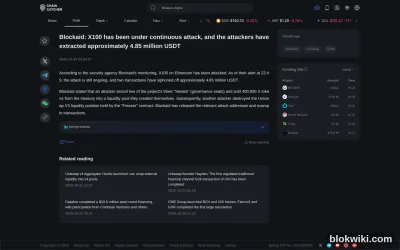
On October 29, Binance lost $6.3 billion from a hot wallet in an EIP-7702 delegation-hijacking attack, the second-largest single security loss in crypto history. On November 1, the FBI attributed the theft to North Korea's "Trader Traitor" group, and Binance said roughly 90% of the loss had been covered with corporate funds and its SAFU insurance pool (full timeline here).
Yesterday we published a guide on the five security metrics that matter when choosing an exchange: track record, user protection funds, proof of reserves, licensing and account-level controls. The question readers kept asking was simple: why has Coinbase, after more than a decade in business, never suffered a loss anywhere near Binance's?
The answer is not in a marketing page. It is in how the private key is stored. This article explains the custody architecture behind that record and adds the metric most people skip: the form in which the key exists, and how many parties must cooperate to use it.
1. Four custody models, and the real difference is not hot vs cold
An exchange holding your coins is really holding a private key that can authorize transactions. Custody models differ on two points: where that key lives, and who must come together to use it.
Hot wallet. The key sits on an internet-connected server and can sign withdrawals at any moment. It is fast, but if that one machine is compromised, the full key walks out with the attacker. That is the link that failed at Binance.
Cold wallet. The key is kept offline. An attacker needs physical access or a supply-chain foothold, which raises the bar considerably. But cold storage still has a single point: one complete key, stored in one place.
Multisig. Control is split into N complete keys, and M of them must sign together, for example 3-of-5. Any single key can sign, but fewer than M cannot move funds. Multisig removes the "one person decides" problem, yet each key remains whole; losing one reduces the safety margin.
MPC (multi-party computation). Instead of copying a complete key, MPC splits one key into multiple shares. A share on its own is a meaningless string that cannot reconstruct the key. To sign, the shares jointly run a cryptographic protocol without exposing themselves, and the group outputs a single valid signature. The complete key never exists on any one machine at any point.
The short version: multisig means several whole keys; MPC means one key broken into pieces that never meet. For a user, the practical takeaway is this: a hot wallet bets on one machine, cold storage bets on one location, multisig bets on M people not turning at once, and MPC bets on several separate environments not falling at once.
2. How MPC actually works: three shards that never share a room
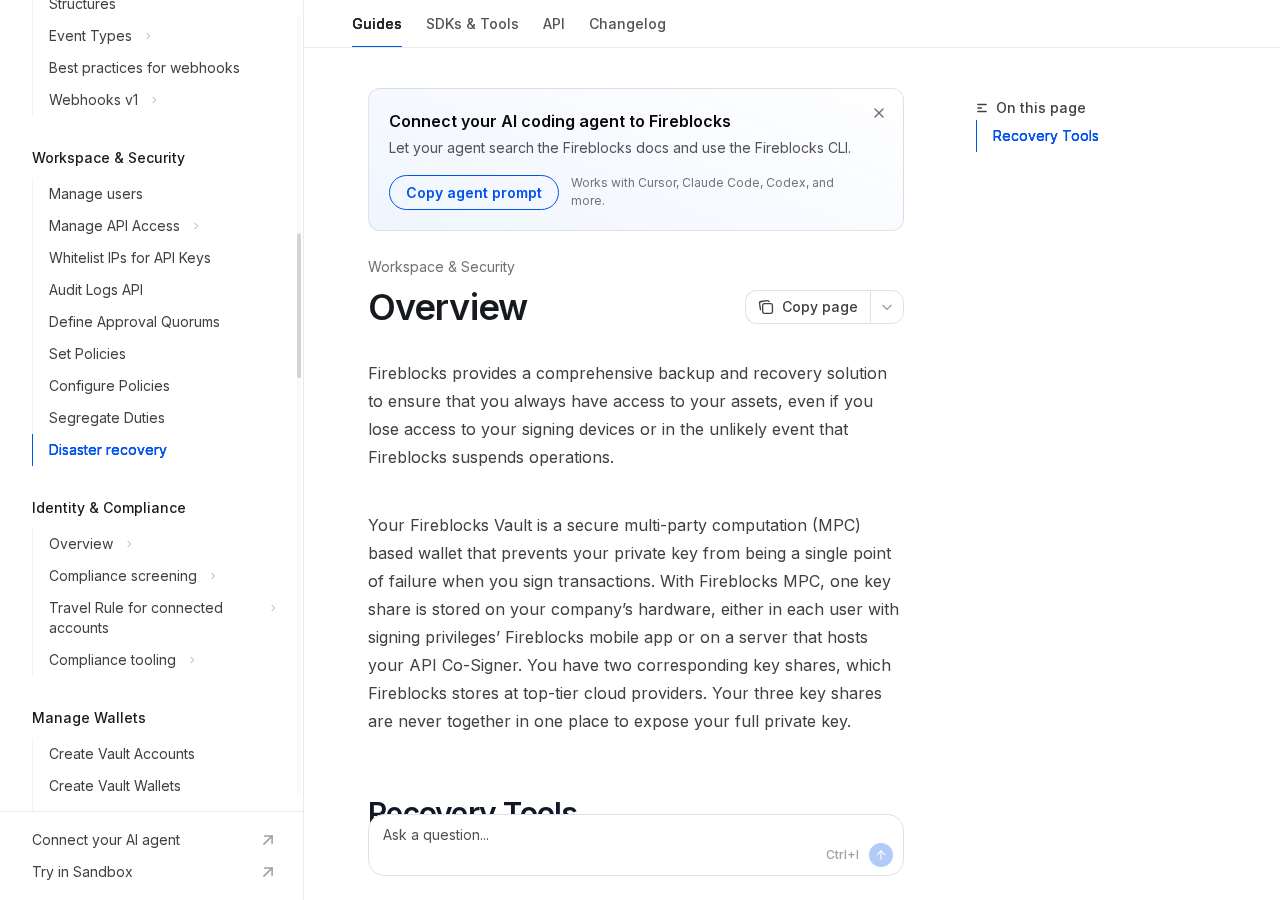
Fireblocks' public developer documentation provides a concrete example. In a Fireblocks MPC wallet, a private key is split into three key shares. One share is stored on the customer's own hardware, either in the Fireblocks mobile app of each user with signing rights or on a server hosting their API co-signer. The other two shares are held by Fireblocks at top-tier cloud providers. The documentation states that the three shares are never together in one place, so the full private key is never exposed.
Signing does not involve shipping the shares somewhere and reassembling them. Each party uses its share inside its own environment to take part in a cryptographic computation, and together they produce a signature. If one party drops out, no valid signature exists. If one share leaves its environment, it is still just data that cannot be used alone. This is threshold signing: the signature broadcast to the blockchain looks like any other signature, but the key itself is never rebuilt.
That is the fundamental difference from a hot wallet. When a hot wallet is breached, the attacker gets the complete key and can sweep everything. When an MPC wallet loses one server, the attacker gets one share that can neither derive the key nor sign alone. To move funds, an attacker must compromise several distinct environments and collect enough shares inside the signing flow.
It is also worth separating MPC from "three backups." MPC shares are linked through key derivation and a signing protocol, and exposing one share does not weaken the others. If a platform merely copies the plaintext key onto three servers, that is three backups, not MPC, and any one leak can still be catastrophic.
3. Why this makes Coinbase harder to take down in one shot
Coinbase's public disclosures line up with the mechanism above. Its 2025 Form 10-K filed with the SEC states that hot wallets generally hold no more than about 2% of assets under custody; that cold-wallet private-key material is stored and secured at facilities in the United States and internationally; and that private keys are never stored in plaintext. Decrypting a key requires the cryptographic consensus of multiple human approvers, and no single individual can control or operate Coinbase's wallet keys. Coinbase Institutional co-CEO Greg Tusar said publicly in 2025 that MPC ensures full private keys are never stored at rest, nor on any single machine during signing.
From an attacker's point of view, copying Binance-style "drain the wallet" is no longer a matter of owning one hot-wallet server. It requires entering several geographically separated facilities, obtaining several shares, and passing a multi-person approval process. Each step is an independent point of failure, and the cost and risk of detection multiply. Social engineering may still win one link, but it must win every link.
This is why the absence of a mega-breach is not simply luck. Keeping hot-wallet exposure below roughly 2% caps the damage even if a hot wallet is breached. Sharded cold keys plus multi-person approval turn "steal everything" from "break one machine" into "break an entire organizational process." The two controls together explain the record.
Coinbase's 2023 Form 10-K made the same point: the company had already expanded its use of MPC and other cryptographic techniques to secure customer funds. That makes this a long-disclosed architectural choice rather than a public-relations line written after a crisis. The caveat matters, though: the filings do not disclose the number of shares, the cloud providers or the storage locations. We can treat "Coinbase uses MPC" as a fact, but we cannot invent where its three shares sit.
4. The limits of MPC: what it stops, and what it does not
MPC is strong, but it is not "absolute security." It addresses single-point private-key exposure. It does not solve people and process risk.
- What it stops: compromise of one server; a single operator being bribed and exporting a complete key; one leaked backup causing a total loss; one cloud provider failing or turning malicious and exposing the key directly.
- What it does not stop: collusion among several insiders; social engineering that bypasses the approval workflow; oversized API keys without IP allowlists; phishing that captures both login and approval; a swapped withdrawal address; abused smart-contract approvals.
Most large losses today are not cryptography failures; they are people handing over authority. Binance combined EIP-7702 delegation hijacking with social engineering, and the 2025 Bybit incident also involved social engineering and infrastructure compromise. MPC raises the cost of stealing a key, but it cannot stop an authorized approver from clicking "approve."
The right expectation is therefore narrower: MPC makes a single point of failure much less likely to become a total loss, but an exchange can still fail through insider misconduct, process gaps, poor API hygiene or address substitution. When choosing a venue, look at sharded custody and at the approval, audit and limit design around it. Architecture sets the floor; operations determine the real-world result.
5. Five questions to ask before you register
You do not need to read cryptography papers. Five questions will filter out most platforms that only know how to say "we have cold storage":
- Is the private key sharded? Is it MPC or multisig? Are shares distributed across regions and cloud providers? If support can only answer "we have cold wallets," the architecture has not been explained publicly.
- Is there a withdrawal address allowlist? Once enabled, funds can only go to saved addresses. Is there a 24-hour cooldown for new addresses? This is the last line of defense against "account takeover, then instant transfer."
- Is there an independent proof of reserves? Not a "1:1 backed" slogan, but a verifiable Merkle tree, on-chain addresses or a third-party attestation, ideally with user-level self-verification.
- Are third-party audits published? Reserve attestations, SOC 2, ISO 27001 and similar reports. Check the date and scope, not the logo on the homepage.
- What is the daily withdrawal limit? Lower limits cap the damage from a single compromise. For most users, limits, allowlists and 2FA matter more than the phrase "we are secure."
Once you have those answers, go back to yesterday's five security metrics. Together they separate exchanges that built an architecture from those that only wrote about security.
6. Five exchanges side by side: public disclosures only
The table below includes only information confirmed in official filings, official help pages or official proof-of-reserves pages. Where we could not confirm a point, the cell says "not publicly disclosed." Note also that "does the exchange use MPC for its own custody" and "does its self-custody wallet use MPC" are different questions, so the table separates them.
| Exchange | Publicly disclosed custody | MPC involvement | Proof of reserves | Withdrawal allowlist |
|---|---|---|---|---|
| Binance | Hot and cold wallets separated; some cold-wallet addresses published with PoR; hot-wallet share not publicly disclosed | Exchange custody not publicly disclosed; Binance Web3 self-custody wallet uses 2-of-3 MPC | Yes: Merkle tree plus user self-verification on the official PoR page | Address-book allowlist with a cooldown for new addresses |
| OKX | Hot and cold wallets separated; exact ratio not publicly disclosed | Exchange custody not publicly disclosed; OKX Keyless Wallet self-custody product uses three MPC shares | Yes: Merkle tree plus zk-STARK, updated monthly, user self-verification supported | Allowlist restricts withdrawals to saved address-book entries |
| Gate.io | Hot and cold wallets separated; official PoR shows a 118% total reserve ratio using Merkle Tree plus zk-SNARKs | Exchange custody not publicly disclosed; Gate Vault self-custody product uses MPC | Yes: monthly Merkle tree plus zk-SNARK audit, user self-verification available | Withdrawal address allowlist supported |
| Coinbase | 10-K: hot wallets hold no more than about 2% of custodied assets; cold-key material stored in the US and overseas facilities | Yes: public disclosures confirm MPC (2023 10-K and a 2025 executive statement); share count and storage locations not publicly disclosed | No retail Merkle self-verification; disclosure mainly through SEC 10-K/10-Q; standalone PoR not publicly disclosed | Address Allowlist and trusted address book supported |
| Kraken | Most assets in cold storage; Kraken Financial is a full-reserve bank; exact hot/cold ratio not publicly disclosed | Not publicly disclosed | Yes: periodic proof-of-reserves audits with external auditors; users can verify after logging in | Address-book process with confirmation for new addresses; a strict allowlist toggle is not publicly disclosed |
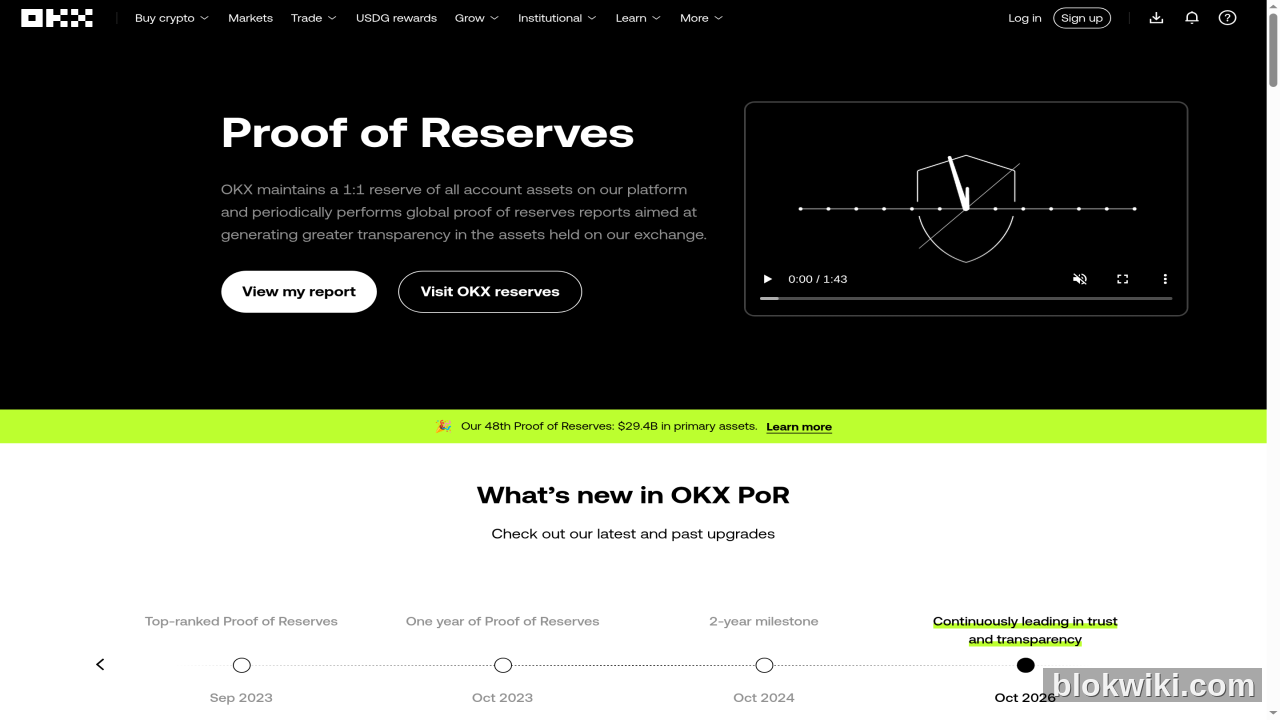
The screenshot below is OKX's official proof-of-reserves page, showing on-chain verifiability: users can follow a Merkle path to confirm their balance is included in the snapshot. That kind of self-verification is more meaningful than a single published reserve ratio.
Three caveats when reading the table. First, Coinbase's MPC disclosure comes from public statements, but the shard details are not public; do not assume its design is identical to Fireblocks'. Second, the MPC information for Binance, OKX and Gate appears mainly in their self-custody wallets; it does not establish that exchange custody uses the same stack. Third, proof of reserves shows that assets covered liabilities at one moment; it does not prove control of private keys and does not rule out hidden liabilities. It complements custody architecture; it does not replace it.
7. If you have not registered yet: architecture first, fees second
If you are still choosing a venue, start with the five security metrics and remove platforms with weak track records or obvious licensing gaps. Then apply the sixth metric: custody architecture, and whether the single-point key has actually been removed. Fees and referral rates come last. The first two determine whether your coins can disappear; the last one only determines how much you keep.
If you want to start with a major venue, two options are worth a look: Binance for the deepest liquidity and widest product range, though after this incident you should confirm that withdrawal allowlists and 2FA are switched on; and Gate, whose Asian licensing and PoR disclosure make it a useful comparison point. Referral rates, fees and promotions shown on those pages are governed by the live page; this article makes no return promises.
For wallet-level choices, see our guide to hot, cold and hardware wallets. Exchange custody solves convenience; self-custody solves "the exchange fails and the assets are still yours." The question is allocation, not either-or.
BlokWiki (blokwiki.com) will keep tracking custody disclosures, proof-of-reserves updates and security incidents across exchanges as a long-term reference for your decision.