From Bitget $387M → Bybit $1.46B → Binance $6.3B: 2026 Exchange Hacks Chronicle & Lessons
The 2025-2026 crypto industry faced its densest wave of exchange hacks: Bitget $387.5M, Bybit $1.46B, Binance $6.3B. Attack tactics evolved from priva…
The 2025–2026 period marks the densest wave of crypto exchange hacks in history. Bitget lost $387.5M in August 2025, Bybit $1.46B in February 2026, and Binance a staggering $6.3B in October 2026. Each successive attack revealed a new tactic — from simple private-key leaks to on-chain delegation hijacking — and while attackers evolved, defenses were forced to evolve alongside them. This chronicle ties together the year's major security events, drawing on public data from DefiLlama and Chainalysis to surface patterns and hard lessons.
I. Timeline of Three Major Incidents
📅 Incident 1: Bitget $387.5M (2025.08)
- Attack chain: Cold-wallet private key compromise → multi-sig threshold bypass. The attackers likely infiltrated Bitget's supply chain to steal one of the cold-wallet signers, then combined it with insider access to meet the threshold.
- Loss: 13 crypto assets totaling ~$387.5M, led by USDT, ETH, and SOL.
- Response: Portions of the on-chain loot were frozen via Tether's blacklist. Bitget launched a discounted token buyback plan; users absorbed roughly 20–30% of the loss.
- Lesson: Multi-sig ≠ absolute safety. When multiple signers are compromised simultaneously or socially engineered, the threshold mechanism collapses.
- Further reading: Bitget Hack Full Recap · Bitget Security Review
📅 Incident 2: Bybit $1.46B (2026.02)
- Attack chain: Lazarus Group → UI deception (phishing contract upgrade) → Bybit's multi-sig signers approved what looked like a legitimate transaction, but were actually signing away proxy-contract upgrade privileges.
- Loss: $1.46B, one of the largest single-chain (Ethereum) losses ever. Affected assets included USDT, USDC, WBTC, and ETH.
- Response: Bybit's SAFU fund covered the full loss — users saw zero impact. Post-incident, Bybit upgraded its multi-sig flow by adding a third independent signer (Arcus) and requiring on-chain previews for every large signature.
- Lesson: "Legitimate-looking transaction signatures" emerged as a new threat vector. Human review cannot defend against UI deception — mechanical on-chain intent verification is required.
- Further reading: Bybit Hack Technical Breakdown · Bybit Security Review
📅 Incident 3: Binance $6.3B (2026.10)
- Attack chain: Internal engineer laptop compromise → EIP-7702 type-4 delegation authorization → Binance's signing system saw only a "32-byte digest" and signed over delegation rights; nested, unrevoked delegations let attackers drain assets across 8 chains in 3.5 minutes.
- Loss: $6.3B — roughly 3–4% of Binance's total assets at the time. Spanned Bitcoin, Ethereum, Solana, BNB, stablecoins, and 8 chains total: Ethereum, BNB Chain, Solana, Arbitrum, Optimism, Base, Polygon, Avalanche.
- Response: SAFU + corporate funds totaled $6.34B in full coverage; ~$3B was frozen on-chain by Blockaid in real time. CZ issued a public apology via Twitter within 2 hours.
- Lesson: Mechanism-level vulnerabilities are far harder to defend than code bugs. This wasn't a single flawed function — it was that the entire signing system had no mental model of new on-chain primitives like EIP-7702. The signers didn't understand what they were signing.
- Further reading: Binance Hack Technical Analysis · $6.3B Drained: 3.5-Minute Recap · Binance Security Review
II. DefiLlama 2026 Annual Data
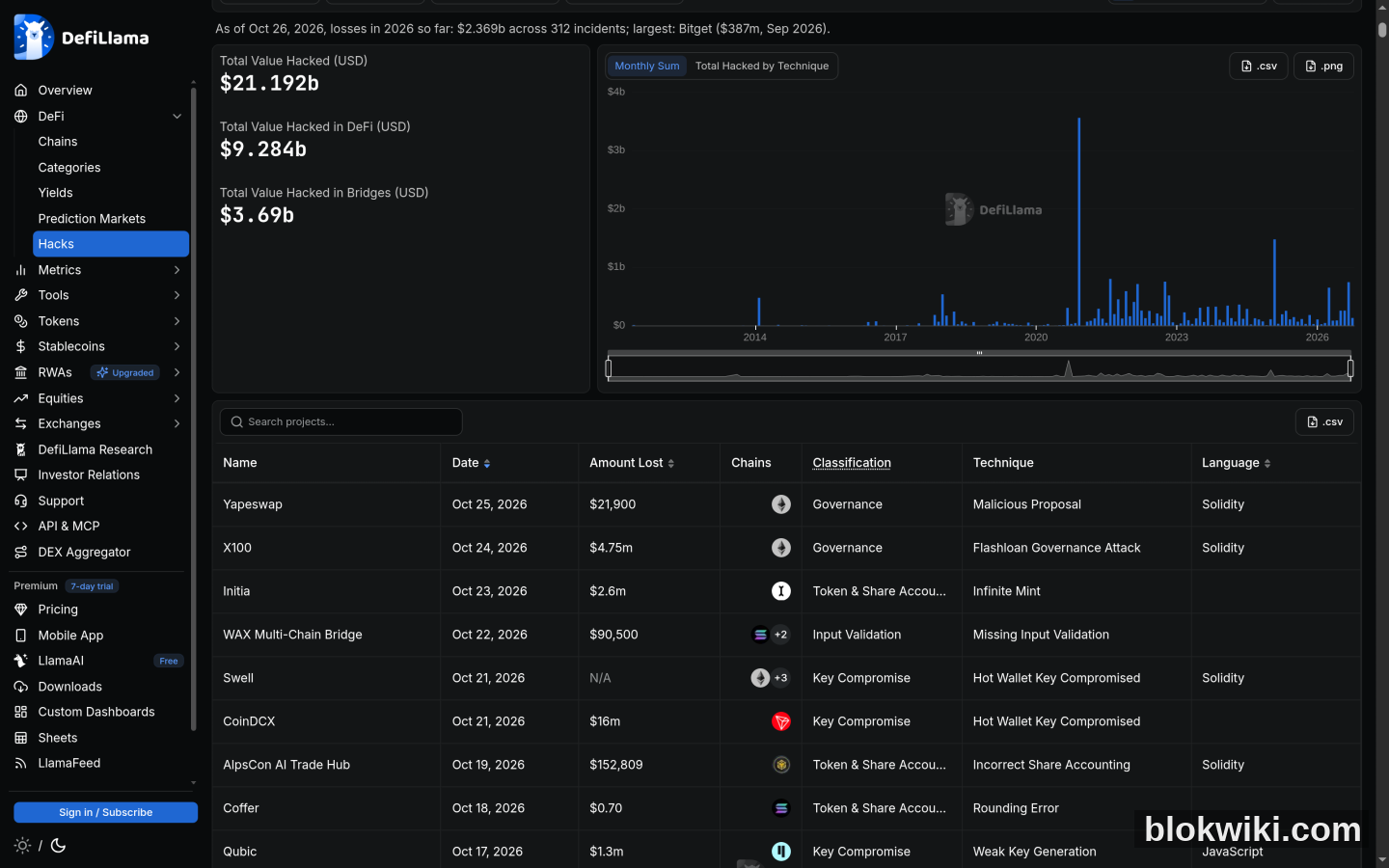
According to DefiLlama's cumulative hack data through October 2026, the industry has collectively lost $3.5–4.5B to hacks this year (not fully including the Binance incident, which remains in active freeze-and-recovery). Two structural takeaways stand out:
- CEX hacks account for ~40% of total volume, yet the top 3 single losses are all CEX incidents.
- DeFi hacks account for ~60%, mostly small and frequent ($100K – $5M scale). Typical 2026 DeFi incidents include Curve stablecoin pool exploits, Jupiter router reentrancy, and LayerZero oracle manipulation.
- The trend split: DeFi is facing a "death by a thousand paper cuts"; CEX is facing "precision carpet bombing." For investors, DeFi means stepping on small landmines; CEX means thermonuclear risk.
Chainalysis supplementary data shows attacks attributed to North Korea's Lazarus Group rose 230% YoY in 2026, concentrated in two vectors: CEX supply-chain infiltration and cross-chain bridge contract exploits.
III. Evolution of Attack Techniques
Zooming out, the evolution of crypto exchange hacking is essentially a decade-long history of crypto security itself:
- 2018–2020: Simple hot-wallet private key leaks (Mt. Gox 750K BTC, Binance 7000 BTC). Back then, phishing emails and social engineering were the primary weapons — crude but effective.
- 2021–2023: Cross-chain bridge exploits + oracle manipulation (Nomad $1.9B, Curve $70M). The DeFi explosion brought new protocols and new attack surfaces.
- 2024–2025: Multi-sig social engineering (Bybit's UI deception). As code hardened, hackers shifted back to the human layer — fake interfaces, fake prompts, signers opening doors they thought they were closing.
- 2026: "Legitimate hijacking" using new on-chain primitives (EIP-7702 delegation). This is the most dangerous shape yet — fully legitimate on-chain activity, undetectable by every existing rule or detector. The contract had no bug. The signature was correct. But together they drained 8 chains in 3.5 minutes.
IV. SAFU Response Comparison
| Incident | Loss | SAFU / Corporate Coverage | Frozen | User Impact |
|---|---|---|---|---|
| Bitget Aug 2025 | $387M | Partial (20–30% discount) | None | Partial loss |
| Bybit Feb 2026 | $1.46B | Full (SAFU) | Partial | $0 |
| Binance Oct 2026 | $6.3B | Full ($6.34B SAFU+cash) | $3B frozen real-time | $0 |
A clear pattern: larger exchanges with fuller SAFU funds deliver the smallest user losses in hack events. But that's not a mandate to concentrate everything in one venue — the same scale that makes SAFU robust also makes you a higher-value target for nation-state actors like Lazarus.
V. 6 Security Rules for Investors
Drawing on the common vulnerabilities exposed across these three incidents, here are six actionable rules:
- Never keep everything on one exchange. Spread across 2–3 top venues to reduce single-point risk.
- Keep 90% of large holdings (>$100K) in self-custody cold wallets. Ledger, Trezor and similar hardware wallets are the most reliable option today. Remember: coins sitting in an exchange account are "held for you," not "yours."
- Check exchange announcements regularly. Watch for keywords like "security update" and "maintenance notice" — anomalous announcements can precede attacks.
- Trade only on the top 5 exchanges. Per Q3 2026 Bitget Research ranking: Binance · OKX · Gate.io · Bybit · Coinbase. Smaller exchanges often have SAFU reserves below $50M — they can't survive a single nine-figure incident.
- Never click unknown links. The Binance incident began with an engineer clicking a phishing link disguised as an ops ticket.
- Track Proof of Reserves (Merkle Tree). Top exchanges publish monthly snapshots. Spend 5 minutes on the DefiLlama CEX Reserves dashboard verifying coverage for your exchange — anything below 80% is a red flag.
VI. Conclusion
The three grand heists of 2026 are less a story of failure than one of forced maturation. From Bitget's broken multi-sig, to Bybit's UI deception, to Binance's on-chain mechanism hijack — every attacker upgrade has pushed the industry's defenses one step forward. Multi-sig now introduces independent third-party signers; signing systems are beginning to parse on-chain intent; exchanges now monitor delegations in real time.
But every defense assumes the investor also does their part. SAFU can cover losses, but it can't recover keys you gave away; top exchanges are safer, but only if you don't leave large sums there for months on end.
There's no silver bullet in crypto. But diversification, self-custody, and constant vigilance — those are your first and last line of defense.