Is HTX Still Usable in 2026? Sign-Up Guide
HTX says it serves 60 million users over 13 years, and its November proof of reserves marks 49 consecutive months (BTC 102%). A full walkthrough from …
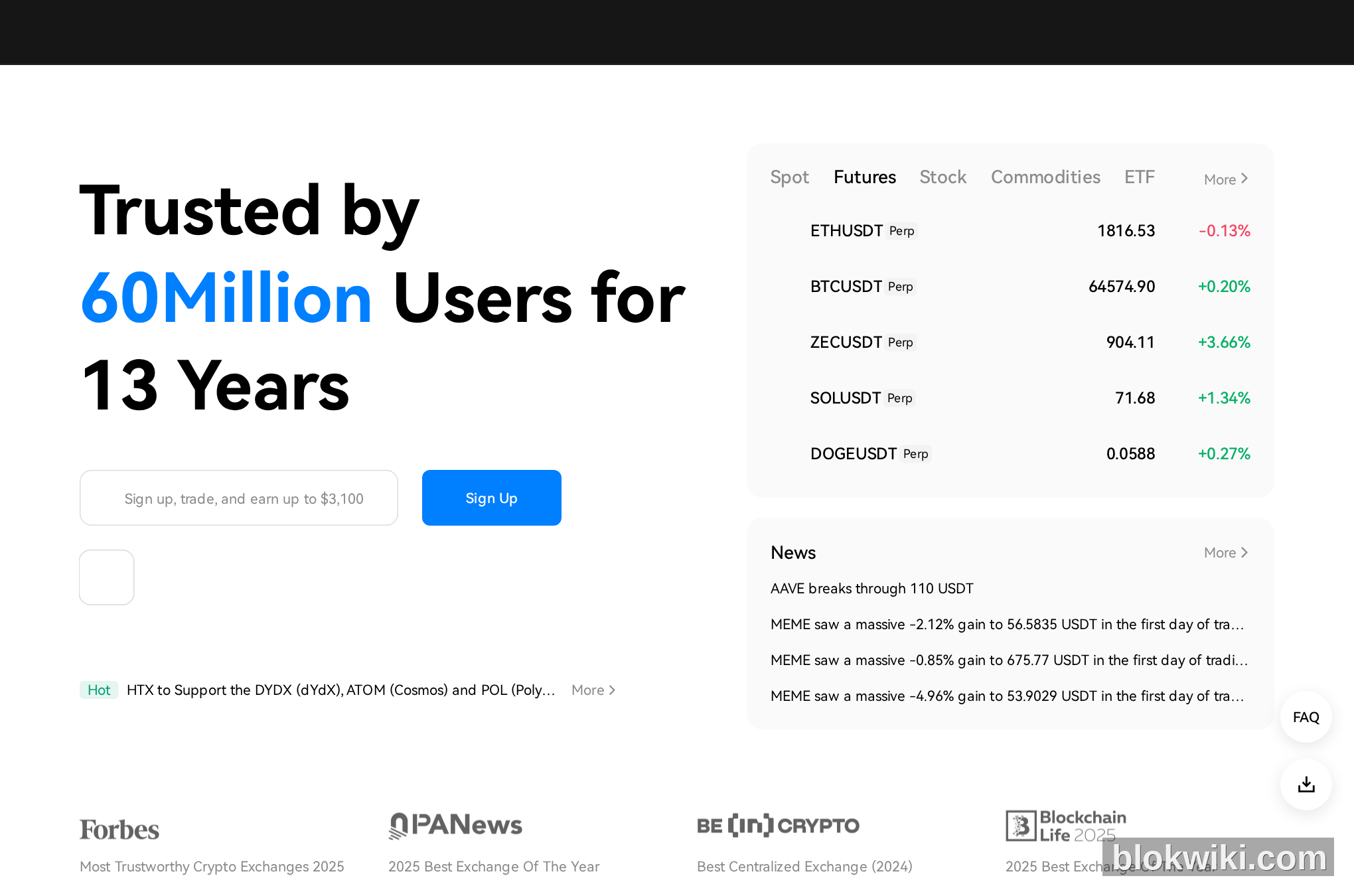
The first thing HTX's homepage says on November 17 is "trusted by 60 million users for 13 years." And the question we keep getting is still the same: can you actually use Huobi in 2026?
That question has two layers: can you use it (access, sign-up, withdrawals) and should you (fees, safety, compliance). Here is the whole path, from registration to your first trade.
1. Can you use it?
HTX is operating normally. The site loads, registration is open, and spot and futures markets are live. Quotes on the homepage on November 17: BTCUSDT perpetual at $64,574.90 and ETHUSDT perpetual at $1,816.53.
Regional restrictions matter, though. HTX blocks access from some jurisdictions outright, and the UK and EU have previously imposed restrictions. The background is covered in our HTX safety review. Confirm your jurisdiction is served before you even think about signing up.
2. Proof of reserves: 49 consecutive months
Its November 1 Merkle-tree proof of reserves shows every major asset above 100%: BTC 102%, ETH 101%, TRX 107%, USDs 105%, HTX 102%, XRP 105%, DOGE 101% and SOL 105% — the 49th consecutive monthly disclosure.

How to read it: the reserve ratio is the platform's holdings of an asset divided by total user balances in that asset. At or above 100%, the books are covered. It cannot prove nobody misappropriated funds, but it does prove the balance sheet at least adds up. The general method is in our three-minute exchange check.
3. Sign-up and KYC
- Go through the HTX page to the registration form and sign up with an email or phone number, using a long password you do not reuse;
- Turn on Google Authenticator (2FA) immediately — do not rely on SMS alone;
- Complete identity verification: usually a photo ID plus a liveness check, with approval taking minutes to a day;
- Withdrawal limits only open up after verification passes.
If verification stalls, check our KYC review-failure guide. The usual culprits are glare on the photo, cropped document edges, or a name that does not match the document.
4. Funding: three routes, pick the cheapest
C2C (buy USDT with fiat) has the lowest barrier; prices float by merchant, so compare and pick high-completion sellers. Card or third-party purchases price close to spot but carry a 1–3% spread and regional limits. On-chain deposits suit people who already hold USDT — just make sure the network matches the sender's.
Start with the equivalent of CNY 100, prove the loop works, then scale. For details, see our $10 starter guide. If you are unsure what to buy first, read why beginners start with USDT.
5. Fees: 0.2% base, 0.15% with the HTX discount
HTX spot fees step down by Prime tier. Prime0 — under $30,000 of 30-day spot volume — is 0.2000% maker and taker; paying fees in HTX takes another 25% off, bringing it to 0.15000%. From Prime3 the base is 0.1000%, or 0.07500% with the discount.
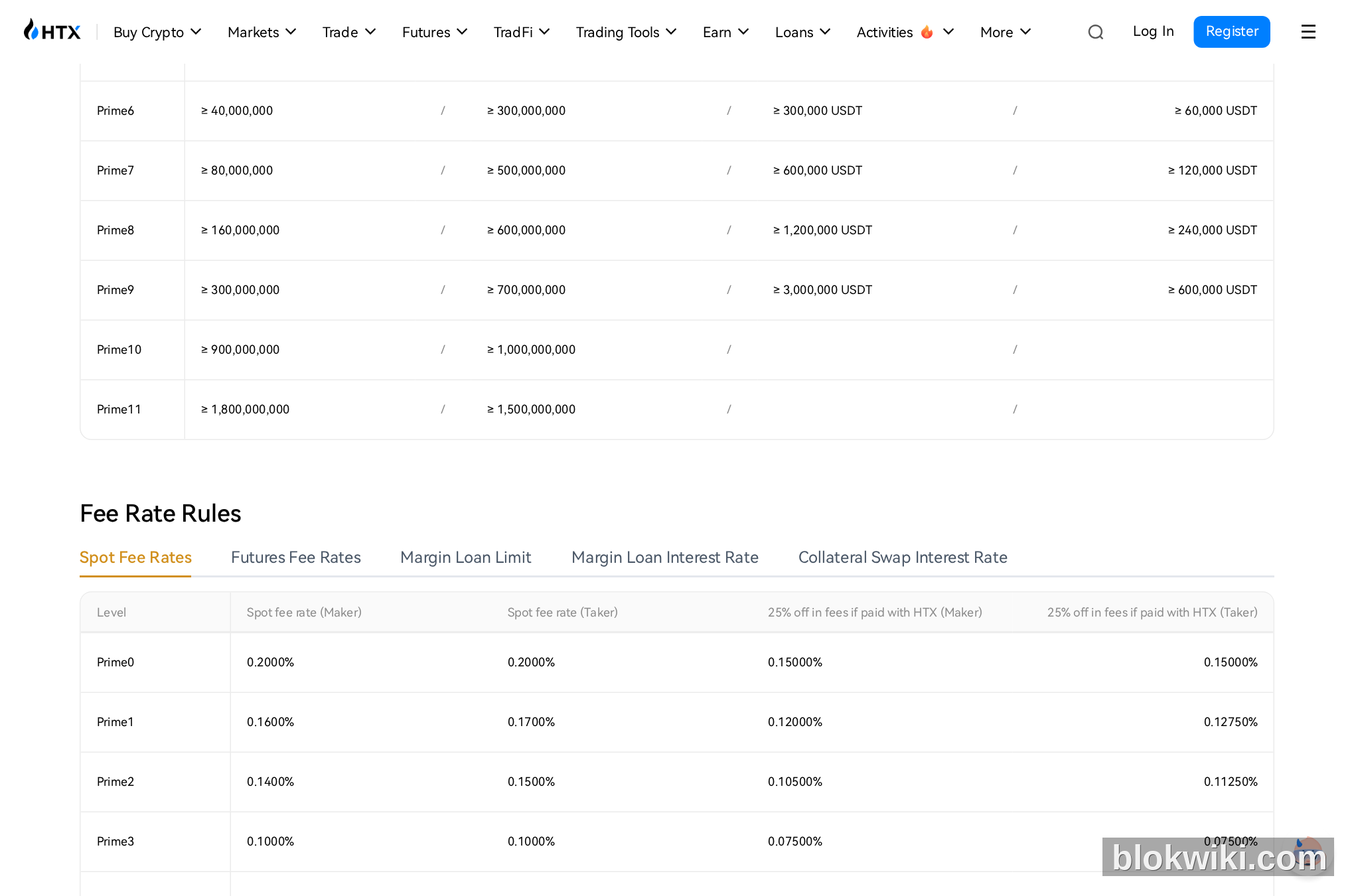
For comparison: Binance charges regular users 0.1%/0.1%, OKX 0.1%/0.2%, and Gate roughly 0.1%–0.2%. HTX's base rate is on the high side and only catches up through the token discount and tier progression. If you trade frequently, factor that in.
6. Withdrawals and your first trade
After funding: convert fiat to USDT in the spot market, then buy BTC with USDT. Immediately run a small withdrawal test — 10 USDT is enough — to confirm the address, network and arrival time all behave, and only then scale up. Steps are in our address-poisoning guide.
Bottom line: HTX works in 2026, but it is not the best fit for everyone. Its strengths are longevity, consistent reserve disclosures and a mature C2C experience; its weaknesses are a higher base fee and regional restrictions. Keep the first deposit small and prove the whole loop — sign up, fund, buy USDT, swap to BTC, withdraw — before worrying about which exchange is "best."
If you have not chosen yet, compare all four: Binance, OKX, Gate and HTX — then use the three-step check to rule out the ones that fail.