Is Now the Time to Buy Your First Bitcoin?
Bitcoin traded at $66,887 on November 14, down 5.6% in two sessions, after a 24-hour window that liquidated $1.31 billion across 158,996 traders. If y…
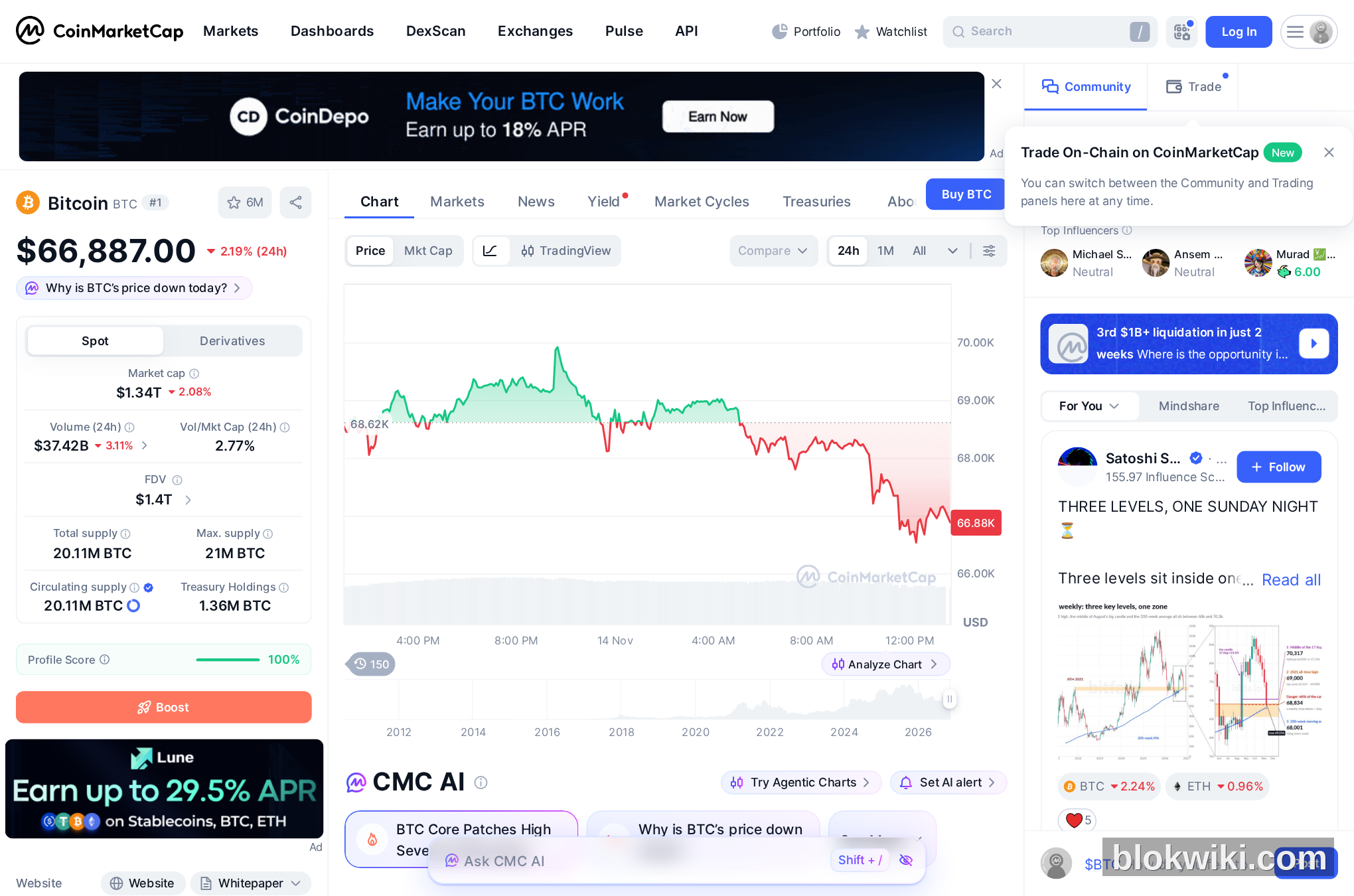
At 13:30 Beijing time on November 14, bitcoin traded at $66,887, down 2.19% in 24 hours, with a market cap of $1.34 trillion. Two days earlier, on November 13, it was at $70,831 — a 5.6% drop in two sessions. Ether was at $1,898 and SOL at $75.4, while CoinGecko's Fear & Greed Index fell to 27, deep in "extreme fear" territory.
If you have not opened an exchange account yet, two thoughts probably crossed your mind: "maybe this is the entry" and "maybe it gets cheaper tomorrow." Both are reasonable. Neither should be answered by feeling. Here is the arithmetic, using data that is on screen right now.
First, why it fell: this was not a crypto story
On November 12, NVIDIA announced that Jensen Huang had resigned as President, CEO and board member, effective immediately, with CFO Colette Kress taking over as interim CEO. The Financial Times reported on November 14 that the board has approached Arm CEO Rene Haas about the role; on the prediction market Predict.fun, Haas's odds rose to 36%, the highest of any candidate. An internal petition asking Huang to return has passed 30,000 signatures, with Elon Musk and Tom Lee publicly saying they would sign.
None of that has anything to do with bitcoin's code. But NVIDIA is the pricing anchor of the entire AI trade. When the anchor wobbles, the Nasdaq wobbles, and crypto — the highest-leverage, 24/7 risk asset — gets sold first. Liquid Capital's Yi Lihua said it plainly on November 14: crypto is now tightly coupled to US equities, and until the Huang situation is resolved he is not adding exposure.
In other words, what got hit today was not "something wrong with bitcoin" but "someone needed cash and sold whatever was easiest to sell." That distinction matters, because it tells you which indicators to watch: US equities and leverage, not on-chain metrics.
The liquidation tape: 83% of the $1.31 billion was longs
Coinglass recorded $1.31 billion of liquidations in the 24 hours ending early on November 14: $1.093 billion from longs and $217 million from shorts, across 158,996 traders. The single largest was a $20.15 million BTC-USD position on Hyperliquid. By the time of our screenshot in the afternoon, the rolling window had fallen to $832 million across 135,654 traders, but longs still accounted for 82.3%.
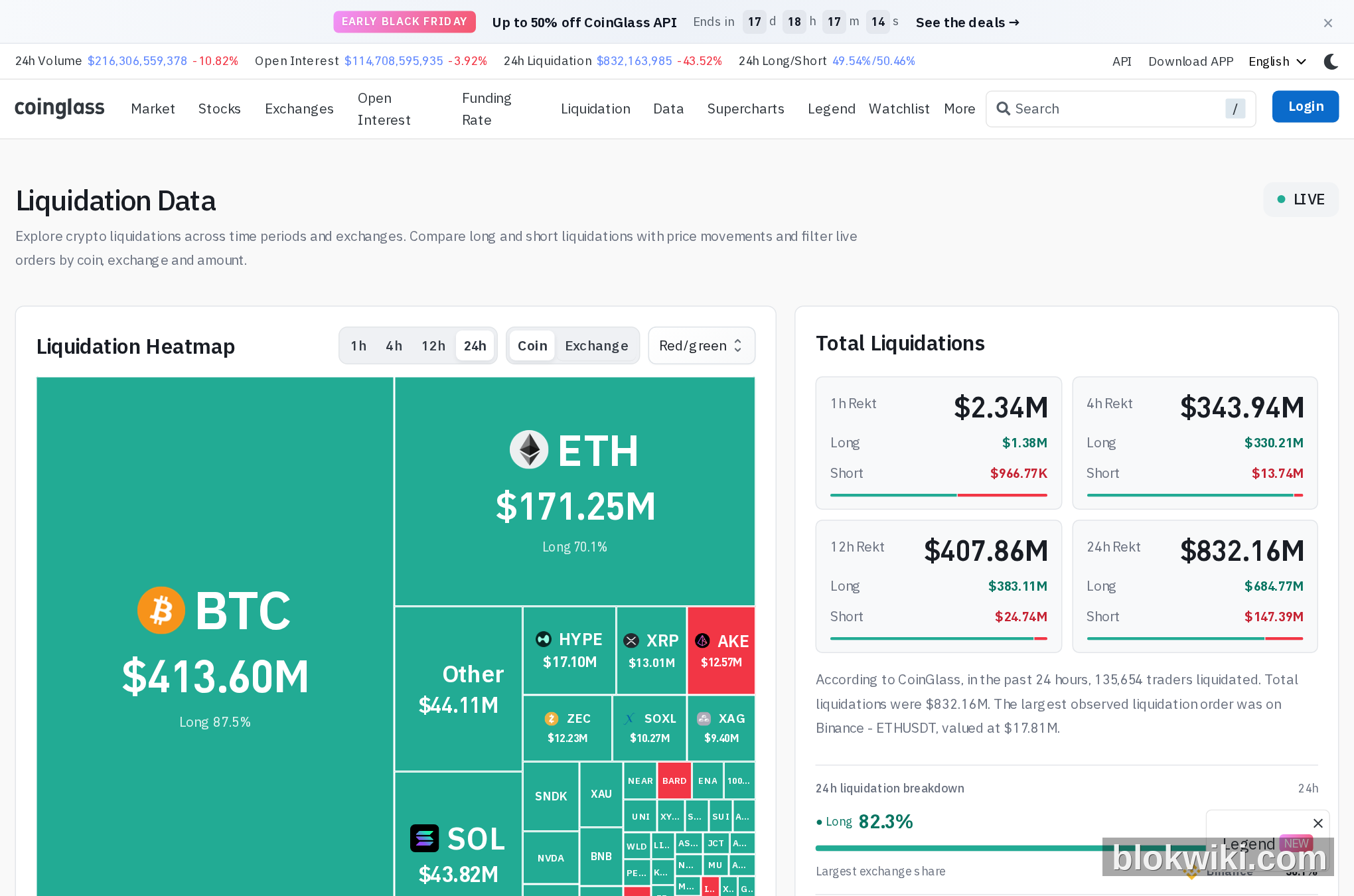
The composition is the lesson: when price falls, the people who get wiped out are almost entirely leveraged longs, not spot holders. A 5% drop costs a spot holder 5% of paper value; a 5% drop wipes out a 20x position. How you open your first position matters far more than when.
The four numbers
1. 22% — how deep this drawdown is
Yi Lihua had flagged $79,000, $75,000 and $71,000 as three support levels; all three are now broken. Measured from the $86,000 swing high, bitcoin at $66,887 is down about 22%, with the Fear & Greed Index at 27. Historically, drawdowns of this size have produced both V-shaped recoveries within three months and another 15% of downside followed by six months of chop. No indicator tells you this is the bottom. What is certain: at this level, going all-in at once carries clearly more risk than scaling in.
2. 600 / 6,000 / 60,000 — how much to commit
Assuming CNY 7.1 per dollar and BTC at $66,887:
- CNY 600 (about $84.5) buys roughly 0.00126 BTC; a 0.1% fee costs about CNY 0.6
- CNY 6,000 (about $845) buys roughly 0.0126 BTC; the fee is about CNY 6
- CNY 60,000 (about $8,450) buys roughly 0.126 BTC; the fee is about CNY 60
The number that matters is not the size of the position but whether you can sleep if it drops 30%. If CNY 60,000 falling to CNY 42,000 would keep you awake, then CNY 60,000 is not your first position.
3. One buy or three — the pace
Lump-sum suits people who have done the work and will not touch the money for three years. Scaling in — three buys a week apart — suits most people; the cost is a slightly higher average price if the market V-shapes. With an unresolved macro event like this one, scaling in is the better trade-off, not because it catches the bottom, but because it leaves you ammunition if your read turns out wrong.
4. 0.1% or 0.2% — what fees actually cost
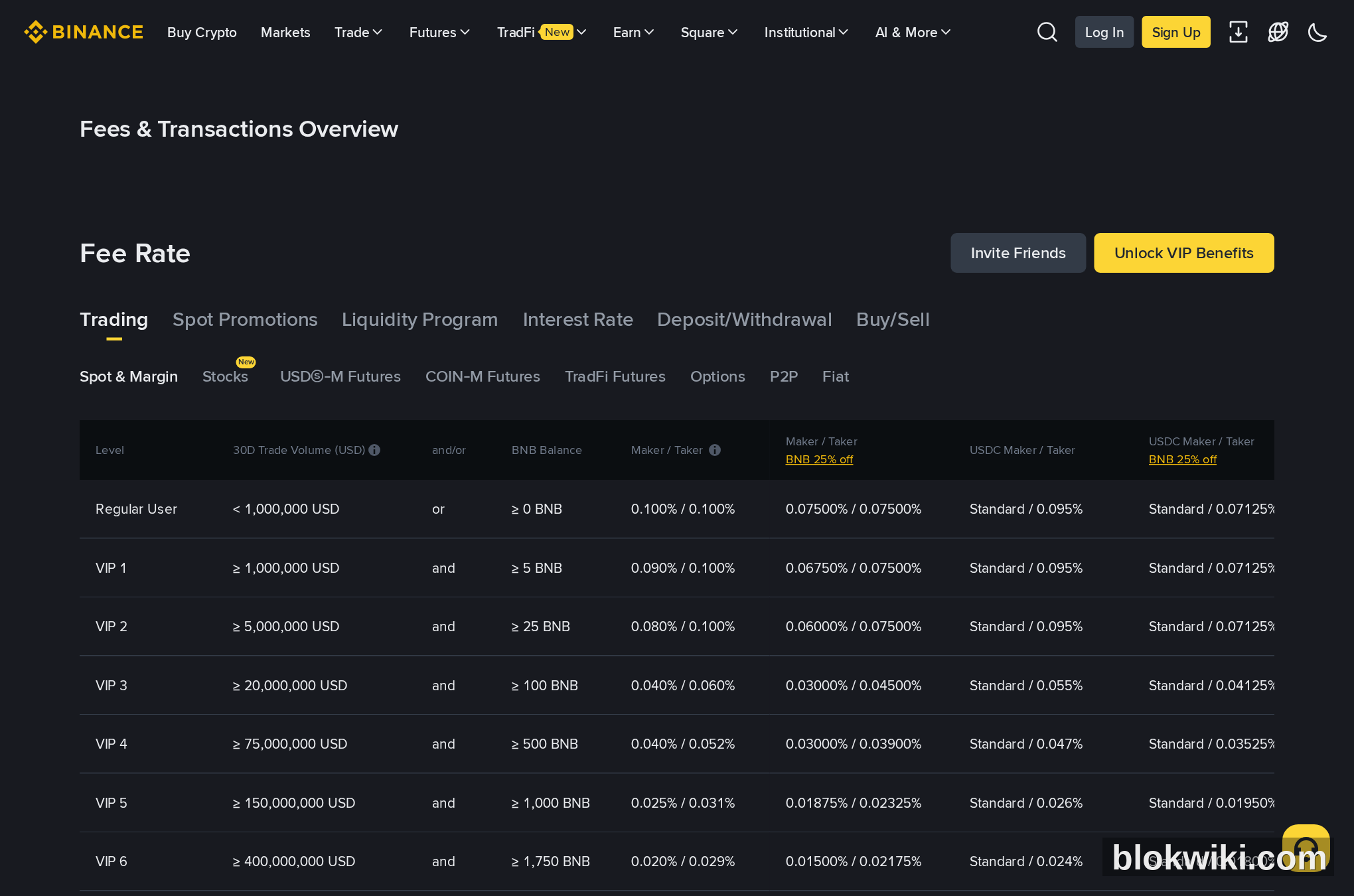
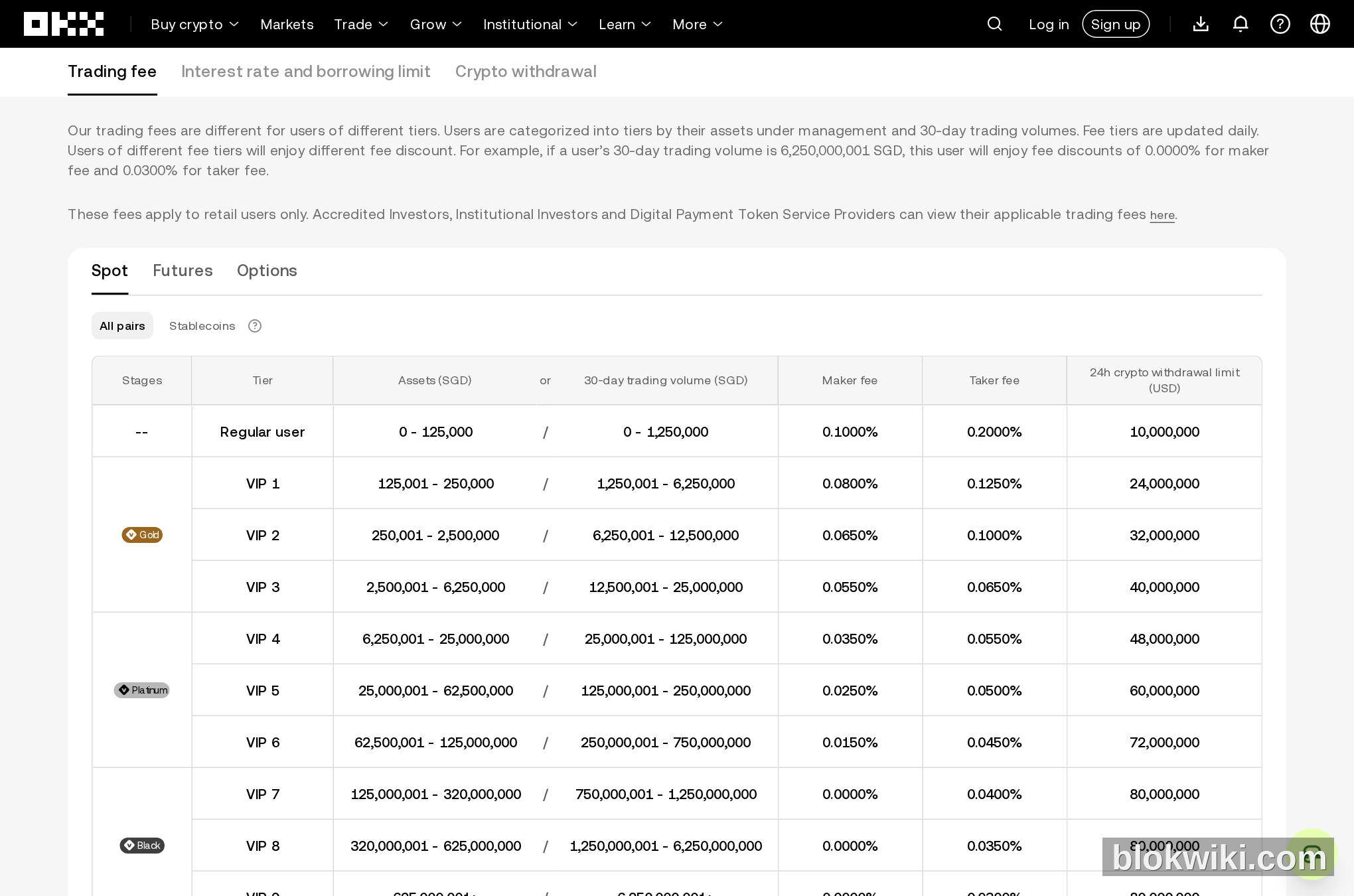
Binance's standard spot fee is 0.1% maker and 0.1% taker, or 0.075% with the 25% BNB discount. OKX charges 0.1% maker and 0.2% taker on spot. On a CNY 600 order the gap is CNY 0.6; on CNY 60,000 it is CNY 60. For a one-off purchase that is noise. For a monthly DCA plan, it adds up.
If you have not opened an account, here is the next 30 minutes
- Set the amount first, using number 2 above.
- Pick one exchange and check reserves, withdrawal status and licensing — the method is in our three-minute safety checklist. The mainstream options are Binance, OKX and Gate.
- Complete KYC and fund the account; the differences between platforms are covered in our $10 starter guide.
- Buy spot only for the first order. No leverage.
- Run a small withdrawal test afterwards so you know the channel works; steps are in our withdrawal guide.
On the "buy now or wait" question, we have already laid out the trade-off between DCA and waiting in this piece. The only new variable today is the cause: this selloff started in US equities, not on-chain. Watch the Nasdaq and the liquidation tape, not just the candles.
One last thing worth saying plainly: a 22% drawdown is neither an opportunity nor a danger — it is just a price level. What determines the outcome is never which day you click buy, but how much you buy, whether you use leverage, and whether you can hold it afterwards.