BTC Rebounds: Should First-Time Buyers Chase?
Bitcoin fell to $55,130 on 21 November and rebounded to $61,221 two days later. The latest 24 hours saw $232 million liquidated, but $161 million were…
Introduction: from $55K to $61K in 48 hours
On 21 November, bitcoin fell as low as $55,130, its weakest level since September 2024. Two days later it reclaimed $61,000 and trades near $61,221 at 13:00 Beijing time on 23 November, up about 3.1% in 24 hours. Ether has rebounded to roughly $1,730.
This rebound is different from the selloff two weeks ago. The earlier move was a long liquidation cascade; the latest data shows shorts getting liquidated: $232 million was wiped out across the market in 24 hours, of which $161 million were shorts and only $71.36 million were longs. The direction has flipped.
So the question today is not "is the bull market back?" It is more specific: if you are buying for the first time, should you chase this rebound or wait for a pullback?

Source: CoinStats republishing Bitcoin World, "Bitcoin Reclaims $60K After $55K Dip, Wiping Out $230M in Shorts", 22 November 2026. BTC shows around $61,293 in the ticker.
1. This is a short squeeze, not new money
Put the last three days together and the mechanics are clear:
| Metric | Data as of 23 November |
|---|---|
| BTC low | $55,130 on 21 November, lowest since September 2024 |
| BTC now | About $61,221, +3.1% in 24 hours |
| Latest 24-hour liquidations | $232 million: $161 million shorts, $71.36 million longs |
| Shorts liquidated during the bounce | About $230 million within four hours (CoinGlass/CryptoPotato) |
| Earlier long liquidations | About $2 billion in the 24 hours around 20–21 November |
| Coinbase premium | -0.15%, negative for 61 consecutive days |
A 9% drop followed by a 9% bounce was not driven by institutions suddenly turning bullish. It was forced deleveraging: once the longs were flushed, selling pressure disappeared; as price rose, shorts were forced to buy back, creating a second leg up. Such rebounds are fast and violent, but not necessarily durable, because the fuel is short stops, not fresh buying.
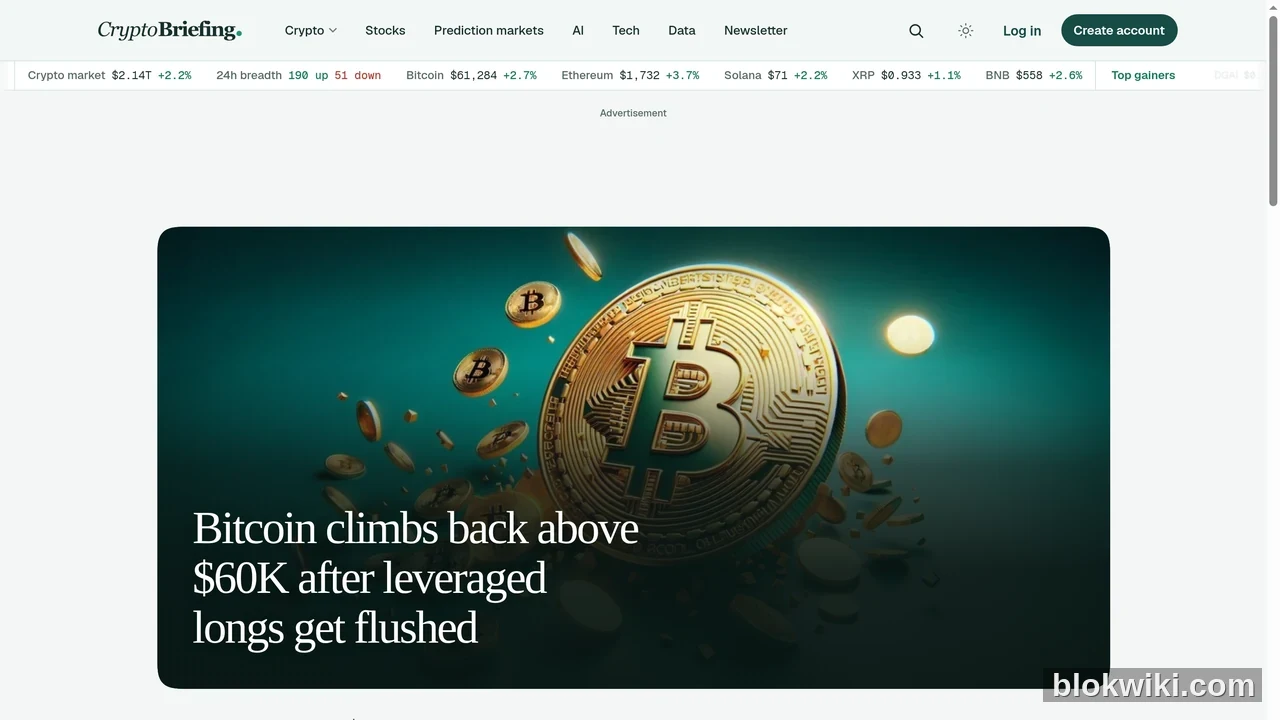
Source: Crypto Briefing, "Bitcoin climbs back above $60K after leveraged longs get flushed", 22 November 2026.
2. Three signals that decide whether to chase
Signal 1: are short liquidations exhausted? If most shorts have already been cleared, the fuel for further upside is gone. Watch two numbers: whether 24-hour short liquidations are falling sharply, and whether perpetual funding rates turn from negative to positive. If the short-liquidation peak has passed but funding stays negative, the market is still hesitant and chasing has poor risk/reward.
Signal 2: does the Coinbase premium turn positive? The Coinbase premium measures the BTC price gap between Coinbase and the global average: positive means strong US buying, negative means US money is waiting or selling. It is currently -0.15% and has been negative for 61 straight days, meaning this rebound is mainly offshore and short-covering; US institutions have not returned. The "check the channel before the price" rule from yesterday's crash-day guide still applies.
Signal 3: do spot bitcoin ETFs turn to net inflows? Around 21 November, US spot BTC ETFs saw multiple consecutive sessions of outflows, with the largest single day at $582 million. Only a return to sustained net inflows would show that allocation money is coming back. A rebound driven only by derivatives short-covering can be given back within days.
Of the three, only the short-liquidation signal is currently in place; the other two have not turned. That is why a small position is reasonable, but treating this as a reversal is not.
3. Three costs of chasing
- You may buy at the tail of short covering. Short buybacks are a one-off flow; once done, they stop. Moving from $55,000 to $61,000 has already absorbed much of that demand, so chasing now means taking over from earlier buyers.
- Weekend and Asian-hour liquidity is thinner. With US markets closed, market makers quote less, spreads widen, and the same market order can fill 0.3%–0.8% worse than on a weekday, especially at size.
- Macro data lands this week. US core PCE, Fed speakers and the Thanksgiving holiday are all on the calendar. A hawkish surprise could send risk assets back down. You do not need to bet on direction; you need room to add if it falls another 10%.
4. If you still want to buy: an execution checklist
No price forecast, just an order of operations. The example uses $600; scale it to your own capital:
| Tranche | Amount | Method | Trigger |
|---|---|---|---|
| First | $200 | Limit order 0.5%–1% below the current price | Place it today; do not chase the market |
| Second | $200 | Limit order | A pullback toward $59,000, or 24 hours without losing $60,000 |
| Third | $200 | Limit order | A hold above $62,500, or another 8% drop |
Four rules: spot only, limit orders only, split into three, and keep the first-day position under 10% of your capital. If you do not have an account yet, finish registration and KYC before the move, not during it. Start from these on-site guides (registration links inside): Binance, OKX, Gate.io and HTX.
After buying, do three things: test a small withdrawal (see our guide to moving coins off an exchange), record your cost, and set a price alert before leaving the screen. Do not keep adding just because the candle is green.
5. When to wait instead
If any two of these are true, keep waiting: the Coinbase premium stays negative without narrowing; ETFs keep seeing net outflows; short liquidations have faded while funding remains negative; price loses $59,000 and fails to bounce. Waiting is not missing out — it keeps the cost of being wrong small.
6. FAQ
Q1: Will I get trapped if I chase now? It is possible. The rebound is driven by short covering; durability depends on ETF and US demand taking over, and neither is confirmed. Position sizing matters more than direction.
Q2: Can it reach $70,000? No one knows. There is heavy prior trading between $62,500 and $65,000; breaking it requires new money, not short covering.
Q3: BTC or ETH for a first purchase? Prefer BTC for liquidity and depth. ETH is more volatile; consider it after you have completed the process once.
Q4: What is the minimum to start? Most exchanges accept spot orders of about $5–10 equivalent. To complete the full deposit-buy-withdraw loop, prepare $50–100.
7. What is still unconfirmed
- Short-liquidation totals differ by window ($230 million vs $161 million); this article labels each separately.
- ETF flow figures come from public reports and may be revised.
- Whether the Coinbase premium turns positive this week cannot be predicted.
- The impact of this week's PCE and Fed comments depends on the data; this article makes no directional call.
Data as of: 23 November 2026, 13:00 Beijing time. BTC about $61,221, +3.1% in 24 hours; ETH about $1,730, +4.1%.
Main sources: CoinStats/Bitcoin World (22 Nov 2026), Crypto Briefing (22 Nov 2026), CoinGlass Coinbase Premium Index (23 Nov 2026).
Risk notice and affiliate disclosure: This article is a summary of public information and a workflow guide, not investment advice. Crypto assets are highly volatile and you may lose your entire principal. Prices, liquidation figures and fees change over time; always check official pages. This article contains affiliate links, and we may earn a commission if you register through them. This does not increase your costs or affect our judgment. Do not buy with leverage or borrowed money, and never share your seed phrase, private key, verification codes or passwords with anyone.