Bitcoin Crashed to $55K: A 3-Step Execution Plan for Your First Buy
On 21 November 2026, bitcoin fell as low as $55,150. About $2.4–2.7 billion was liquidated in 24 hours and roughly 343,000 traders were wiped out befo…
Introduction: this time is different from 14 November
On 21 November, bitcoin fell as low as $55,150, its weakest level since September 2024, down about 9.2% in 24 hours. Ether bottomed near $1,561. CoinGlass-based estimates put 24-hour liquidations at $2.4–2.7 billion, with roughly 343,000 traders wiped out and longs accounting for the vast majority. The largest single liquidation was a Binance BTC/USDT position of about $52 million. Bitcoin then rebounded to $60,135; at the time of writing it trades near $59,069.
Our 14 November article on whether to open a first position after a 5% drop already covered position sizing, dollar-cost averaging and fees. This piece does not repeat that. It answers one question: if you decided today to make your first purchase, what is the correct order of operations from registration to order execution?
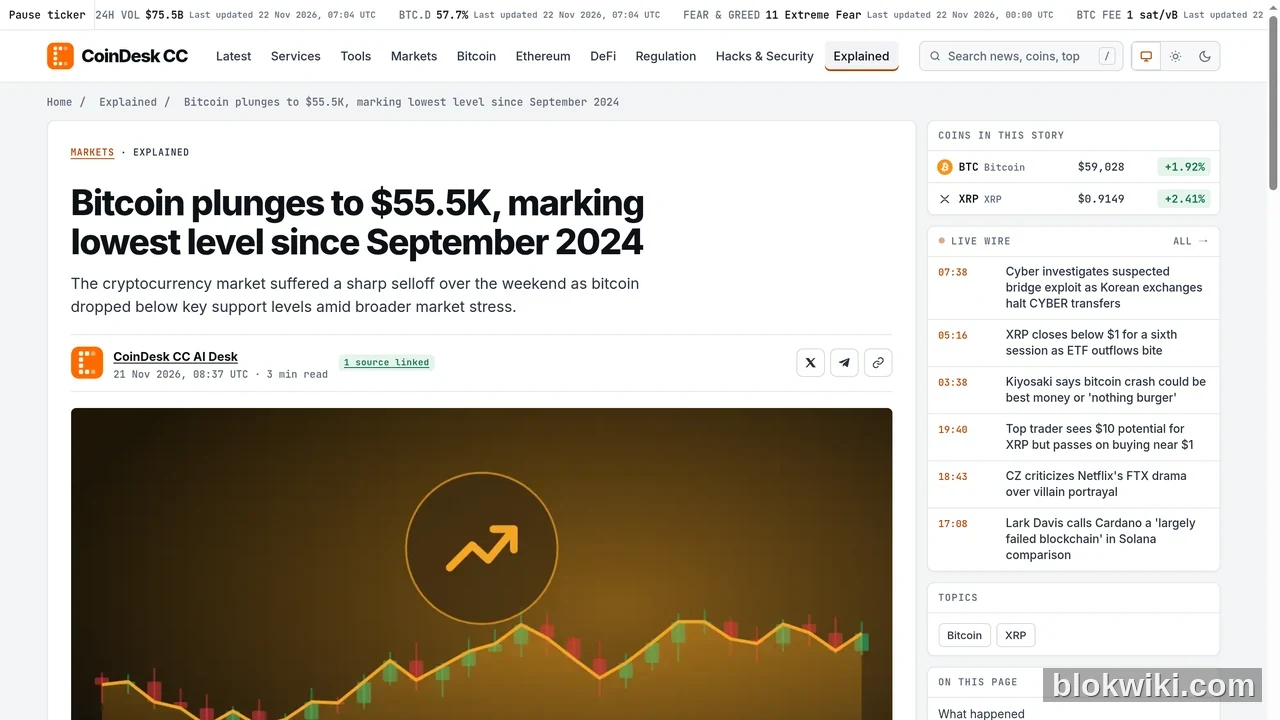
Source: CoinDesk CC, "Bitcoin plunges to $55.5K, marking lowest level since September 2024", 21 November 2026. The ticker at the top right shows BTC around $59,028 when the screenshot was taken.
1. First, be clear: leverage blew up, not spot
Put the numbers from 21 November in one place and you get a textbook leverage flush:
| Metric | 21 November 2026 |
|---|---|
| BTC low | $55,150 (lowest since September 2024) |
| 24-hour decline | About 9.2% |
| Market-wide liquidations | $2.4–2.7 billion, about 90% longs |
| Traders liquidated | About 343,141 |
| Largest single liquidation | Binance BTC/USDT, about $52 million |
| US equities | S&P 500 −3.00%, Nasdaq 100 −4.63% |
| Spot bitcoin ETFs | Three straight sessions of outflows, including $582 million in one day |
Two conclusions follow. First, forced selling came mainly from leveraged longs; spot holders saw paper losses but were not liquidated. Second, this was not a crypto-only event: the S&P 500 fell 3%, the Nasdaq 100 fell 4.63%, and spot bitcoin ETFs saw three consecutive days of outflows as risk assets were sold together.
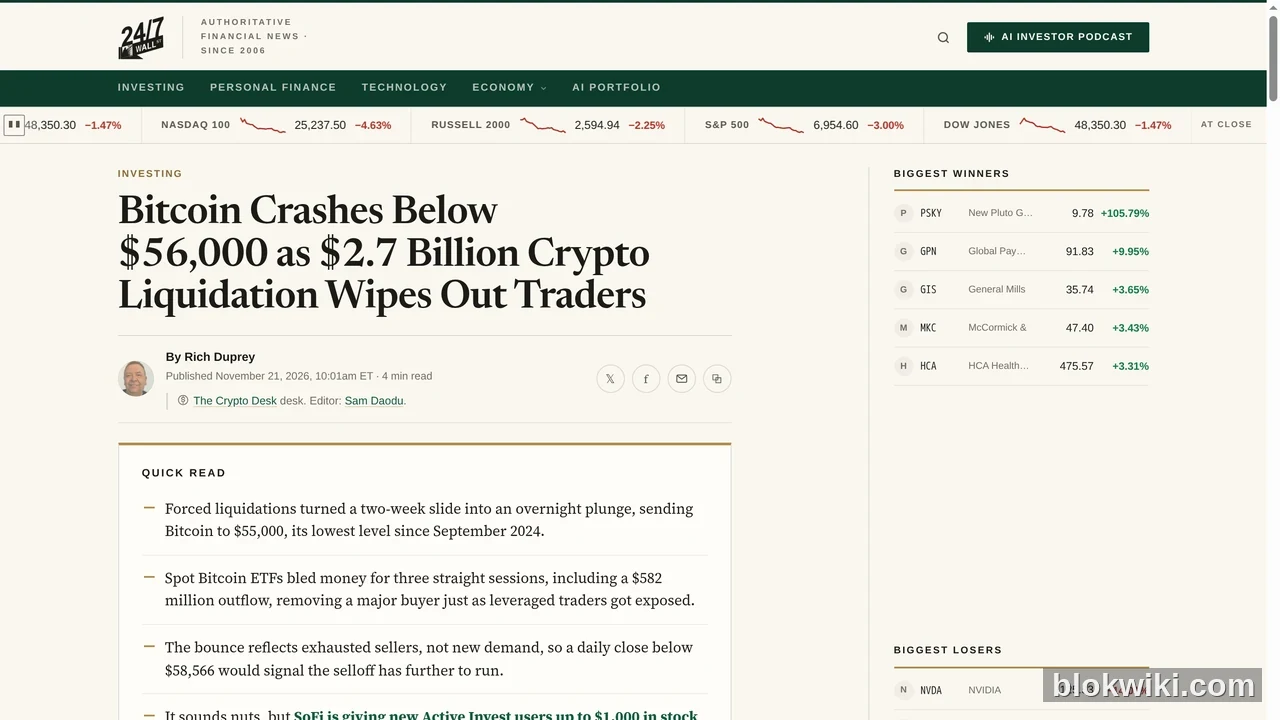
Source: 24/7 Wall St, "Bitcoin Crashes Below $56,000 as $2.7 Billion Crypto Liquidation Wipes Out Traders", 21 November 2026. The page also shows the S&P 500 down 3.00% and the Nasdaq 100 down 4.63%.
So the right approach to a first position was never "guess the bottom". It is: make sure you cannot be liquidated, make sure the funding channel works, and do not empty your magazine at peak emotion.
2. Step 1: open the account today, not during the crash
Many people lose money not because they pick the wrong direction, but because they register only after the move starts. KYC gets stuck, the email code never arrives, the card is declined, the P2P merchant cancels — and by the time the account works, the move is over.
Today's job is not to place an order. It is to get the account ready:
- Pick a primary exchange. The mainstream options are Binance, OKX, Gate.io and HTX; all four support USDT deposits and spot trading. Start from these on-site guides (registration links inside): Binance, OKX, Gate.io, HTX.
- Complete KYC with your own identity. Do not buy accounts or borrow a friend's; a name mismatch will block withdrawals later.
- Immediately enable three security controls: authenticator-based 2FA (not SMS alone), a withdrawal address whitelist, and removal of API permissions you do not need.
- Run one small deposit through your funding channel. Card, P2P and third-party payments vary by region; start with the minimum and confirm the funds arrive.
This feels slow but is actually the fastest path. The market will not disappear because you waited 30 minutes, but a blocked account will leave you watching during the best time to practise.
3. Step 2: fund through one channel, starting small
On a crash day, funding channels are more fragile than usual: bank risk controls tighten, P2P merchants raise prices, and on-chain congestion slows arrivals. You do not need "more channels". You need one channel that works.
Three numbers to check on P2P: price, limits and merchant completion rate. The cheapest quote is not automatically the best — offers far below market often carry higher risk. Make sure the limit covers your planned amount, and skip merchants with a completion rate below 95%. Keep all communication inside the platform chat; do not move to WeChat or Telegram, and never transfer money privately.
For cards and third-party payments, check: regional availability, per-transaction and daily limits, and settlement time. Do not fund with the exact amount you plan to invest on the first attempt. Send a small test amount and confirm you can both deposit and withdraw.
Do not: buy "cheap USDT" from group chats, send crypto first and wait for a bank transfer, or use payment QR codes from strangers. These scams become more common during sharp selloffs.
Once funded, move the USDT to your spot account. Use only one third of your planned capital for the first purchase; keep the rest in the account for the next decision.
4. Step 3: spot only, limit orders only, split into three
Suppose you plan to buy your first bitcoin with $600. Here is an execution plan you can copy (the numbers are examples; scale them to your own capital):
| Tranche | Amount | Order type | Trigger |
|---|---|---|---|
| First | $200 | Limit order 0.5%–1% below the current price | Place it now; do not chase the market |
| Second | $200 | Limit order | Price falls another 3%–5%, or 24 hours pass within the range |
| Third | $200 | Limit order | Price stabilises above $60,000, or falls another 8% |
Three rules:
- Spot only. Perpetuals have a liquidation price; spot does not. Touching derivatives on your first purchase converts "tuition" into "risk of zero".
- Limit orders only. Post-crash rebounds often come with wide spreads; a market order fills at the price you least want. A limit order can fail to fill, but it cannot overpay.
- Split into three, don't fire everything at once. This is not about catching the exact low. It keeps ammunition if you are wrong and gives you time to adapt to volatility.
If you only want to experience the workflow, $20–50 of BTC is enough. Fees are negligible at that size; what matters is completing the full loop from deposit to order to withdrawal.
5. Ten minutes after buying: finish these three tasks
1. Test a small withdrawal. Send a small amount from the exchange to your own wallet and confirm the address, network and arrival time. This surfaces restrictions, wrong addresses and wrong networks before they matter. See our guide to withdrawing from an exchange to your own wallet.
2. Record your cost. Write down the purchase price, quantity and fees. You will need them for P&L, taxes and deciding whether to add. Watching only the floating number in the app makes it easy to fool yourself.
3. Set a price alert and leave the screen. The most common crash-day mistake is not "buying wrong"; it is buying again, and again. Set the alert, lock the rest of your capital to the original plan, and do not change pace because of one green candle.
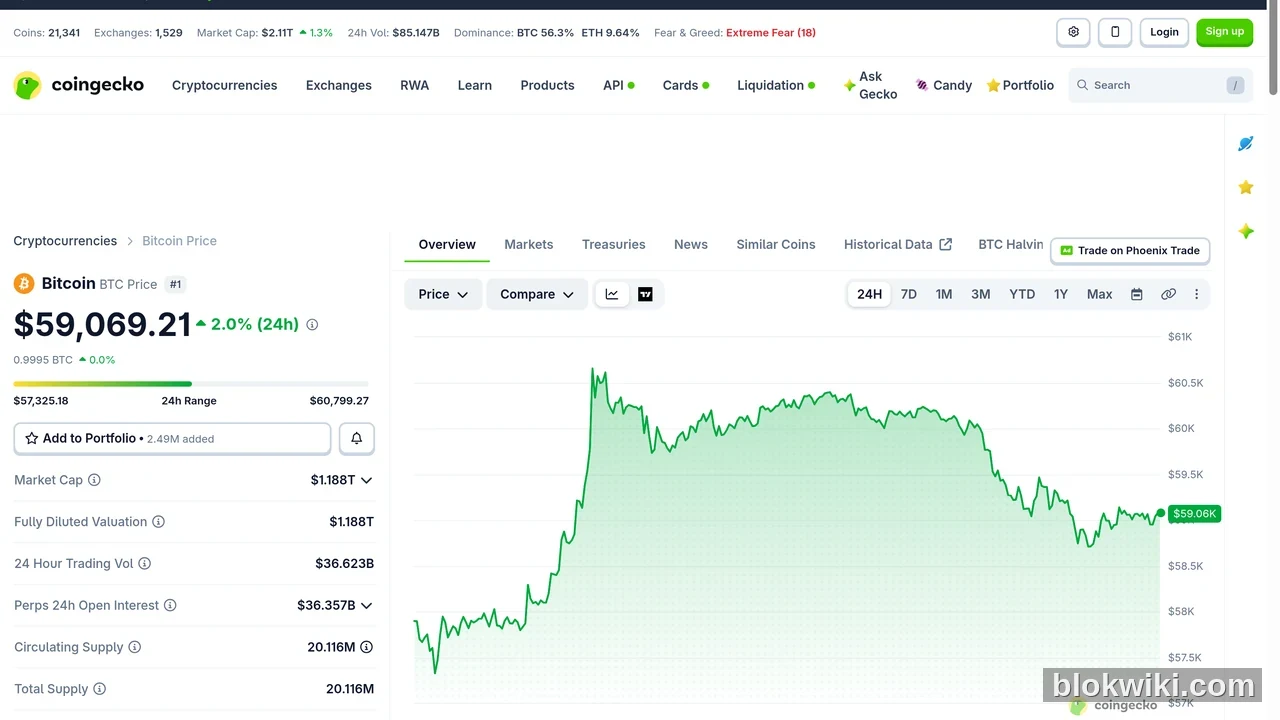
Source: CoinGecko bitcoin price page, 22 November 2026. BTC is around $59,069, up 2.0% in 24 hours, with the fear and greed index at "Extreme Fear".
6. Three "don'ts"
Don't use leverage. At 5x, a 20% adverse move gets close to wiping out your margin; this week's $2.4–2.7 billion liquidation is the evidence. The goal of a first position is to survive and learn the workflow, not to get rich in one trade.
Don't go all in. "It has fallen so much, it must be the bottom" is not a reason to buy. You are not obliged to spend all your capital today; keeping half in cash is rarely a catastrophic mistake.
Don't follow signal sellers. "Teachers", "inner circles" and "guaranteed strategies" are most active during a crash. By the time you are invited to take the other side, they have usually already positioned. You only need to answer to your own account.
7. FAQ
Q1: Can I buy right now? There is no universal answer. What is certain: spot, three tranches, no leverage and limit orders keep the cost of bad timing within a range you can absorb. This article does not forecast price.
Q2: Will it fall to $50,000? Nobody knows. Some see $50,000; others think $55,000 was an interim low. Both are opinions. Your position should be built on "can I hold if it falls another 20%?"
Q3: What is the minimum to start? Most exchanges accept spot orders of about $5–10 equivalent. To complete the full deposit-buy-withdraw loop, prepare $50–100. The amount does not affect whether the workflow is complete.
Q4: BTC or ETH? For a first purchase, prefer BTC because of its liquidity and depth. ETH is more volatile; consider it after you have completed the process once. Do not turn your first position into a basket of altcoins.
8. What is still unconfirmed
- 24-hour liquidation estimates range from $2.4 billion to $2.7 billion because CoinGlass and Kobeissi measure at different times; this article gives the range.
- Spot ETF flow figures come from public reports and may be revised.
- Whether BTC breaks its $55,150 low cannot be predicted; this article makes no directional call.
- Minimum order sizes, P2P limits and review rules vary by region and exchange; check the live page.
Data as of: 22 November 2026, 13:00 Beijing time. BTC was about $59,069, up 2.0% in 24 hours; ETH about $1,665.
Main sources: CoinDesk CC (21 Nov 2026), 24/7 Wall St (21 Nov 2026), CoinGecko (22 Nov 2026).
Risk notice and affiliate disclosure: This article is a summary of public information and a workflow guide, not investment advice. Crypto assets are highly volatile and you may lose your entire principal. Prices, liquidation figures and fees change over time; always check official pages. This article contains affiliate links, and we may earn a commission if you register through them. This does not increase your costs or affect our judgment. Do not buy with leverage or borrowed money, and never share your seed phrase, private key, verification codes or passwords with anyone.