How to Buy Bitcoin in Canada (2026): CSA-Authorised Platforms, Interac e-Transfer and CRA Tax
In Canada the first question is not which exchange has the lowest fee — it is whether the platform appears on the CSA list of firms authorised to do b…
The short answer: check the register before you compare fees
Buying bitcoin in Canada does not require an offshore account or a "special channel". For most people the correct sequence is three steps: pick a platform from the CSA list of firms authorised to do business with Canadians, fund it with Interac e-Transfer, then complete KYC and place an order. The first step is where the work is, because Canada regulates crypto platforms through a register rather than a simple "licensed or not" test.
Newcomers often start with fee comparisons and end up on an offshore venue that is not on the list: funding is limited to cards or P2P, there is no local recourse if something goes wrong, and the bank's fraud team may block the payment anyway. This guide works through regulation, funding, fees and tax in that order, then lists the five mistakes new immigrants and students make most often.
Regulation: the CSA register and FINTRAC registration are two separate gates
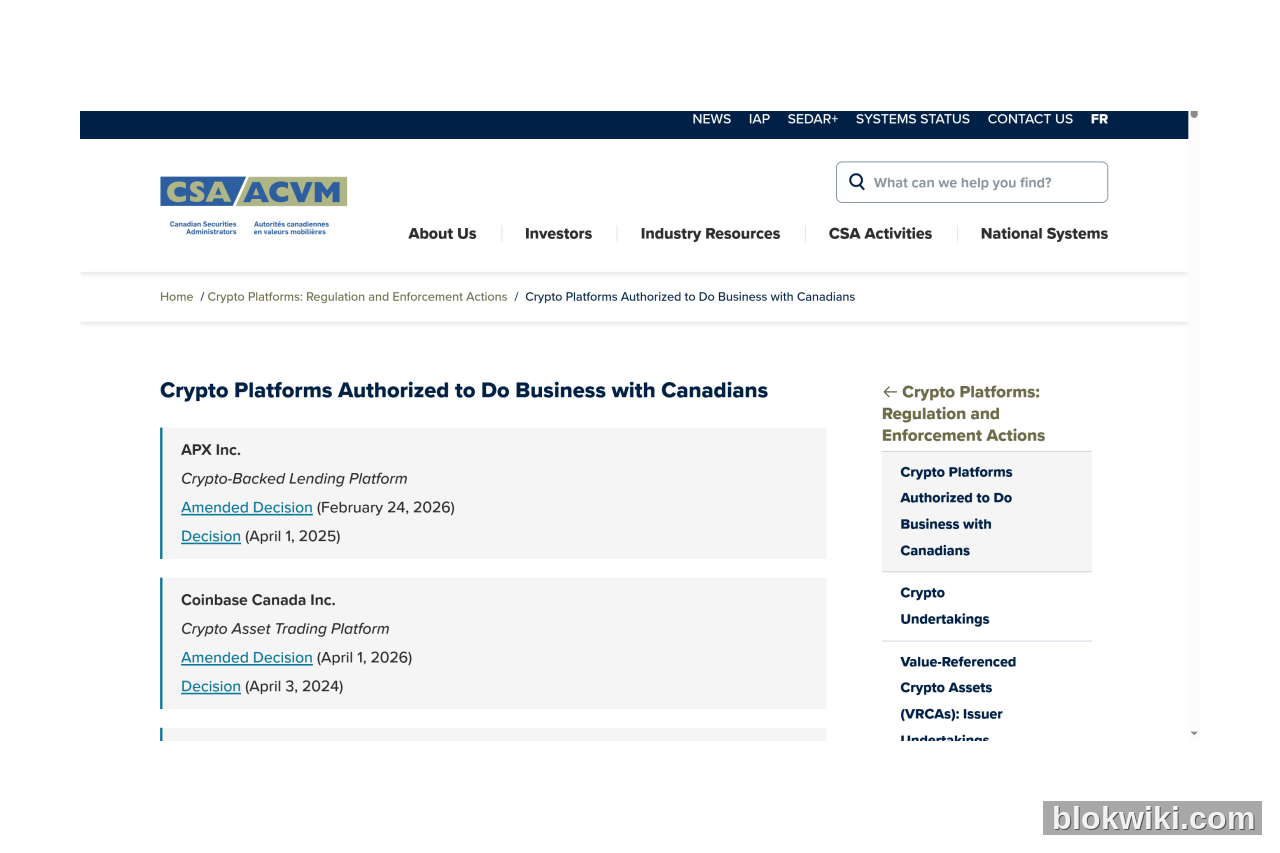
Canadian crypto oversight runs on two tracks. The first is securities regulation: the CSA maintains the "Crypto Platforms Authorized to Do Business with Canadians" list, and only platforms with the relevant decision are permitted to offer crypto asset trading to Canadians. The second is anti-money-laundering supervision: registration with FINTRAC as a money services business (MSB), which carries KYC, record-keeping and large-transaction reporting duties.
Keep the two apart. The CSA list answers "may this firm legally serve Canadians?" FINTRAC registration answers "does it run an AML programme?" A platform can be FINTRAC-registered yet absent from the CSA list, or appear on both. For a user, a platform on both lists is the safer default; only then compare fees and coin coverage.
- On the CSA list: subject to provincial securities regulators, with a defined complaints and recourse path;
- FINTRAC only: AML obligations apply, but that does not authorise securities-type trading activity;
- Neither: an offshore venue outside the direct reach of Canadian regulators — if it fails, you absorb the loss.
Verification takes a minute: open the CSA page, use your browser's find function to search the platform's English name, and check the decision and its latest amendment date. The list changes; a recent amendment usually means an active filing.
Choosing a platform: local dealers, bank-linked apps and global brands
Canadian options broadly fall into three groups. The table below reflects public information at the time of writing; verify current status on the CSA register and FINTRAC's registry before registering rather than relying on this table alone.
| Platform | Regulatory status (verify) | CAD funding | Best for |
|---|---|---|---|
| Coinbase Canada | On the CSA list (visible in screenshot) | Interac e-Transfer, debit card | Beginners who want a familiar global brand |
| Netcoins | On the CSA list (amended decision 16 Sep 2026) | Interac e-Transfer, EFT | Users who prefer a Canadian team and CAD pricing |
| Coinsquare | FINTRAC MSB; verify provincial status | Interac e-Transfer, EFT | Long-term local-account users who need CAD rails |
| NDAX | FINTRAC MSB; verify provincial status | Interac e-Transfer, wire | Low fees and order-book trading |
| Shakepay | FINTRAC MSB | Interac e-Transfer (autodeposit) | Small recurring buys of BTC or ETH only |
| Bitbuy | FINTRAC MSB; verify provincial status | Interac e-Transfer, EFT | Beginners who prefer flat fees |
If this is your first purchase, use a local platform with Interac autodeposit for a small test buy, confirm the whole chain works, and only then consider moving the main position to a cheaper venue. Do not send money to an unheard-of offshore site to save 0.1% in fees.
Account and funding: five steps
1. Check eligibility and documents
The age of majority is 18 or 19 depending on the province. You will need a valid passport, Canadian driver's licence or provincial ID; some platforms ask for proof of address (a utility bill or bank statement from the last three months) when you raise limits. Your name must match the document exactly, including middle names and spacing.
2. Register and enable two-factor authentication
Register with an email you control and turn on 2FA immediately — an authenticator app rather than SMS. If the platform offers an anti-phishing code, set it too. This matters more than any "security tip", because once your email is compromised, SMS codes are intercepted as well.
3. Complete KYC
Upload both sides of your ID and complete the liveness selfie. The usual failures are glare, cropped corners, or a screenshot instead of the original. If your legal name is written in a non-Latin script, enter the transliteration exactly as it appears on the document rather than reordering it yourself.
4. Fund with Interac e-Transfer
In the platform's deposit screen, choose Interac e-Transfer. You will get a receiving email and a reference code. Open your bank app (TD, RBC, BMO, Scotiabank, CIBC and others), add the recipient, enter the amount and put the reference code in the message field. With Autodeposit enabled, funds usually land within minutes; without it you set a security question and the transfer is accepted manually, typically within 15–30 minutes.
- First deposits or larger amounts may trigger a source-of-funds request — normal compliance, not a red flag;
- Never use a friend's account or a third-party payment; a name mismatch will trip risk controls;
- Bank e-Transfer limits vary by institution; split large transfers and notify the platform in advance.
5. Trade and withdraw
Start with a small market order to see the executed price and fee, then move to limit orders once you are comfortable. If you plan to hold long term, withdraw to a self-custody wallet and back up the seed phrase offline. Leaving coins on an exchange means handing the private keys to a third party.
Fees: "zero commission" is not the whole cost
Local platform costs usually come in three parts: trading fee + spread + network withdrawal fee. Interac deposits are generally free; wire transfers may carry a fixed charge. "Zero fee" offers often recover the cost in the spread, so your fill is slightly worse than the spot market.
Be careful with credit cards. Some issuers treat a crypto purchase as a cash advance, charging a fee immediately and interest from day one, with no grace period. That can cost far more than the fee shown on the exchange. Debit cards and Interac are usually cheaper.
Tax: the CRA treats crypto as a commodity
The Canada Revenue Agency's position is clear: crypto assets are treated as commodities, not currency. Selling, paying with crypto, and crypto-to-crypto swaps are all dispositions that require a capital gain or income calculation.
- Capital gains: 50% of the gain is added to taxable income and taxed at your marginal rate;
- Business income: frequent trading or trading as a business can mean 100% inclusion as income;
- Crypto-to-crypto: BTC to ETH is a disposition and must be recorded at its CAD value at the time;
- Records: keep the date, quantity, CAD value and fees for each trade — at least six years;
- Registered accounts: TFSAs and RRSPs cannot hold crypto directly; an exchange account is not a tax-free account.
Capital gains go on Schedule 3; business income goes on T2125. Forms and reporting rules can change, so confirm against the CRA's guidance for the relevant tax year.
The five most common mistakes
- Chasing yield and ignoring the register: high-interest "earn" products from unlisted platforms leave you with no local remedy when they collapse;
- Using a VPN to bypass regional limits: a mismatch between registration country and IP gets KYC rejected, and frozen accounts are hard to recover;
- Forgetting crypto-to-crypto tax: "I never converted back to CAD" is not a defence — every swap is a disposition;
- Treating an exchange as a bank: large long-term balances can be frozen along with the platform if it runs into trouble;
- Paying for "verification services": handing your ID to a third party gives away both your identity and your account, with no recourse if it is later stolen.
FAQ
Is buying bitcoin legal in Canada?
Yes. Individuals may buy and hold crypto assets, but platforms must follow securities and AML rules, and individuals must report tax. Details vary slightly by province.
Can I buy without a Canadian bank account?
You can, but your options shrink. Without a local bank account you cannot use Interac e-Transfer, leaving debit cards, wires or P2P — higher cost and more friction. Newcomers should open a local bank account first.
How long does Interac e-Transfer take?
With Autodeposit, usually minutes. If a security question is required, typically 15–30 minutes. First deposits, large amounts or risk checks can push it to manual review.
What is the minimum purchase?
It varies; many platforms allow purchases as small as CAD 10–20, but fixed fees make tiny trades inefficient. Do the fee maths before setting up recurring buys.
Can international students buy bitcoin?
Yes, provided they meet the age requirement, hold valid ID and report their tax residency accurately. Some platforms ask for extra address or study-permit details.
If you are still comparing exchanges, start with our Coinbase exchange profile, or read the funding logic in our Hong Kong bitcoin guide to see why a local payment rail matters more than the headline fee. After your first purchase, work through the wallet approvals and theft response guide and configure each control.
Risk notice. Crypto assets are highly volatile and you can lose your entire principal; nothing here is investment advice. Canadian provincial rules and CRA reporting positions can change — verify each platform on the CSA register and FINTRAC registry before registering, and rely on the CRA's guidance for the relevant tax year. This article contains no affiliate links; platforms are named as public examples only.