Crypto Exchange Guide for Japan 2026: FSA Register and Bitget Exit Timeline
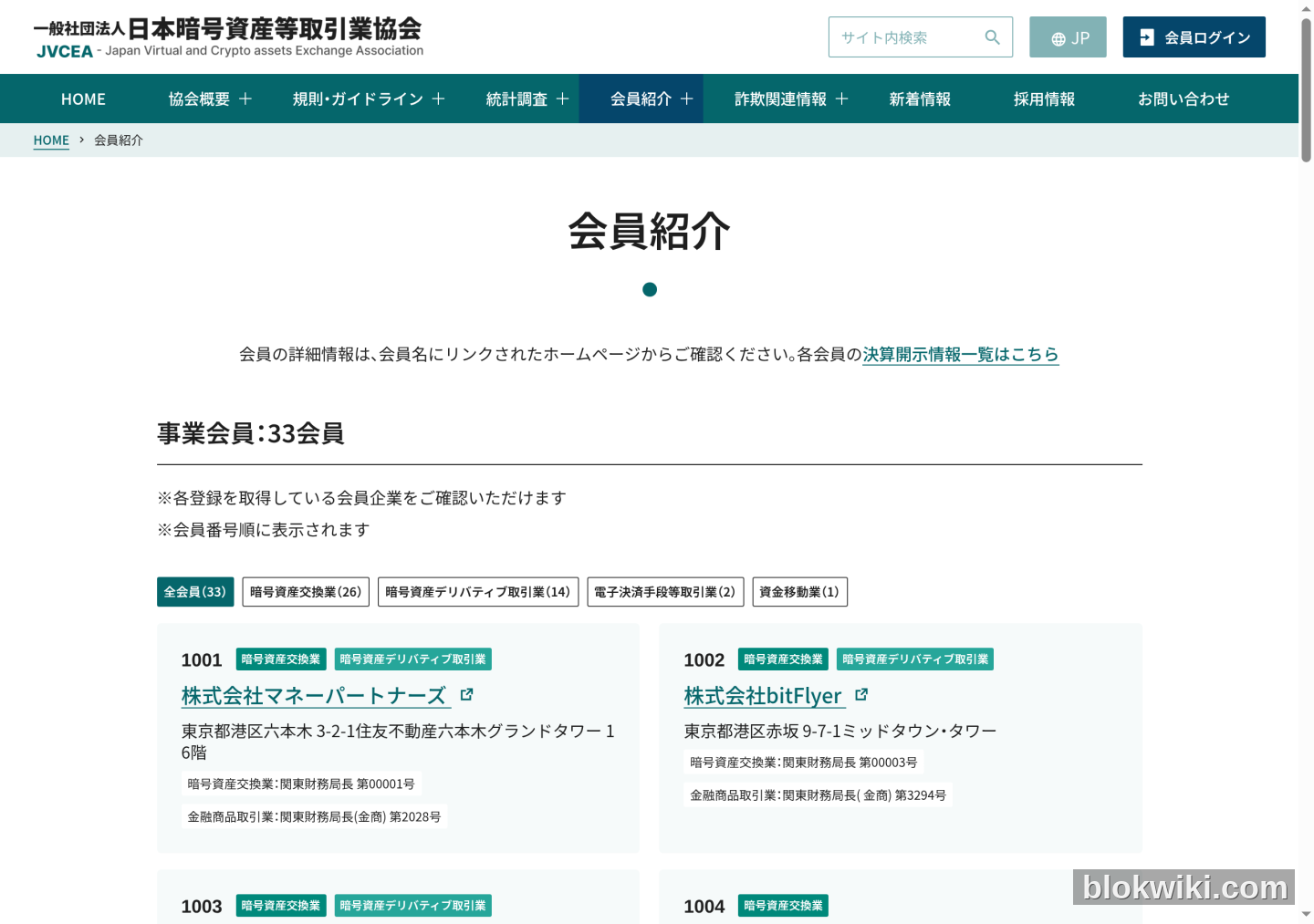
Japan runs a registration regime: without an FSA registration number a platform cannot legally offer crypto-asset exchange services. The FSA list curr…
If you live in Japan, the 2026 exchange question starts in only one place: does the platform hold a Financial Services Agency (FSA) registration number, and is it in the middle of exiting Japan? Japan does not run a permissive “licensed means allowed” market; it runs a registration regime where offering crypto-asset exchange services without registration is illegal. At the same time, offshore platforms have followed the same exit sequence over the past two years: Bybit has finished, and Bitget has about nine weeks left.
As a result, “can I even use it?” is usually settled before anyone gets to compare fees.
| Check | Why it matters | Where to verify |
|---|---|---|
| Registration number | Providing crypto-asset exchange services without registration is illegal in Japan; a platform can be warned and forced to exit at any time | FSA registered-provider list / JVCEA member directory |
| Japan exit status | Bybit completed its exit on 22 July 2026; Bitget restricts accounts from 1 November and force-closes from 31 December | The platform’s official “Japan residents” notice |
| Your residency classification | Determined by the address in KYC, not by IP; a VPN cannot change it | The verification level and address on your account |
Japan is a registration regime: 27 providers on the list
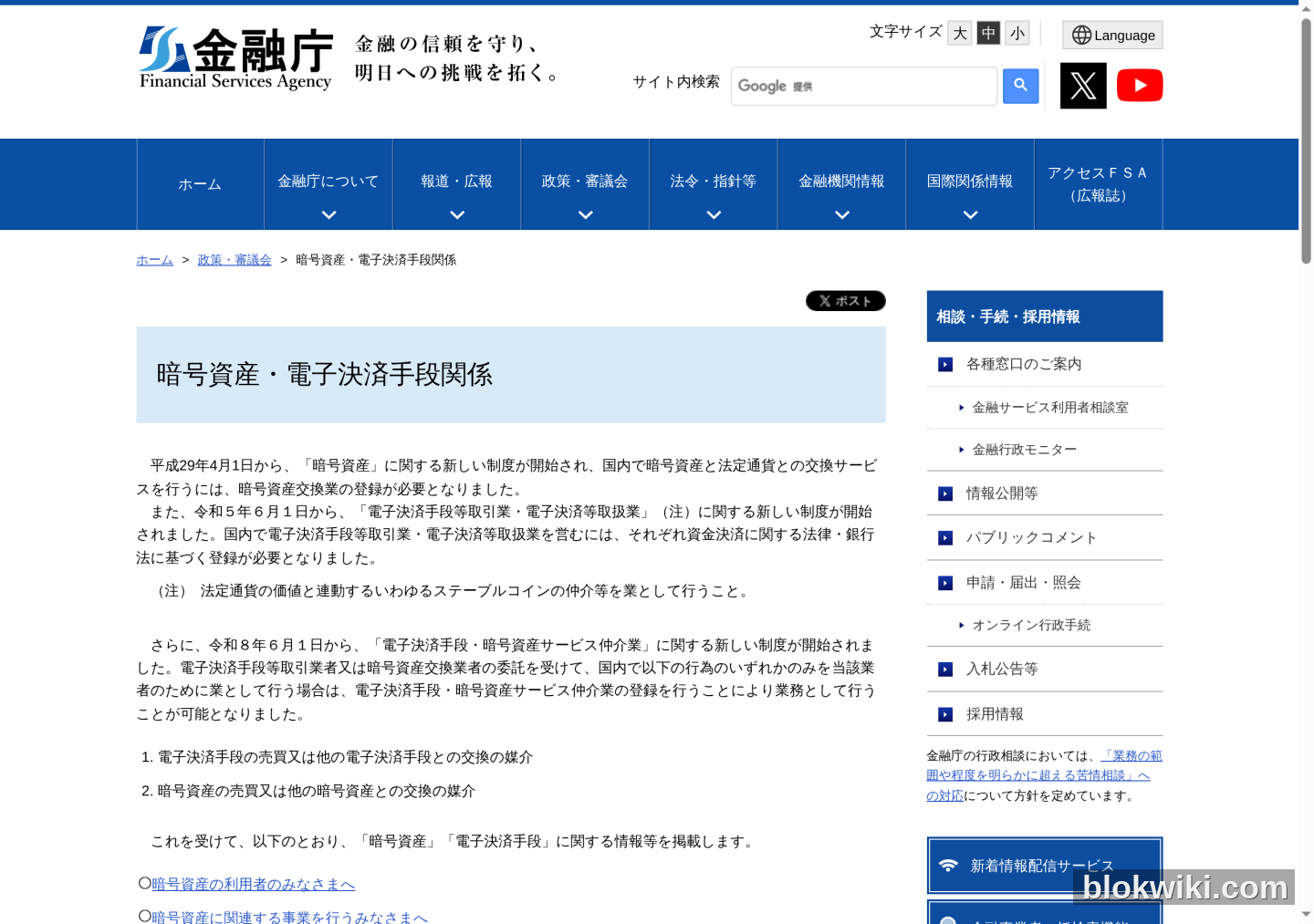
Japan introduced crypto-asset exchange registration on 1 April 2017. Anyone exchanging crypto assets for legal tender in Japan must first register with the FSA and the local finance bureau. On 1 June 2023 the “electronic settlement instruments transaction business” category was added; on 1 June 2026 a new “electronic settlement instruments and crypto-asset service intermediary business” category took effect, requiring intermediaries to register separately.
The FSA’s published list of registered providers (27 entries in the English version) includes the core platforms that also appear in the Japan Virtual and Crypto Assets Exchange Association (JVCEA) directory: bitFlyer, bitbank, GMO Coin, SBI VC Trade, Coincheck, Rakuten Wallet, Money Partners, BitTrade, BtcBox, Tokyo Hash, Mercoin, Binance Japan, OKCoin Japan, Coinbase (Japan entity), OSL Japan and Digital Asset Markets, among others.
A common misunderstanding: the register is not a recommendation list; it is the precondition for legal operation. Registered platforms differ widely on fees, coin coverage and app quality. Outside the register, the issue is not user experience but the risk that the platform is ordered to leave Japan on a deadline and your account is pushed into close-only mode.
Also note that one brand can be two different legal entities in two markets. Binance Global stopped serving Japanese residents after Binance Japan launched; Binance Japan is a Japanese entity registered on 14 October 2022 (Kanto Finance Bureau No. 00031) and lists fewer assets than the global platform. OKX is similar: Japanese users deal with the registered entity OKCoin Japan.
Offshore platforms are leaving in the same sequence
Start with Bybit, which has already completed the process. On 28 November 2024 the FSA issued a warning to Bybit Fintech Limited for operating crypto-asset exchange services without registration; the notice explicitly described it as serving Japanese residents as counterparties. Industry media then recorded the full timetable: new Japanese registrations stopped at the end of October 2025, exit was announced on 22 December 2025, a detailed schedule followed at the end of January 2026, Japanese accounts entered close-only mode at noon on 23 March 2026, and the exit was completed on 22 July 2026. Japanese accounts can no longer trade; only withdrawals remain.
Bitget followed almost the same sequence, roughly nine months later. The FSA issued warnings to Bitget Limited on 31 March 2023 and 14 June 2024. On 3 August 2026, Bitget published a Japanese-language notice announcing the termination of services for Japanese residents.
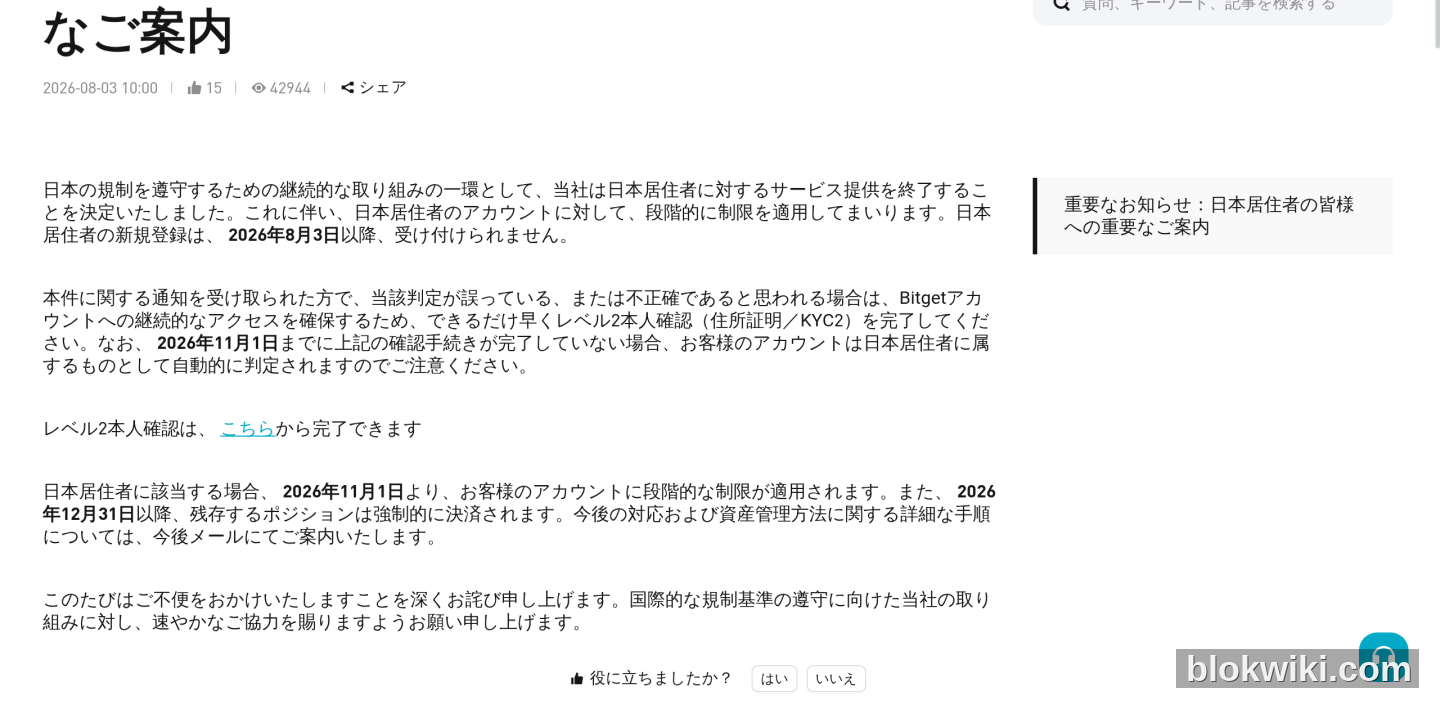
The timetable is specific and worth checking line by line:
- 3 August 2026: new registrations from Japan residents stop, effective immediately.
- From 17 September 2026: notices go out to accounts identified as potentially belonging to Japan residents.
- 1 November 2026, 11:00 JST: accounts classified as Japan residents enter close-only mode. No new positions and no additions; apart from limited deposits and withdrawals, spot, futures, P2P, Convert, Earn, card, copy trading and trading bots are unavailable. The same deadline applies to users who were misclassified and need to complete Level 2 verification (proof of address / KYC2).
- 31 December 2026, 11:00 JST: all remaining open positions across products are force-closed and the card service stops. Crypto withdrawals remain available afterwards.
Two points matter. First, residency is determined by the address registered in KYC, not by IP — a VPN does not make you a non-resident and may trigger risk controls. Second, if you genuinely no longer live in Japan but were misclassified, submit proof of address (bank statement, utility bill, tax certificate) before 1 November, or you will be treated as a Japan resident by default.
Five things Bitget users should do before 1 November
- Confirm your residency classification. Check whether you received a “Japan resident” notice and verify that the country and address in your KYC match your current situation.
- If misclassified, complete KYC2 immediately. Prepare a bank statement, utility bill or tax certificate and submit it before 11:00 JST on 1 November 2026.
- Inventory every position and product. Spot balances, futures positions, Earn products, copy trading, bots and card balances are handled differently.
- Close positions early and plan where the money goes. Do not wait for the 31 December force-close. If moving to an FSA-registered provider, confirm it supports your assets and networks first.
- Verify the address and network when withdrawing. A wrong chain or address means permanent loss. Log in only through the official app or website and never click links in emails or direct messages.
What Japan residents can actually use
| Platform | Status | Notes |
|---|---|---|
| bitFlyer | Kanto Finance Bureau No. 00003 | Long-established, broad asset coverage, used by institutions and retail |
| bitbank | Kanto Finance Bureau No. 00004 | Strong spot execution and depth, wide asset coverage |
| GMO Coin | Kanto Finance Bureau No. 00006 | Group-backed, offers recurring purchases and derivatives |
| SBI VC Trade | Kanto Finance Bureau No. 00011 | Securities-group platform with broad asset coverage |
| Coincheck | Kanto Finance Bureau No. 00014 | Large user base; compensation scheme and security overhaul after the NEM incident |
| Rakuten Wallet | Kanto Finance Bureau No. 00015 | Integrated with Rakuten’s loyalty ecosystem |
| Binance Japan | Kanto Finance Bureau No. 00031 (14 Oct 2022) | The local entity of Binance; among the widest asset lists in Japan but not the full global product set |
| OKCoin Japan | Kanto Finance Bureau No. 00020 | The OKX group’s Japanese entity |
| Coinbase (Japan entity) | Kanto Finance Bureau No. 00028 | Registered, though publicly listed asset coverage is limited |
If your goal is simply to convert yen into major coins and hold them long term, the registered providers above are sufficient; the differences come down to fees and asset coverage. More coins or lower fees mean choosing between compliance and product breadth — not using an unregistered platform that may exit at any time. When opening a Binance account, note that our Binance registration link points to the global platform; Japan residents cannot open an account through it and should use Binance Japan instead. Non-residents can register normally. For spot-fee comparisons, see the OKX registration link (the same Japan-resident restriction applies). For KYC rejections, see our exchange KYC troubleshooting guide; for access, DNS and routing problems, see Binance not opening: a three-step fix.
Tax: current rules and the 2026 reform
Crypto gains in Japan are generally classified as miscellaneous income and taxed together with salary and other income on a comprehensive basis, with a top rate of 55.945% (income tax plus inhabitant tax plus reconstruction surtax). Employees with more than ¥200,000 of miscellaneous income in a year must file a tax return.
The tax reform has already written “separate taxation at 20.315% for certain transactions” into law (the FY2026 tax reform outline, conditional on the related FIEA amendments). Coverage is limited to certain crypto-asset transactions, and the start date is tied to the enforcement of the amended law; public guidance points to January 2028, and the scope covers certain transactions at registered providers — offshore exchanges fall outside it. That means keeping assets on an unregistered platform carries not only exit risk but also loses the benefit of the reformed tax treatment.
FAQ
Can Japanese residents still use Binance Global?
Binance Global stopped serving Japan residents after Binance Japan launched and blocks new registrations from Japan. Japan residents should use Binance Japan, the registered entity (Kanto Finance Bureau No. 00031).
Can I keep using an exited platform through a VPN?
Residency is determined by the address in KYC, not by IP. A VPN does not change the classification and may trigger risk controls, making deposits and withdrawals harder.
Will Bitget confiscate my coins when it exits?
No. According to the official notice, crypto withdrawals remain available after 31 December 2026; trading, Earn and card services are what stop, and open positions are force-closed. The key is to close positions and withdraw proactively rather than waiting for the system.
Is there any way to keep using Bybit?
Industry media record that Bybit completed its exit on 22 July 2026 and Japanese accounts are withdrawal-only. Do not deposit into a Bybit account registered as a Japan resident.
What if I am misclassified as a Japan resident?
Complete Level 2 verification (proof of address / KYC2) before 11:00 JST on 1 November 2026. Submissions after that date are still possible, but the account will first be restricted as a Japan resident.
Risk notice and affiliate disclosure: Crypto assets are highly volatile and you may lose all of your capital. This article is information, not investment advice. Registration status, exit timetables and tax rules change; rely on the latest FSA, JVCEA and platform notices before acting. This article contains affiliate links; we may earn a commission if you register through them, at no extra cost to you, and it does not affect our conclusions. Japan residents should use FSA-registered providers.