Meme Coin Case Study: A 0% Win Rate, 12 Losses and Over $1 Million Gone
On 20 October 2026 on-chain monitor Lookonchain recorded a trader who made 12 trades in Solana meme coins, lost money on every one, and ended with a 0…
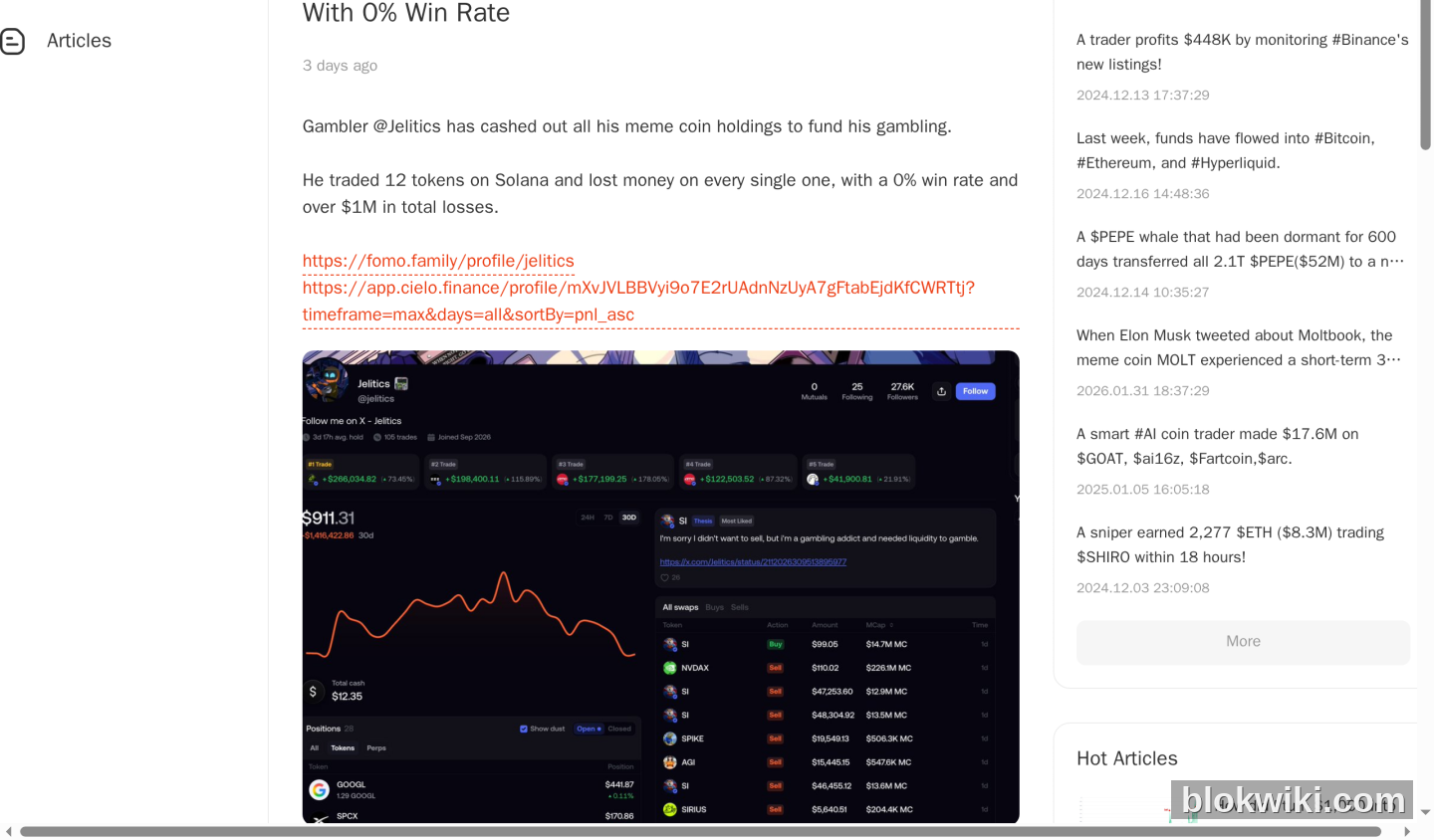
On-chain monitor Lookonchain published a textbook anti-case on 20 October 2026: a trader known as @Jelitics traded 12 tokens on Solana and lost money on every single one, for a 0% win rate and over $1 million in total losses. Afterwards he sold every remaining meme coin holding — to fund more gambling.
The story is worth writing not because it is painful, but because it lays out the three layers of cost that meme-coin speculation usually hides. Here it is split into facts, mechanics and discipline.
The facts: 12 trades, 12 losses, over $1 million gone
Lookonchain’s post states that the gambler “has cashed out all his meme coin holdings to fund his gambling”, and that he “traded 12 tokens on Solana and lost money on every single one, with a 0% win rate and over $1M in total losses”. It links to third-party on-chain dashboards (a fomo.family profile and a Cielo profile) so each trade can be verified individually.
One clarification: a 0% win rate does not mean twelve unlucky coin flips. If each trade were a genuine 50/50, twelve straight losses would happen about once in 4,096 attempts. That is possible, but the more likely explanation is that this was not twelve independent bets — it was the same mistake repeated twelve times.
Why all twelve lost: three cost layers stacking up
The cost structure of meme-coin trading is more complex than most people assume. A single round trip carries four separate costs:
- Swap and liquidity-pool fees. Every swap pays the protocol and the liquidity providers; a round trip pays twice.
- Slippage. Meme-coin pools are thin. Your buy pushes the price up and your sell pushes it down, so your average fill is worse than the quote you saw.
- MEV and front-running. Large buys on busy chains get sandwiched by bots, and your fill can be several percentage points off the on-chain quote.
- Timing. For social-hype tokens, the price peak usually arrives the moment the narrative floods social media — and most retail buyers see it after that.
Stack those four and a full round trip can lose 3–8% even if the price goes nowhere; buy at the peak of the hype and the drawdown itself often starts at -50%. That is exactly why “twelve different tokens” fails to diversify risk in meme coins: they all share the same entry-timing mistake.
The same Lookonchain page carries two parallel cases with the same mechanics and different instruments. Machi (@machibigbrother) sold two Mutant Apes bought three years earlier for 1 ETH each to fund more trading on Hyperliquid and papertrade — against original costs of 6.13 ETH and 7.5 ETH, a combined loss of 11.28 ETH (about -85%). A separate address went long the semiconductor index SOXL twice within four hours and was liquidated both times, losing roughly $586,000 in total; two minutes after the second liquidation it opened a fresh $2.22 million long.
The common thread is not bad luck — it is immediately increasing size after a loss to win the money back. That is the behaviour path behind most liquidation blow-ups and meme-coin wipeouts.
Five rules ordinary users can take away
- Write your per-trade loss limit down. Cap each trade at 1–2% of capital and refuse any “I’ll just top it up” exception.
- Do not chase tokens that already flooded your feed. By the time you see it repeatedly on social media, the earliest buyers are thinking about selling.
- Price total cost into expected return. Fees, slippage and MEV can consume 3–8%; high-frequency meme trading is a negative-sum game by construction.
- Enforce a 24-hour stop after a loss. The dangerous part of a losing streak is not the market but the urge to win it back at once — cashing out to keep gambling is exactly what that missing rule produces.
- Only risk money you can lose entirely. Meme coins have no cash flow and no fundamentals; going to zero is normal, not exceptional. For the two opposite paths this asset class can take, see the SQUID token that went to zero in five minutes and how Dogecoin grew from a joke into a multi-billion-dollar asset.
FAQ
Is the 0% win rate real or an exaggeration?
It is an on-chain statistic: 12 tokens, every trade at a loss, so the win rate calculates to 0%. The data can be verified trade by trade, but note that win rate is a backward-looking metric and says nothing about the next trade.
Doesn’t trading 12 tokens diversify risk?
Not in meme coins. Diversification requires different sources of risk; all twelve of these tokens were driven by the same thing — short-term social attention. Identical entry timing makes the outcomes highly correlated.
Aren’t fees on Solana very low?
Base network fees are low, but the real costs are swap fees, slippage and MEV. On large or hyped tokens the hidden cost is usually far higher than the network fee you see in your wallet.
Should I follow people posting profit screenshots?
No. Profit screenshots carry built-in survivorship bias: losers do not post, and cases like this one only become visible through on-chain data. Judge trading skill from the full on-chain record, not a social media screenshot.
If you are going to trade high-volatility assets anyway, get comfortable with account security and withdrawal flows first, then start small: you can open an account through our Binance registration link, and the usual identity-verification rejections are covered in our exchange KYC troubleshooting guide. Keep long-term positions in major coins in self-custody, and size any meme-coin position so that losing all of it changes nothing about your life.
Risk notice and affiliate disclosure: Meme coins have no practical utility and extreme volatility; they can go to zero within minutes. This article is not investment advice. Case data comes from Lookonchain’s on-chain record of 20 October 2026; amounts and win rates are statistical results and the addresses can be verified independently. This article contains affiliate links; we may earn a commission if you register through them, at no extra cost to you, and it does not affect our conclusions.