Is Gate Safe? 2026 Reserve Ratio, Licences and Incident History Reviewed
Gate reported a 118% total reserve ratio on 18 October 2026, with about $1.356 billion in excess reserves, and holds entity-level licences or registra…
Gate (Gate.io) is a long-established exchange founded in 2013, with more than 50 million registered users in 2026 and spot support for over 4,400 assets. Its safety cannot be reduced to “it is a big exchange”: reserves and licences are at the front of the industry, but a $230 million allegation from 2018 still has no official conclusion, and products in Japan and other regions are not the same as the global platform.
This review separates four verifiable dimensions — reserves, licences, incident history and account security — and ends with who the platform does and does not suit.
| Dimension | Finding |
|---|---|
| Reserves | 118% total reserve ratio on 18 Oct 2026, about $1.356 billion in excess; BTC, ETH and USDT all above 100% |
| Licences | Malta MiCA + payment institution, Dubai VARA, Bahamas SCB, Japan FSA No. 00018, Australia AUSTRAC, Cyprus CySEC and more |
| Incident history | Predecessor Bter lost about 7,170 BTC in 2015; a 2018 ~$230 million theft allegation remains unconfirmed; the 2019 ETC double-spend was disclosed |
| Who it suits | Users who need long-tail asset breadth and value PoR transparency; not those who need full local regulatory recourse or a full-featured Japan product |
Reserves: 118%, with $1.356 billion in excess
Gate’s proof-of-reserves page shows that as of 18 October 2026, 00:00 UTC, total reserves were about $8.688 billion, customer net balances about $7.333 billion, and excess reserves about $1.356 billion (+18.49%), for a total reserve ratio of 118%. The scheme uses a Merkle Tree plus zk-SNARKs, and the Merkle root is published.
| Asset | Reserve ratio | Note |
|---|---|---|
| BTC | 121.60% | 21,156 BTC in customer net balances vs 25,727 BTC in platform wallets |
| ETH | 123.78% | 362,785 ETH in customer net balances vs 449,042 ETH in platform wallets |
| USDT | 111.68% | Covers about 833 million USDT of customer balances |
| USD1 | 100.98% | A tight balance just above 100% |
| GUSD | 181.11% | Relatively high excess coverage |
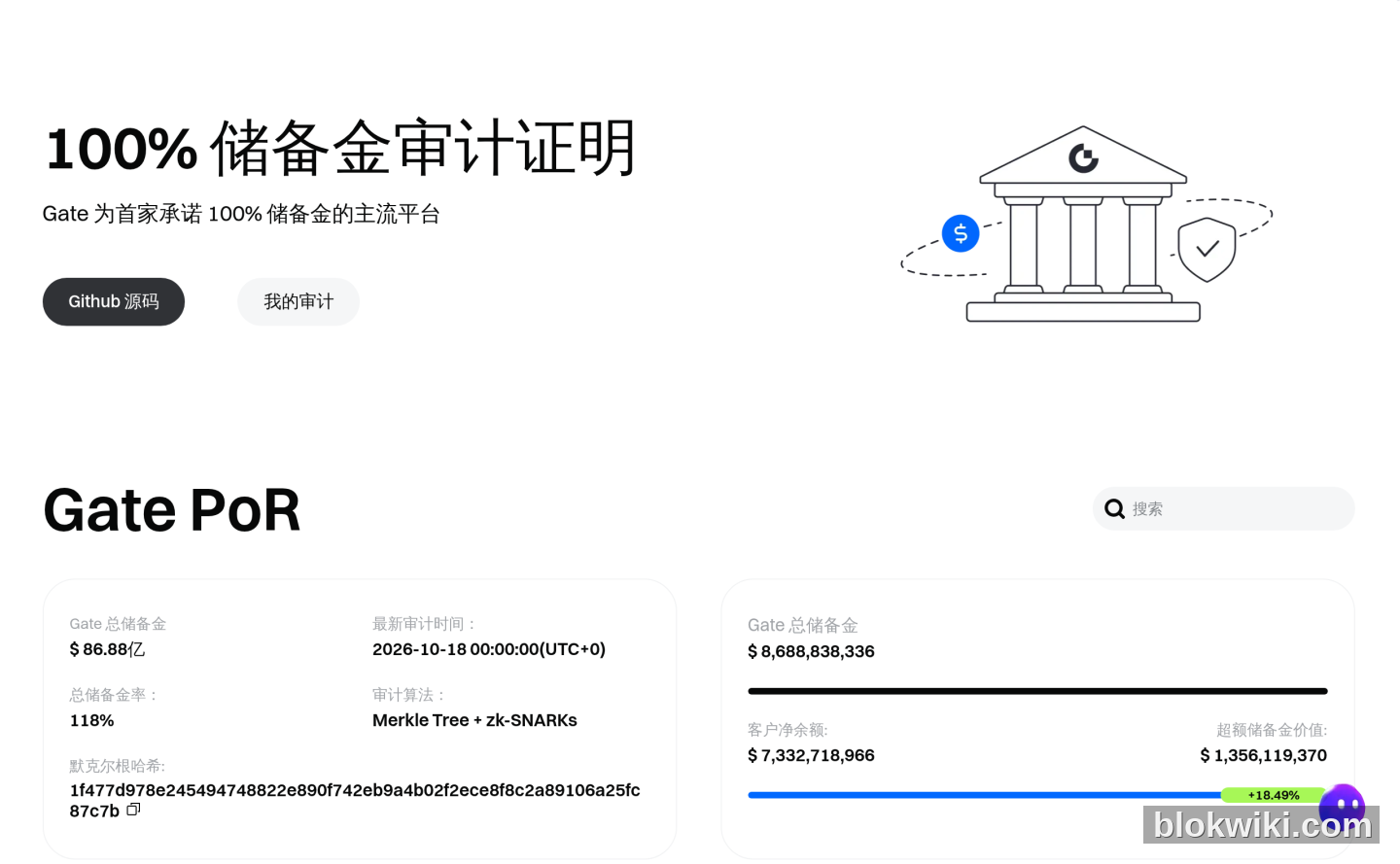
Distinguish proof of reserves from a full audit. PoR shows that published on-chain assets are at least the user liabilities the platform counts, which rules out the most direct form of shortfall. It does not prove that the liability figure is complete, and it is not a substitute for audits of governance, related-party transactions or use of funds. Gate says reserves cover nearly 500 user assets, but depth and pricing in long-tail coins still need separate scrutiny.
Licences: multiple jurisdictions, but each entity stands alone
According to Gate’s official “Licences, registrations and approvals” page, the group includes at least:
- Malta: Gate Technology Ltd is authorised by the MFSA as a MiCA crypto-asset service provider, covering fiat-to-crypto and crypto-to-crypto exchange, operating a trading platform, custody and transfer services. It also holds a payment-services authorisation under the Financial Institutions Act and passports into multiple EEA states.
- Dubai: Gate Technology FZE holds a VASP licence from the Dubai Virtual Assets Regulatory Authority for spot exchange services; Gate MENA DMCC is permitted to conduct proprietary trading in crypto commodities.
- Bahamas: Gate Global Limited is approved by the Securities Commission of the Bahamas for digital-asset exchange, trading and transfer services.
- Japan: Gate Japan K.K. holds a licence from the Financial Services Agency, registration No. 00018.
- Australia: Gate Information Pty Ltd is registered with AUSTRAC as a digital currency exchange provider.
- Cyprus: Gate Securities (Cyprus) Ltd is supervised by CySEC under CIF licence 395/20.
- Hong Kong: Hippo Financial Services Limited holds a TCSP licence (No. TC008572) for digital-asset custody.
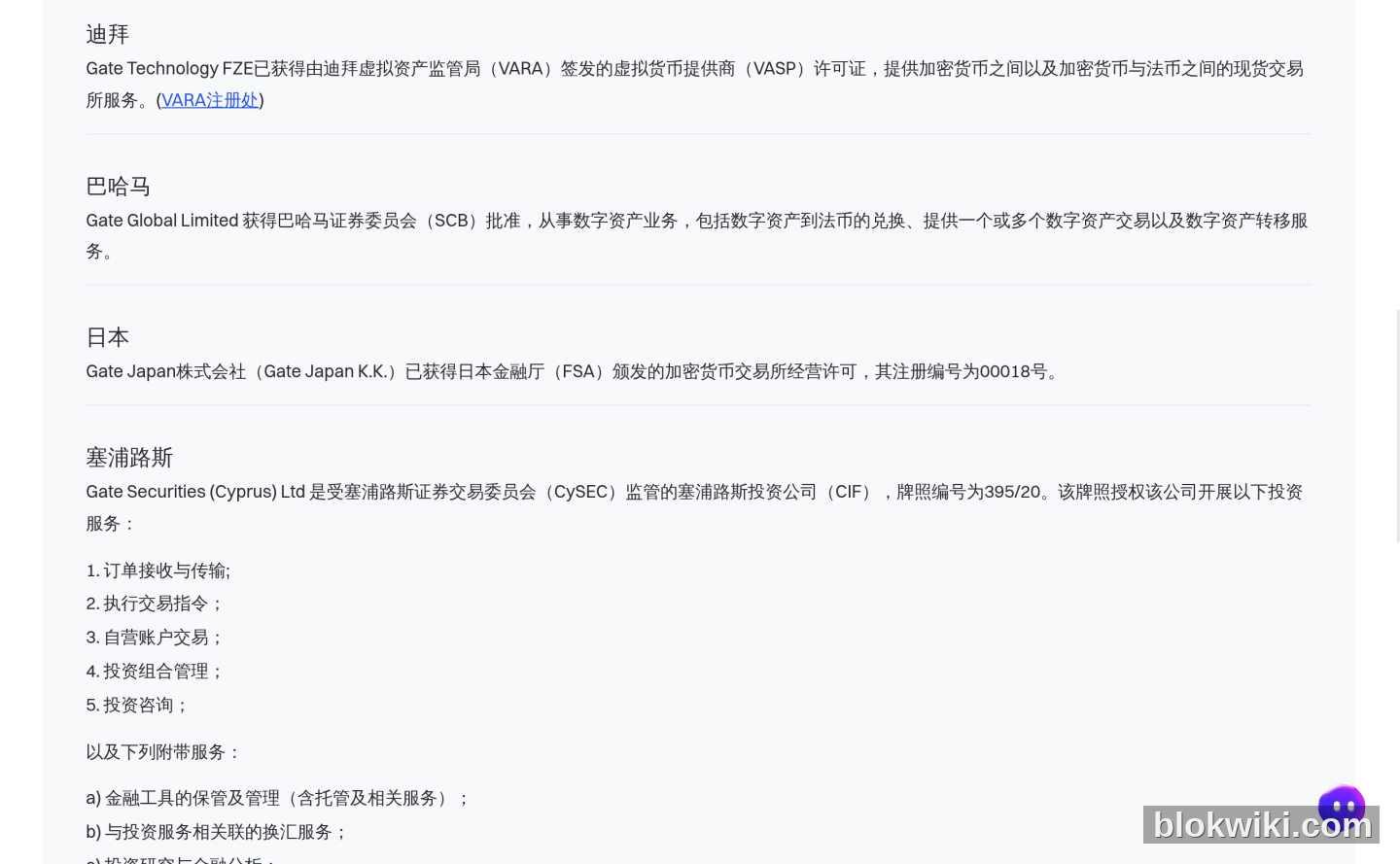
Two misunderstandings are common. First, licences are held by entities, not by the brand: Gate Global, Gate Japan and Gate US are different legal persons, and the regulator and recourse path depend on where you registered. Second, a Japanese licence does not mean the global product is available: the FSA register lists Gate Japan under No. 00018, but the only asset currently shown for it is RYO. Japanese users face a narrow local platform, not the 4,400+ assets of the global site.
Incident history: three records, not a clean sheet
Gate’s history is not “never had an incident”; it is “incidents happened, with uneven disclosure”. Three records matter:
- 2015, predecessor Bter: Gate grew out of Bter.com, founded in 2013. In 2015 Bter’s cold wallet was hacked for about 7,170 BTC, one of the larger exchange thefts of the time. This belongs to the brand’s predecessor rather than today’s Gate entity, but it explains why long-time users associate Gate with Bter’s risk history.
- 2018, the ~$230 million allegation: in November 2022, on-chain investigator ZachXBT publicly accused Gate.io of concealing an April 2018 theft of about $230 million. US prosecutors separately described North Korea stealing about $250 million from an unnamed exchange, which ZachXBT linked to Gate. Gate has never confirmed the allegation. It should be labelled an unconfirmed major allegation — not treated as established fact, nor dismissed simply because the company stayed silent.
- 2019, the ETC 51% double-spend: in January 2019 Ethereum Classic suffered a 51% attack, and the attacker double-spent through exchanges including Gate. Gate disclosed that about 40,000 ETC had been moved out, and the attacker later returned about $100,000 worth of ETC. Disclosure and handling in this case were relatively timely.
The right question is not “has it ever been hacked” but “after a hack, did it disclose, compensate and improve”. Gate’s record on the first two is not perfect, which is the gap between it and cases such as Binance and OKX that publicly reimbursed users.
Account security: what the platform does, and what you still must do
Gate’s official security page lists cold/hot wallet segregation, AI-enhanced WAF, DNSSEC/Anycast, DDoS defences, abnormal-withdrawal controls and a 24-hour withdrawal freeze after security-setting changes. These are platform-side defences; the last door is still the user’s:
- Enable 2FA. Prefer an authenticator app over SMS, and store the recovery key safely.
- Set a withdrawal whitelist. Allow withdrawals only to addresses you have verified, with a cooling-off period for new addresses.
- Restrict API keys. Never grant withdrawal permission to an API key; if you must, bind it to an IP whitelist.
- Run a PoR self-check. Use the official verification tool to confirm your balance is included in the reserve tree, rather than trusting the announcement alone.
- Separate accounts. Keep large balances in a separate sub-account or self-custody wallet, not mixed with the daily trading account.
Who Gate suits — and who it does not
It suits users who need long-tail asset breadth, value reserve transparency and can accept an offshore, multi-entity compliance structure; users who need Gate’s on-chain products and Gate Card.
It does not suit users who require the ability to complain to a local regulator and obtain local legal recourse; Japanese users who want full-featured spot trading and broad asset coverage, because Gate Japan currently lists only RYO; and users in restricted regions such as the US or Hong Kong, who should read the user agreement first and confirm whether they are eligible for service.
FAQ
Could Gate run away with user funds?
No one can guarantee “it will not”. The verifiable facts are a 118% total reserve ratio, $1.356 billion in excess reserves and licences held by entities in several jurisdictions as of 18 October 2026. These reduce the risk of an asset shortfall and of operating with no regulator at all, but they do not eliminate governance, hacking or regional-policy risk.
Is the 118% reserve ratio credible?
It relies on a public Merkle Tree + zk-SNARK verification scheme, and users can check whether their balance is included. It proves published assets ≥ counted liabilities, not a full financial audit; the completeness of the liability figure still depends on third-party audit and regulatory oversight.
Was there really a $230 million hack in 2018?
There is an on-chain investigator’s allegation and a US prosecution description of an unnamed exchange; Gate has not confirmed it. Treat it as an unconfirmed major allegation, not established fact.
Can Japanese users use the global Gate platform?
Japanese users are served by Gate Japan (FSA registration No. 00018), and the FSA register currently lists only RYO for that entity. Gate Global and Gate Japan are different entities with different product scopes; do not infer Japanese availability from the global marketing.
Is Gate safer than Binance or OKX?
All three are above the baseline on reserves and core security; the differences are mainly incident disclosure, licence depth and regional availability. For the full comparison, see our three-exchange security comparison; for Gate versus MEXC, see this comparison. Gate’s card product is covered in our Gate Card guide.
Risk notice: Crypto assets are highly volatile and you may lose all of your capital. This article is not investment advice. Reserve ratios, licence status and regional availability change; verify against Gate’s official PoR page, licence page and user agreement before acting. The incident-history section includes allegations that Gate has not confirmed and labels them as such; do not present them as established fact.