Chainalysis Breach: Password Hashes and Live Tokens Exposed
Chainalysis first described the breach as non-sensitive, then confirmed that names, usernames, password hashes and live tokens for all users had been …
Chainalysis Breach: Names, Password Hashes and Live Tokens Exposed — Is Your Exchange KYC Data Safe?
The short version: Chainalysis first said the breach exposed "non-sensitive" information such as names and email addresses. A week later it confirmed that the names, usernames, password hashes and live tokens of every Chainalysis user had been taken. That is not an ordinary credential-stuffing story. It is a breach of a compliance vendor that sits inside the crypto industry's risk stack.
If you have not opened an exchange account yet, this still matters to you. You may never have signed up for Chainalysis, but your transaction data may well have passed through it.
What Chainalysis does, and why you are exposed
Chainalysis is an on-chain analytics company. Its customers are mostly crypto exchanges, financial institutions, and law enforcement or regulators. Its core products:
Reactor (on-chain analysis): labels public blockchain addresses and behavior so clients can tell which exchange an address belongs to, or whether it is tied to stolen funds or sanctioned entities.
KYT (Know Your Transaction): real-time monitoring at the transaction level. Exchanges feed user deposit and withdrawal records into the system, which assigns each transaction a risk score.
Address Screening: checks whether a given wallet address is "clean."
Put those together and you get a chain most users never see: you sign up at an exchange, the exchange records your identity under KYC rules, the exchange uses a vendor like Chainalysis for risk controls and address screening, and your on-chain addresses and behavioral profile land in that system. You never registered with Chainalysis, yet your data may carry a label inside its database.
That is why this should be read as an incident in compliance infrastructure, not as one data company losing its own files.
Timeline: how the official account got worse
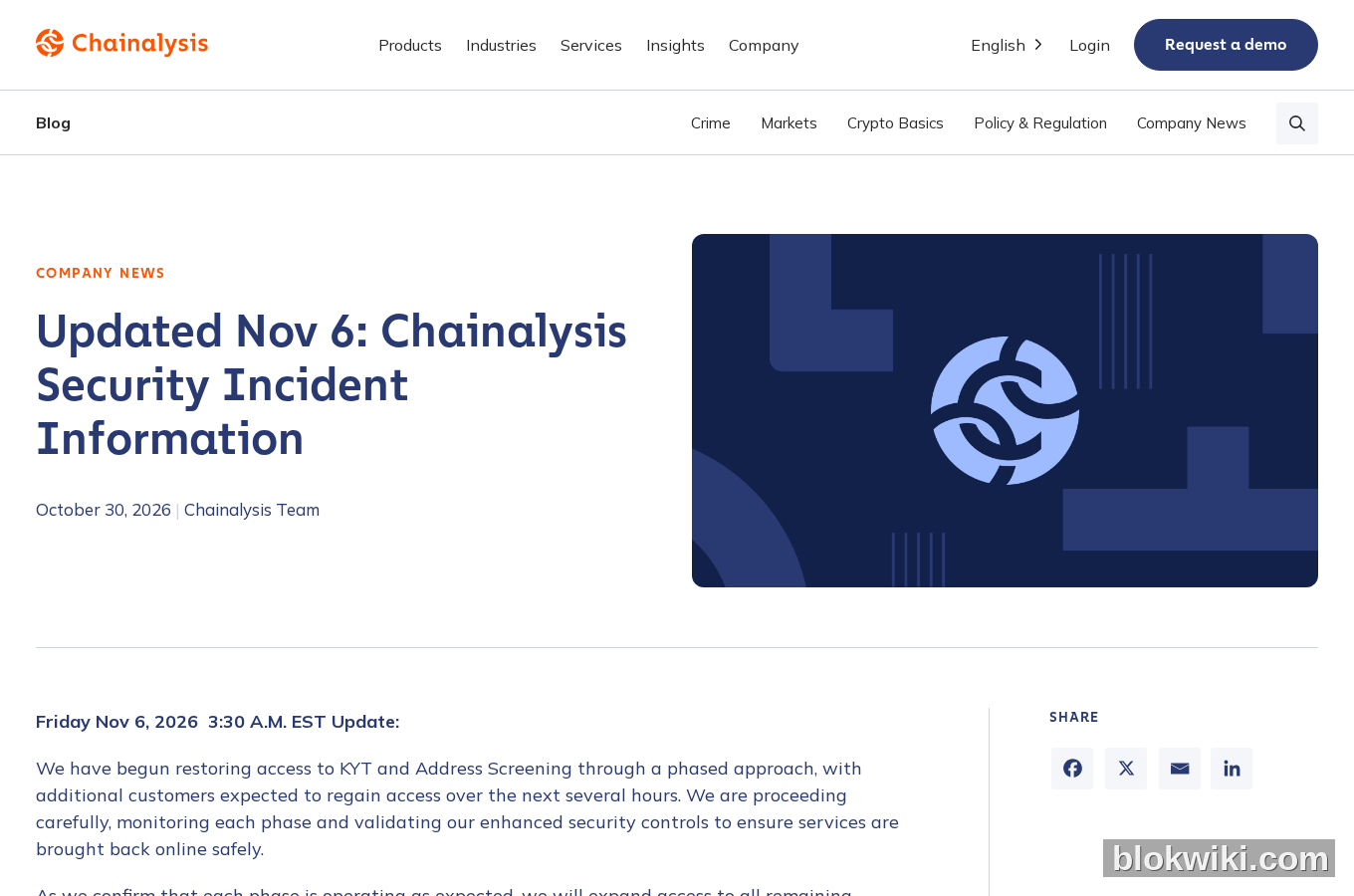
According to Chainalysis's official notice (blog/security-incident-october-30), the disclosure moved through three stages.
October 30 — first disclosure. The company said attackers obtained user IDs, full names, email addresses and organizational role labels, plus information about client organizations, and described the scope as "non-sensitive." Many customers read that as limited impact.
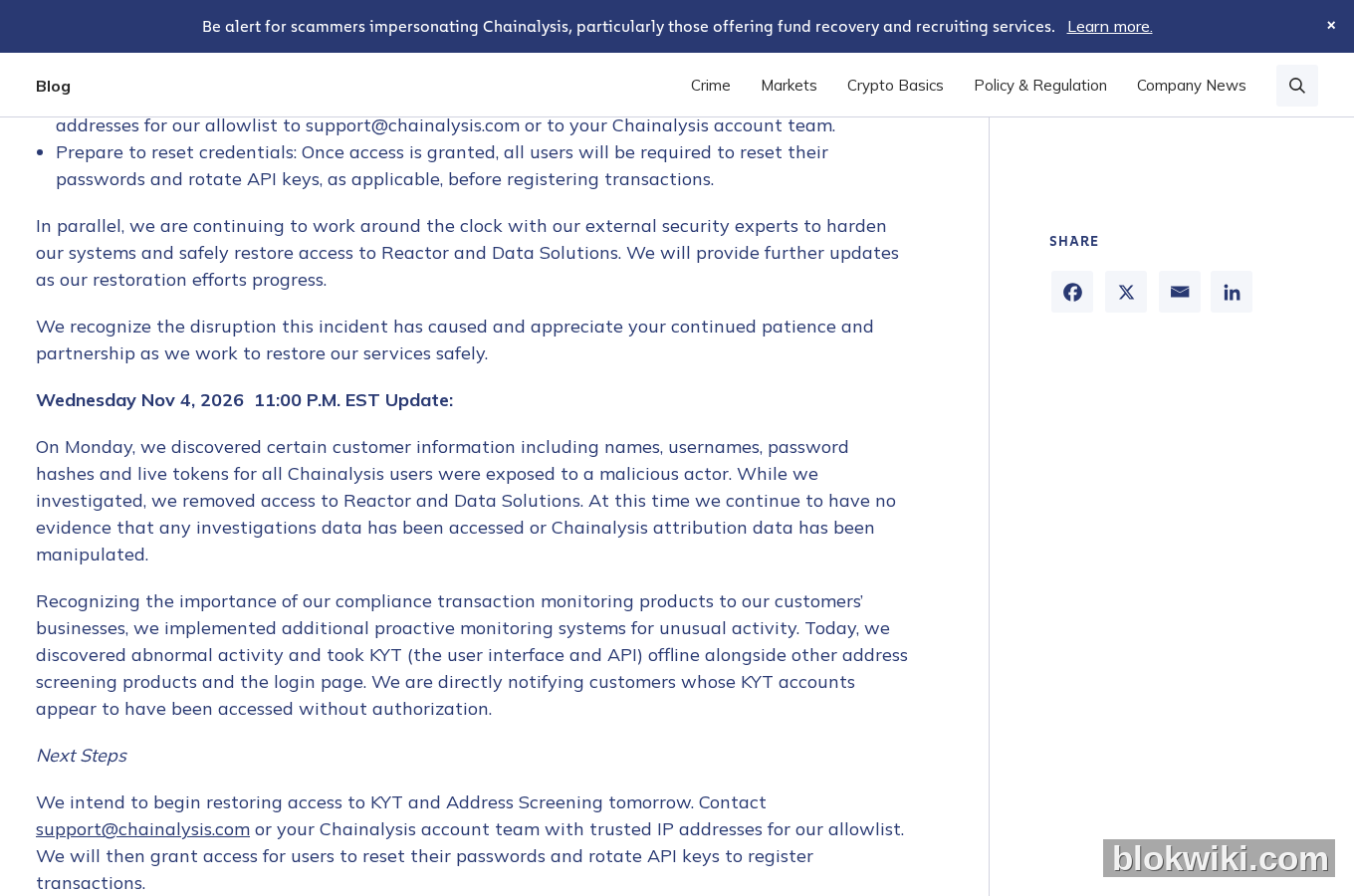
November 4 — the key update. Chainalysis confirmed that the names, usernames, password hashes and live tokens of all Chainalysis users had been obtained by malicious actors. Moving from "some fields, non-sensitive" to "every user, password hashes plus live tokens" changes the nature of the incident: password hashes can be attacked offline, and live tokens can be replayed until they expire.
November 6 — phased restoration. During the investigation, Chainalysis removed access to Reactor and Data Solutions, and service went offline for a period. From November 6, the company began restoring access to KYT and Address Screening in stages. It also instructed all users to reset passwords and rotate API keys, and asked customers to submit trusted IP addresses for allowlisting.
The notice also carries a warning at the top of the page: beware of scammers impersonating Chainalysis, especially anyone offering to "recover your funds" or conducting "recruitment."
Cointelegraph reported the incident on November 6, with ChainCatcher following the same day.
What was exposed, and what was not
Read this section carefully. There is no need to panic over the phrase "everything leaked," and no need to treat things that did not happen as if they did.
Confirmed by the company: names, usernames, email addresses, organizational role labels, password hashes and live tokens.
Not observed, per the company: access to investigation data, or tampering with attribution data. Note that "no evidence at this time" is not the same as "confirmed not to have happened." That is the boundary the notice itself sets.
Not mentioned as exposed: plaintext passwords, private keys, seed phrases, or your exchange account balance. Those are separate from the data discussed here and should not be conflated.
One more item deserves its own line: some customers' KYT accounts showed signs of unauthorized access, and Chainalysis says it is notifying affected customers directly. The blast radius may therefore be wider than "internal user accounts." The official notification is the authoritative scope.
What it means for ordinary users: three cases
Case 1: You are not a Chainalysis customer (the vast majority). Direct impact is limited. You have no account, password or API key in that system. The real risk is impersonation: scammers will use the breach as a hook for phishing emails, fake support staff and bogus "security notices" claiming your account is affected and you need to click a link to verify.
Case 2: You have an exchange account and your exchange uses a vendor like this. Your on-chain address labels and behavioral profile may be affected. In theory, an attacker could use that to infer a link between an address and an institution. But your exchange balance is not affected — that money sits in the exchange's custody system, not in Chainalysis's database.
Case 3: You are a Chainalysis customer. Change your password immediately and make sure the old one is not reused anywhere else, rotate every API key, review recent activity for unusual calls or logins, and submit trusted IPs for allowlisting as instructed.
For a broader framework on whether your coins are safe when an exchange has a bad day, see this breakdown of five security metrics to check before registering, and MPC key sharding versus exchange hot wallets. Last week's two exchange incidents in one week covered the Bithumb customer data leak and pairs well with this piece.
Five things to do now
1. Retire reused passwords. Once a password hash leaks, attackers will try it against your accounts elsewhere. Your email, exchange and cloud storage passwords should all be different. Generate them with a password manager rather than inventing them.
2. Turn on 2FA, and prefer a hardware key. SMS codes can be intercepted through SIM swaps. An authenticator app is better than SMS; a hardware key such as a YubiKey is better still. If your exchange supports hardware keys, use one.
3. Audit exchange API keys for permissions and IP allowlists. If you have authorized a trading bot or third-party tool, confirm it cannot withdraw funds and is bound to a fixed IP. Delete anything you no longer use.
4. Watch for "fund recovery" follow-up scams. This is the most reliable fraud pattern after any breach: someone claiming to be a security firm, official support or an on-chain sleuth asks for an upfront fee and disappears. No legitimate party will message you asking for a private key or seed phrase.
5. Move long-term holdings to a self-custody wallet. Keep only what you trade on the exchange. Test with a small amount first, and watch for address poisoning — the step-by-step guide is here.
So is exchange KYC data actually safe?
The conclusion first: KYC data cannot simply not exist. The risk concentrates in two places you do not control — vendors and internal access.
Exchanges are legally required to perform KYC under anti-money-laundering and counter-terrorism-financing rules, so your ID, face scan and proof of address will be stored. Switching exchanges does not change that. What actually determines your risk is two things.
First, where the data sits and who touches it. In-house systems, third-party KYC providers and on-chain analytics vendors carry very different exposure. Chainalysis is the textbook case of "your customer's customer" being breached.
Second, how many insiders can reach the data. Bithumb's incident involved a compromised internal office system; Chainalysis's involved a compromised platform account system. Both are failures of access control.
So when choosing an exchange, beyond fees and licenses, ask three concrete questions:
1. Is there a public security incident disclosure process? Does the company announce incidents itself, or wait for reporters? A security notice page and a track record of disclosure are positive signals.
2. Are withdrawal address allowlists supported? With an allowlist, a stolen account still cannot send coins to an unfamiliar address.
3. Is there an independent proof of reserves? Proof of reserves answers a different question — whether the exchange has been misusing your coins — but both come down to whether the company is willing to be audited from the outside.
Should this stop you from opening an account?
No. One vendor incident does not make every exchange unsafe. But it does confirm a rule: when you hand identity data to any platform, assume it may have an incident one day, and keep the damage within a range you can live with.
If you are about to open an account, these three are a reasonable starting point, with solid Chinese-language support, 2FA and withdrawal allowlists:
Binance: /exchange/1.html
OKX: /exchange/2.html
Gate.io: /exchange/12.html
The first thing to do after registering is not to deposit. It is to enable 2FA (hardware key preferred) and set a withdrawal address allowlist. Ten minutes of setup blocks the overwhelming majority of account-takeover scenarios.