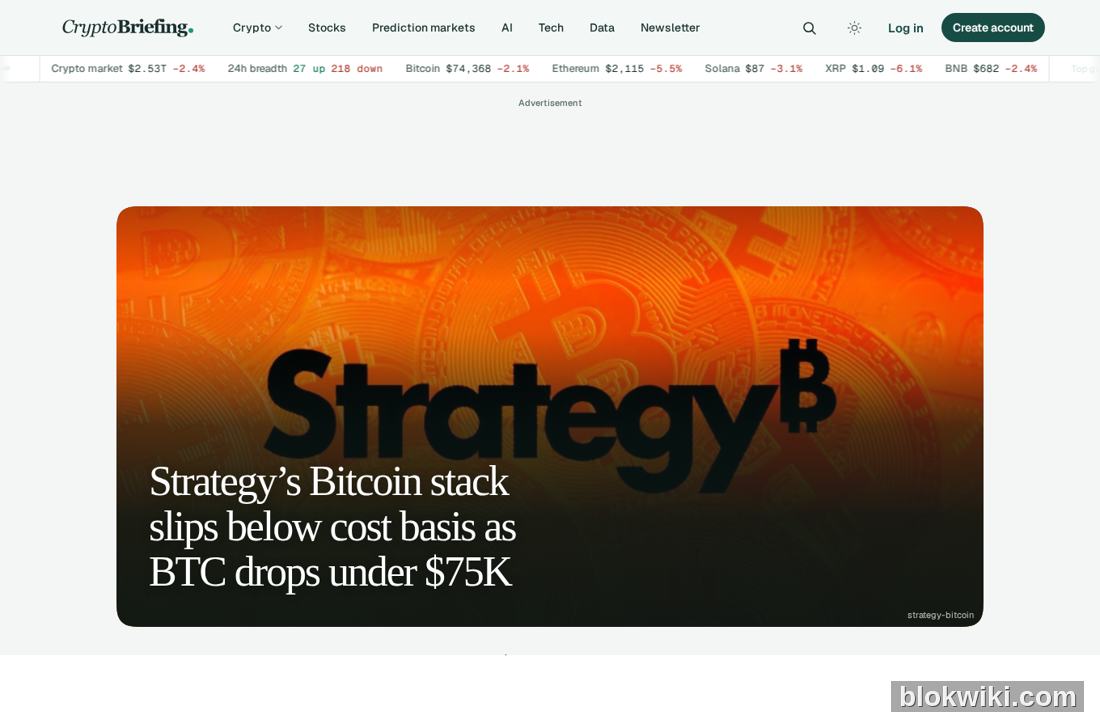
Strategy's 849K BTC Sinks Below Its Cost Basis
Strategy holds 849,327 BTC worth about $63.58 billion against a $64.08 billion cost basis, an unrealized loss of roughly $500 million and the first br…
Start with the numbers. One company holds 849,327 BTC. At current prices that stake is worth about $63.58 billion; acquiring it cost roughly $64.08 billion, leaving an unrealized loss of about $500 million. That company is Strategy, formerly MicroStrategy. Since it began building the position in August 2020, this is the first time the holding has fallen below its aggregate cost basis.
Bitcoin trades near $74,762 (CoinMarketCap, down 0.91% over 24 hours). Before the weekly close on November 9, BTC briefly wicked down to $73,510 and liquidated $715 million of long positions within an hour; the ETH/BTC ratio dropped 4.22% in the same move. Strategy's stock closed at $125.59 on November 9, down 2.59%, with earnings per share of -$60.93.
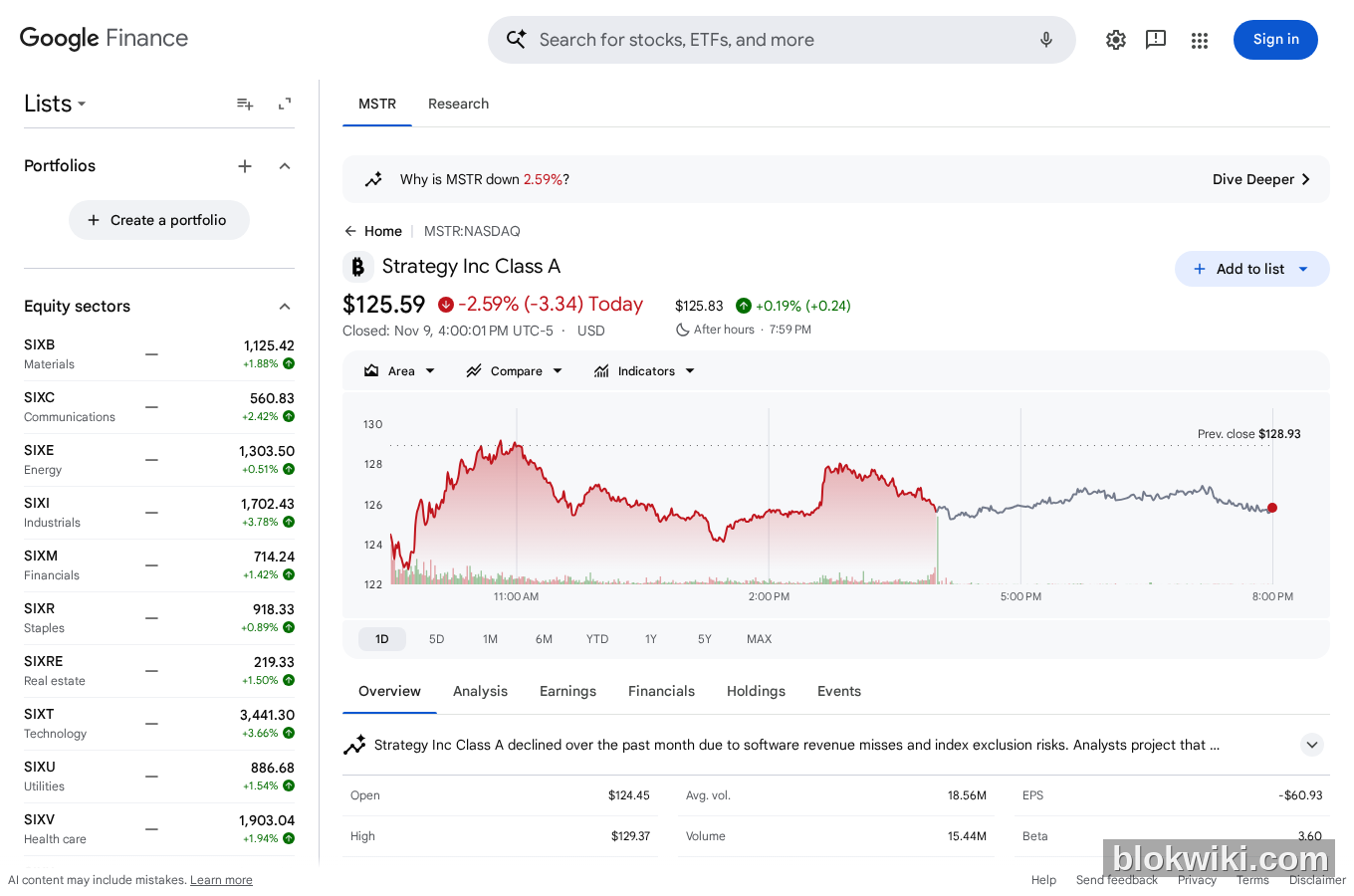
The counterintuitive part is who this is happening to. Strategy is the listed company most closely identified with bitcoin. If even that balance sheet can slip below cost, the idea that institutions always buy the bottom deserves a second look.
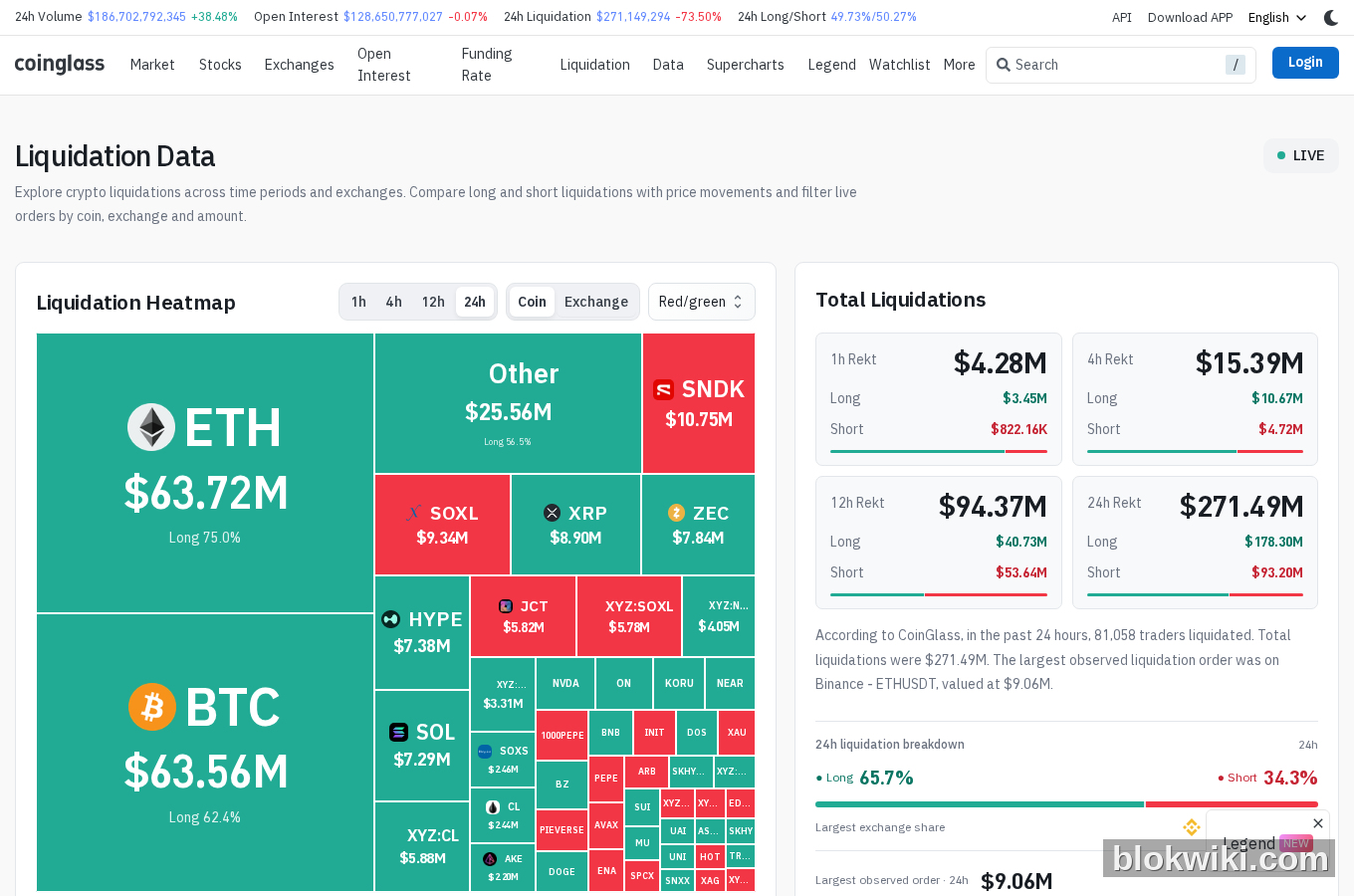
CoinGlass data paint the same picture from another angle: roughly $271 million liquidated across the network in the past 24 hours, 81,058 traders wiped out, longs accounting for 65.7%. BTC liquidations totaled $63.56 million and ETH $63.72 million. Those trades are not Strategy's paper loss, but they share the same mood.
Why this matters
Strategy's cost basis has become a kind of institutional faith line. For years, whenever bitcoin approached it, people cited it as evidence that sophisticated buyers were waiting below. Breaking it matters psychologically far more than it matters mechanically.
Be clear about what the line is: it is not technical support. It is a weighted average of hundreds of purchases, an accounting figure. Nothing about it forces bitcoin to bounce. The market does not know your cost basis, and it will not reverse because of yours.
Three facts worth understanding
An unrealized loss is not a liquidation
Remove the most alarmist reading first: Strategy is not facing a margin call. It funded purchases mainly with equity and convertible debt, not by pledging bitcoin as collateral, and there is no forced-liquidation threshold. The paper loss can sit on the books indefinitely until the company chooses to sell.
Unrealized and realized losses are different animals. Until it sells, the $500 million is a mark on a spreadsheet. What actually determines the outcome is the price and size of future sales.
The pressure is real
It shows up in three places. The stock: MSTR closed at $125.59 on November 9, down 2.59%, with EPS of -$60.93, a sign the market is discounting the treasury. Flows: Farside Investors data show U.S. spot bitcoin ETFs bleeding through late October and early November — -$643.2 million on October 30, -$398.6 million on November 2, -$115.6 million on November 3, +$74.6 million on November 4, -$430.2 million on November 5, -$411.9 million on November 6, then +$12.2 million on November 9. Index inclusion: MSCI-related decisions could trigger passive outflows, though the timing and outcome remain uncertain.
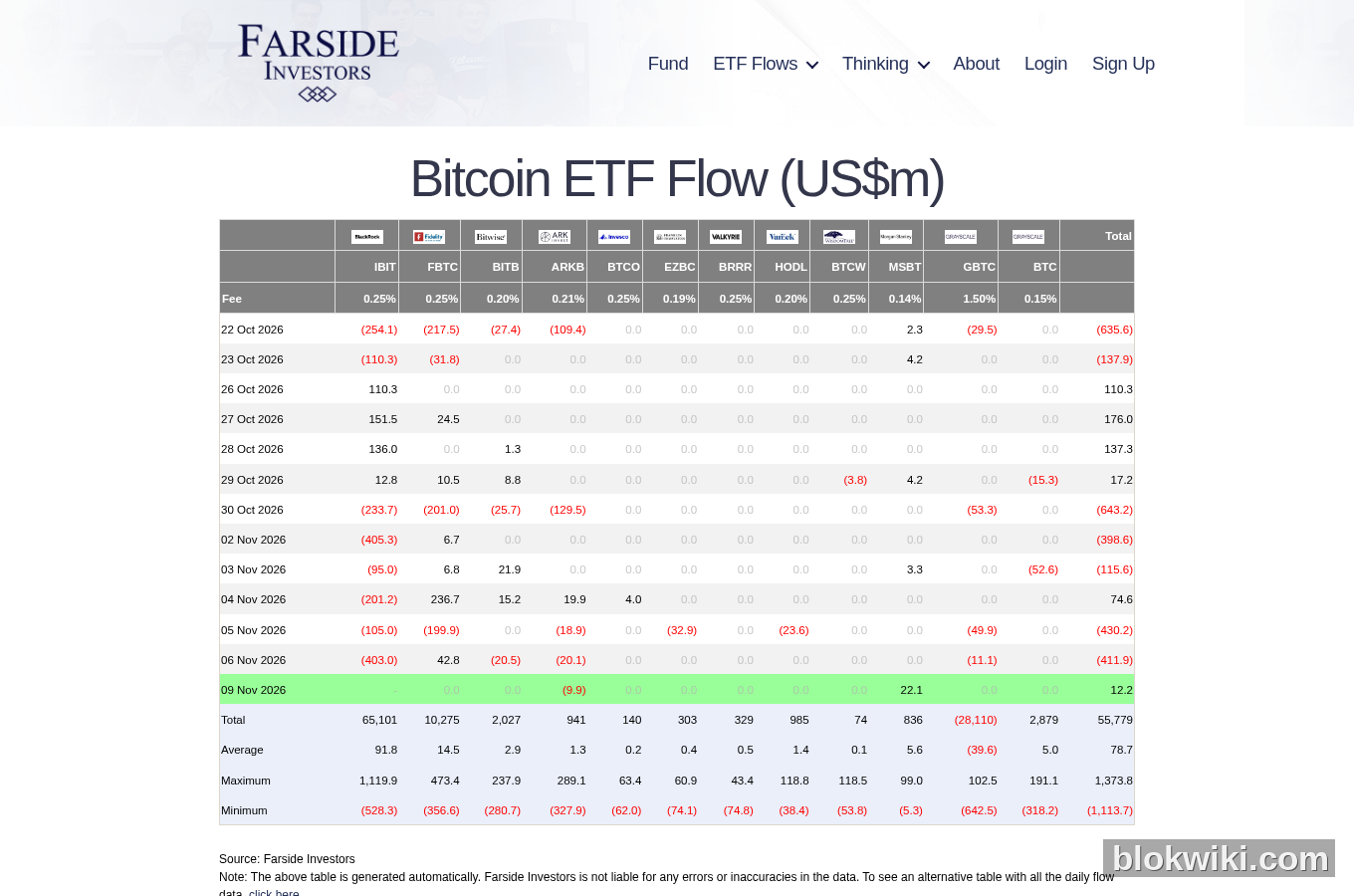
Read together, these numbers do not show panic selling in Strategy. They show the market repricing a listed bitcoin proxy: a narrower premium, the risk of passive money leaving, and a stock that trades on sentiment as much as on net asset value.
It is buying a long-term narrative, not this week's candle
Strategy was never trading the weekly chart. It turned its balance sheet into long-duration bitcoin exposure, a bet on adoption measured in years rather than months. That is exactly why it can carry a $500 million paper loss: its measurement horizon and a retail investor's are not the same unit of time.
Three things retail investors get wrong
Copying the all-in position. Its capital comes from equity issuance and convertible notes, with costs, maturities and dilution that have no equivalent in your salary and savings. Going all-in means funding a capital-markets strategy with household money.
Copying the bottom call. It started in August 2020 and bought across hundreds of transactions over five years; the first was $250 million for 21,454 BTC. That cost basis was built in slices. If you enter in one lump sum, the same direction carries a different order of risk.
Copying the hold. It has no forced-liquidation line and can carry a paper loss indefinitely. You cannot. Perpetual futures have a liquidation price; even spot holdings can be sold under pressure when rent is due. Its ability to hold rests on a structure you do not have.
| Difference | Strategy | Retail investor |
|---|---|---|
| Source of funds | Equity and convertible debt | Salary and savings, sometimes leverage |
| Forced liquidation | None | Futures have a liquidation price; spot can be sold under pressure |
| Time horizon | Five years and counting, measured in cycles | Often measured weekly or monthly |
Three things worth actually learning
Discipline. Five years and hundreds of purchases worked not because every entry was well timed, but because "when to buy and how much" became a rule. Rules execute when you are most afraid.
Cost management. 849,327 BTC and $64.08 billion produce a weighted average cost that can be calculated. It was not "this feels cheap." Every purchase was logged. You do not need hundreds of buys; you need a record of price and quantity for each one.
No leverage. This is the real reason Strategy can sit through a $500 million drawdown. Without a liquidation line, a paper loss stays paper. With one, the paper loss becomes real at the worst possible moment. For retail investors, this matters more than the first two.
What a first-time buyer can do here
No price forecast, just actions. Four steps:
- Open a compliant account first. Finish registration and identity verification, test the deposit and withdrawal rails, and only then decide whether to buy.
- Buy in fixed amounts, in batches. Turn the plan into a rule: how much per week or per month, and for how many periods. Size it with money you could lose entirely without changing your life.
- Move long-term holdings to a self-custody wallet. The exchange is for buying; the wallet is for keeping. Before withdrawing, check the full address and guard against address poisoning.
- Decide how much unrealized loss you can tolerate before deciding position size. Someone comfortable with a 30% drawdown and someone who can only accept 10% should not hold the same position.
If you are ready to start, pick one of these three
For a first entry, one mainstream, compliant exchange with smooth withdrawals is enough:
- Binance: deep liquidity and the widest selection, a reasonable first stop. Registration link
- OKX: a complete Chinese-language interface and wallet experience, good for learning self-custody as you buy. Registration link
- Gate.io: broad small-cap coverage, suited to small test positions. Registration link
Remember the combination: the exchange buys, the wallet holds. Before withdrawing, verify the full address to avoid address poisoning; the walkthrough is in Moving coins from an exchange to your own wallet. For the security checklist, see the five security indicators. If you are still torn between buying now and waiting for lower prices, start with Bitcoin at $75K: should first-time buyers DCA or wait?
The real value of the Strategy story is not the conclusion that institutions get stuck too. It is the exposure of two completely different games: one trades capital structure for time, the other trades household money for return. You can learn the discipline and cost management from the first. You cannot copy its funding structure. Accept that before you decide whether to enter.