Stablecoin Supply Drops $14.2B as Bitcoin Slips
Major stablecoin supply shrank by $14.2 billion over 30 days, the sharpest contraction since June 2022, while US spot bitcoin ETFs bled for four strai…
Bitcoin traded at $70,831.26 on November 13, down 4.2% in 24 hours, with a market value of $1.42 trillion and 24-hour volume of $27.37 billion — 14.46% lighter than the day before. Most people are staring at that candle, asking whether they can still hold. A quieter number explains the move better: over the past 30 days, the supply of major stablecoins has shrunk by $14.2 billion, the sharpest contraction since June 2022.
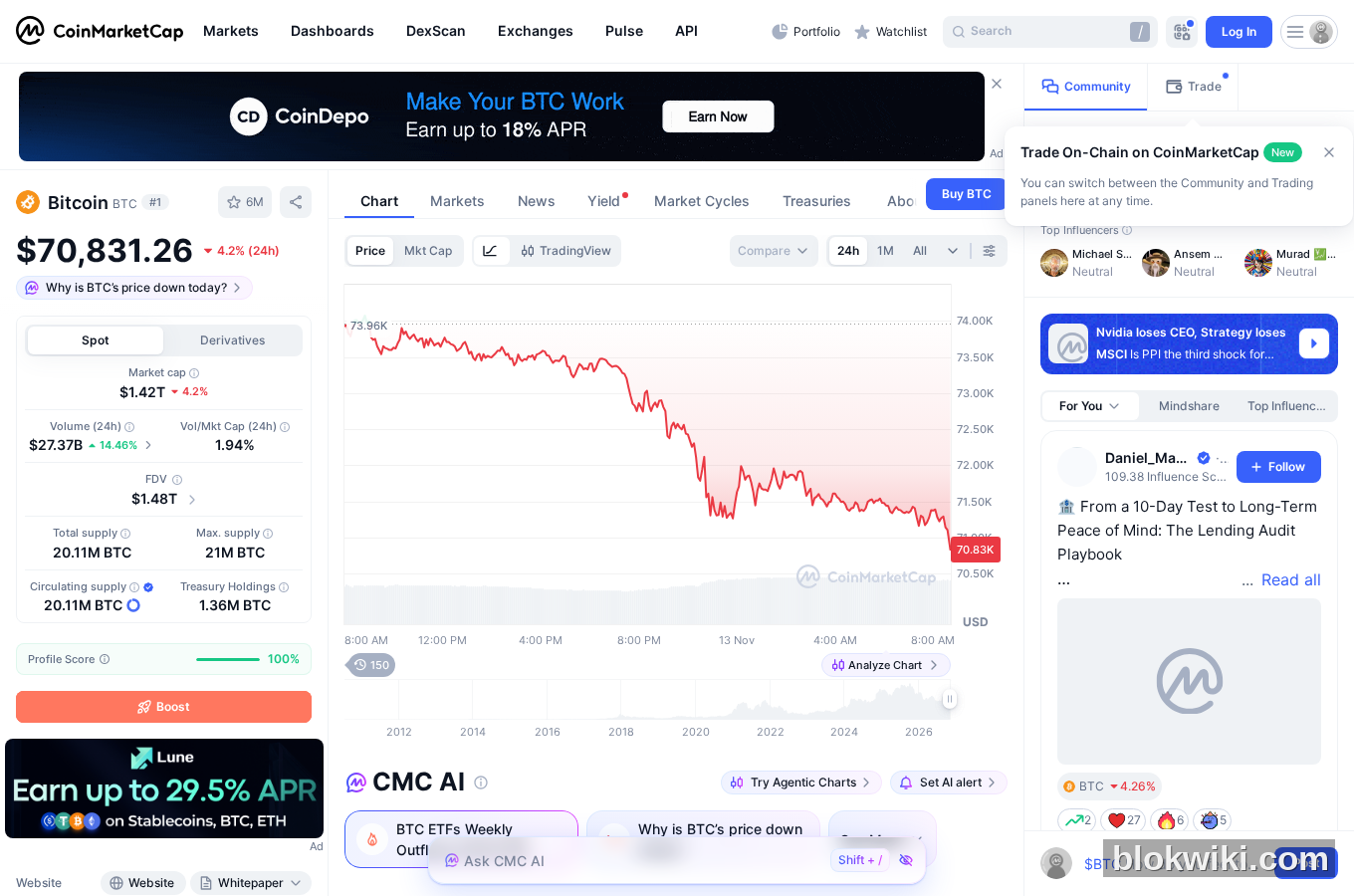
Price is the outcome. Stablecoins are the cause. At 08:23 that morning, 21st Century Business Herald reported bitcoin slipping below $72,000 to $71,391.9, with ether and SOL down more than 2%. The numbers agree. The order in which you read them should be reversed.
The concept that matters: stablecoins are the market's ammunition
Picture crypto as a battlefield that has to keep firing. BTC and ETH are the positions; stablecoins are the ammunition depot. Buying is the act of carrying a shell out of the depot and firing it: stablecoins become BTC, the depot shrinks, the position grows. Selling does the reverse.
That gives stablecoin supply two meanings. First, it is latent buying power: more shells in the depot means more fuel for prices. Second, it is a record of exits: when the total falls, someone swapped coins for dollars and chose not to leave those dollars on the field.
Why does it lead price? A price only needs one trade to move; $10,000 can nudge the last print. Aggregate stablecoin supply only changes when a real deposit or redemption settles. Price is mood. Stablecoin supply is logistics. Logistics move first and are much harder to fake.
The metaphor has limits. Stablecoin supply also covers payments, settlement and remittances, so it is not a precise measure of bids. Direction still matters, and 30 consecutive days of shrinkage is not noise.
Evidence one: $14.2 billion gone in 30 days — two measures, kept separate
Glassnode's November 11 report tracks the supply of major stablecoins: a net $14.2 billion decline over 30 days, the largest contraction since June 2022.
DefiLlama tracks market capitalization. As of November 12, the total stood at $286.87 billion, down 1.49% over seven days and 6.84% over 30. USDT accounted for $175.643 billion, USDC $69.888 billion and USDS $5.358 billion, with USDT at 61.23% of the total. Sina Finance cited a dollar-stablecoin float of $289.07 billion, against $303.9 billion 30 days earlier.
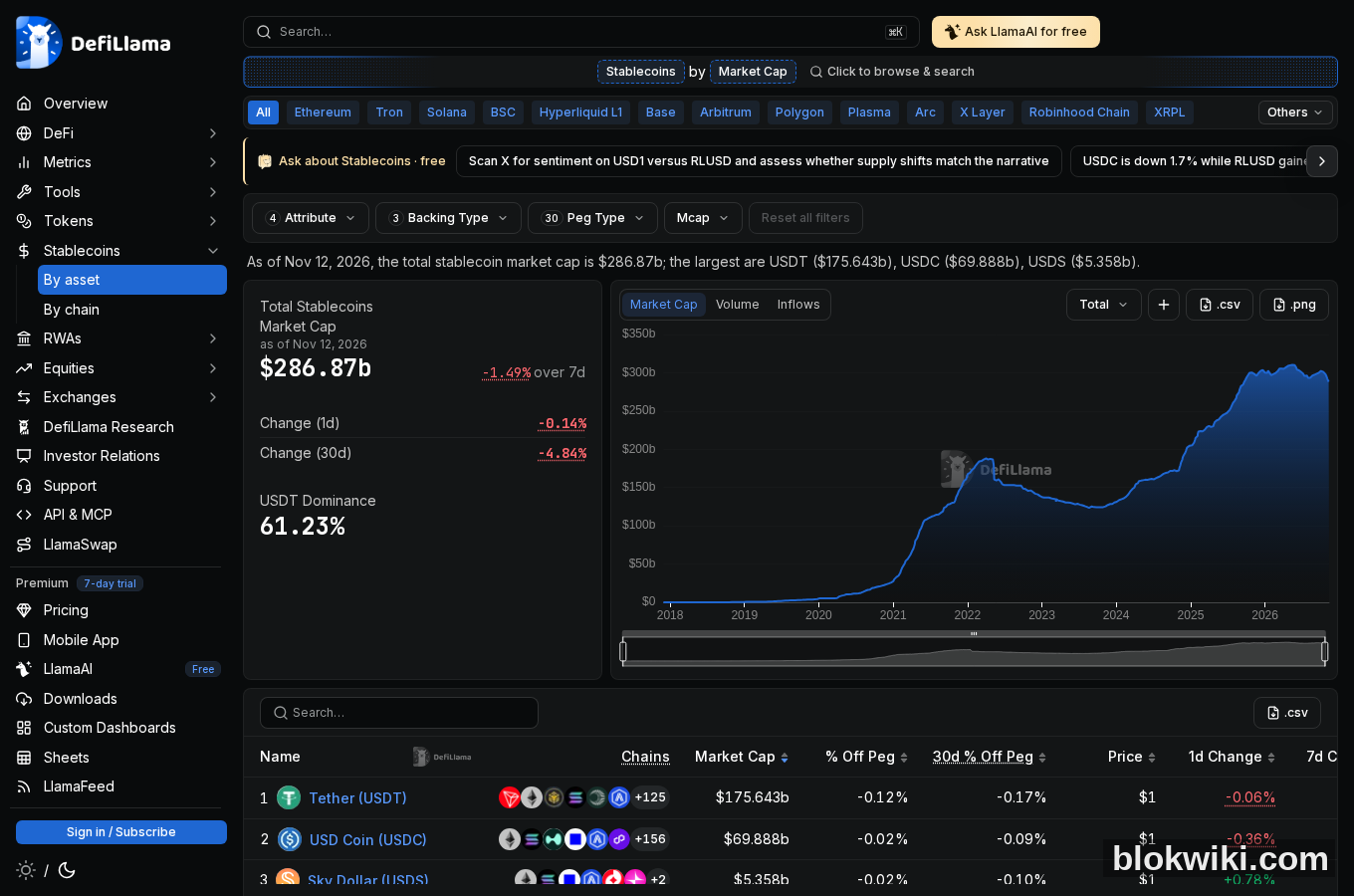
The figures do not match, because scope, timing and the treatment of algorithmic coins differ. The $14.2 billion comes from Glassnode's supply measure; the $286.87 billion comes from DefiLlama's market-cap measure. They should not be added together or blended into one number. They point to one conclusion: the depot is emptying, faster than at any time in more than four years.
Evidence two: the ETF channel bled out, and the turnaround was $3.3 million
Farside Investors' data on US spot bitcoin ETFs is blunter: -$411.9 million on November 6, -$201.0 million on November 9, -$95.0 million on November 10, -$299.8 million on November 11. Only on November 12 did flows turn positive, at $3.3 million.
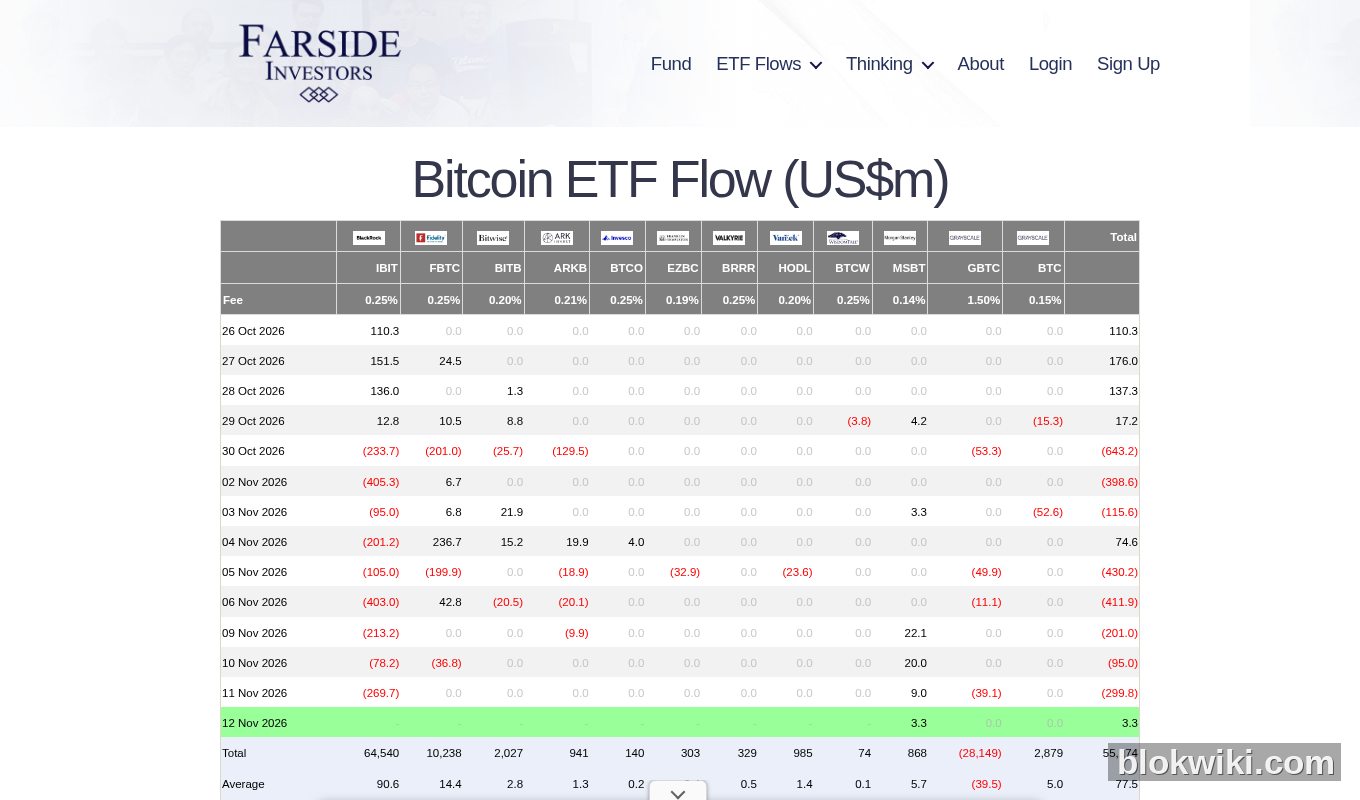
That is roughly $1.01 billion of net redemptions across four sessions. $3.3 million is a rounding error at this scale. It does not mean capital returned; it means the bleeding paused. ETFs are one of the main pipes for institutional and regulated money into bitcoin, and that pipe ran backwards for four sessions — the same story as shrinking stablecoin supply, told from the other end.
Evidence three: leverage keeps getting flushed, and 88% of it was long
CoinGlass puts 24-hour liquidations at $680.73 million across 113,319 traders, with longs accounting for 88.0%. Bitcoin positions accounted for $324.97 million, of which 95.3% were long. Ether added $106.24 million, SOL $18.98 million and tokenized Nvidia (XYZ:NVDA) $25.68 million.
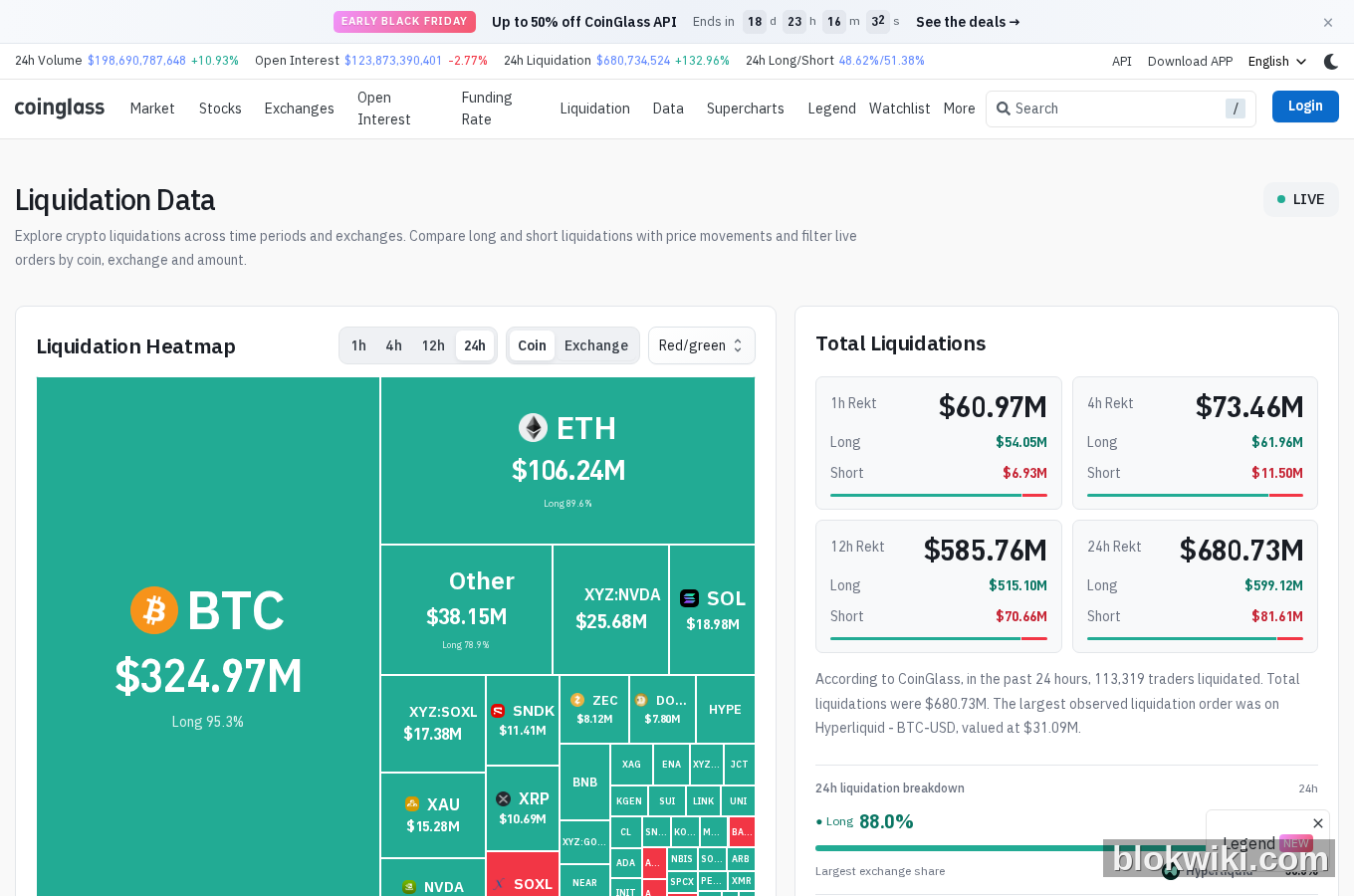
When 88% of the damage is on the long side, the people being removed are mostly the ones trying to buy the dip. They are not choosing to stop out. They are being pushed into it. A voluntary stop is "I was wrong, I'm out." A forced liquidation is "I still want the trade, but my margin is gone." The second kind does not consult opinion, only balances — which is why it repeats in waves.
This is not a simple risk-off move
Many attribute the drop to risk aversion. But if this were plain risk-off, gold should be bid. Instead gold broke below $3,900 to a fresh low for the year, the 10-year Treasury yield pushed above 5.10%, and the dollar index climbed above 103.
Read together, those three prints say something different: capital is going into dollar cash and the short end of the curve, not into traditional havens. Gold down, the dollar up, 10-year yields above 5.10% — cash-like instruments now pay well enough that the cost of holding a volatile asset has risen.
That is why bitcoin is not rallying. It is not that conviction vanished; the opportunity cost of holding it got more expensive. When the risk-free alternative yields more than 5%, every reason to hold a high-volatility asset has to be re-underwritten. Glassnode's read is that BTC has fallen below the short-term holder cost basis: capital is leaving, but the longer-term trend is not yet broken.
Three practical takeaways for ordinary investors
One: three indicators are enough. Stablecoin supply for ammunition, ETF net flows for the regulated pipe, and the long-short split of liquidations for leverage sentiment. When all three point the same way, the environment is clear. When they conflict, conviction is split — a good moment to do less.
Two: when the depot is emptying, size in small tranches, not one lump. Nobody knows when the contraction stops. Write the plan as a rule — a fixed amount every week or month, for a fixed number of periods — and set the budget so that losing all of it would not change your life. Rules do not make you right; they make you consistent when you feel worst.
Three: this is the phase to build the plumbing. Open the account, turn on 2FA, set a withdrawal address whitelist, and run a small test withdrawal. None of that earns a cent, but it decides whether you can act when opportunity arrives or are still waiting on verification.
To track those three indicators, start with an account
Reading real capital flows and order books requires a working account. For a first account, one mainstream, regulated exchange with smooth withdrawals is enough:
- Binance — deep liquidity and broad listings, a reasonable first stop. Register
- OKX — full Chinese interface and a solid wallet for learning self-custody. Register
- Gate.io — plenty of smaller tokens, good for small test positions. Register
After registering, run a small test withdrawal and verify the full address string before scaling up — the step-by-step is in this withdrawal guide. For context on this decline, compare why bitcoin did not follow the Nasdaq's 2.74% rally and what Strategy's $500 million unrealized loss means. If you are still deciding between dollar-cost averaging and waiting for a lower price, this framework is a practical starting point.
Back to the depot: price can mislead, volume can mislead, but "how much money walked in and how much walked out" is the hardest thing to fake. Stablecoin supply, ETF net flows and the long-short liquidation split require no forecasting — only a daily glance.