The Cryptoqueen: How OneCoin's Ruja Ignatova Vanished With Billions
OneCoin had no blockchain, no public ledger and no real exchange trading — its "price" was announced by the company itself, making it a multi-level py…
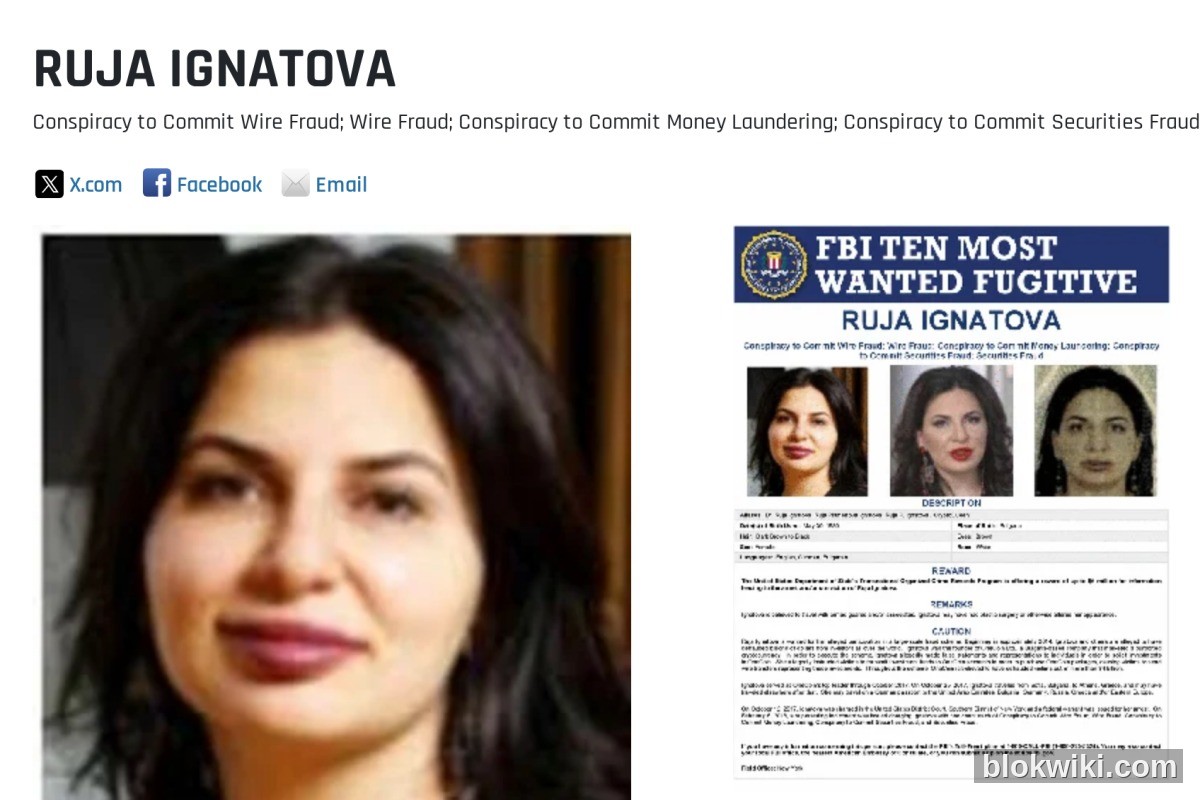
In October 2017, a Bulgarian woman who flew on private jets and gave keynote speeches in designer clothes boarded a flight from Sofia to Athens — and was never seen in public again. Her name was Ruja Ignatova, self-styled “Cryptoqueen” and founder of OneCoin. The project she marketed as “the next Bitcoin” took billions of dollars from millions of ordinary people around the world. She is still on the FBI’s Ten Most Wanted Fugitives list today, with a reward of up to $5 million.
Start here: it was never a cryptocurrency
This is the key to the whole story — OneCoin had no blockchain, no public ledger, and could not be freely traded on real exchanges. The “mining” ran on the company’s own servers, the “price” was set by the company, and the price movements were announced by the company. Its value came not from market consensus but from a continuous stream of new recruits buying “educational packages”.
So it was, in substance, a multi-level pyramid with a Ponzi structure wearing crypto clothing: existing members earned commissions for recruiting, and recruits banked on the price going up. As soon as new money slowed, the structure had to collapse. It is the same mechanism as the SQUID token rug pull we covered — just several orders of magnitude larger.
How the scheme actually ran (2014–2017)
Public filings from the US Department of Justice and IRS Criminal Investigation state that OneCoin began operations in 2014, headquartered in Sofia, Bulgaria, and marketed a fraudulent cryptocurrency of the same name through a global network-marketing structure. Three design choices made it work:
- The “educational package” wrapper. To buy coins you first had to buy a learning package at various price tiers — dressing up an investment as “education plus opportunity” and sidestepping securities rules in many jurisdictions;
- Conferences and scripts. Glitzy events, success-story speeches and celebrity appearances manufactured a get-rich atmosphere, with members encouraged to recruit on the spot;
- A self-set “price”. The company claimed the coin kept rising, but that was an internal bookkeeping number, not a traded market price — the “paper gains” members saw could not be cashed out on any public market.
The structure expanded fast between 2014 and 2017 across parts of Europe, Asia, Africa and Latin America, often in markets where crypto literacy was only beginning and where the “crypto equals overnight wealth” narrative spread quickly.
Why professionals could spot it immediately
Put OneCoin next to a genuine crypto asset and several things look wrong at once:
- No verifiable chain. Every Bitcoin or Ethereum transfer can be independently checked in a block explorer. OneCoin “transactions” lived only in the company’s internal database — nobody outside could verify anything;
- No real withdrawal. A real asset can be moved to your own wallet. OneCoin members who “withdrew” to the company’s so-called exchange often found they could not sell or cash out;
- The seller set the price. In a free market, price comes from matching buyers and sellers. OneCoin’s “price” was published unilaterally by the company.
In other words, the three fastest tests for any project are: can you verify it on-chain, can you withdraw to your own wallet, and is the price formed by a market? If any one of those fails, be very suspicious. For a broader checklist, see our 10 common crypto scams beginners should avoid.
Timeline: from Sofia to the FBI’s Ten Most Wanted
- 2014: OneCoin starts operating in Sofia, Bulgaria; Ruja Ignatova and Karl Sebastian Greenwood are co-founders;
- October 2017: Ignatova flies from Sofia to Athens and disappears; she has not been seen publicly since;
- February 2018: US prosecutors file a superseding indictment adding conspiracy to commit securities fraud and securities fraud (per the US Embassy in Bulgaria);
- 2018: Co-founder Greenwood is arrested; he later pleads guilty;
- 2019: Her brother Konstantin Ignatov pleads guilty and cooperates, testifying as a government witness; Mark Scott, the lawyer who handled her money, is convicted of money laundering;
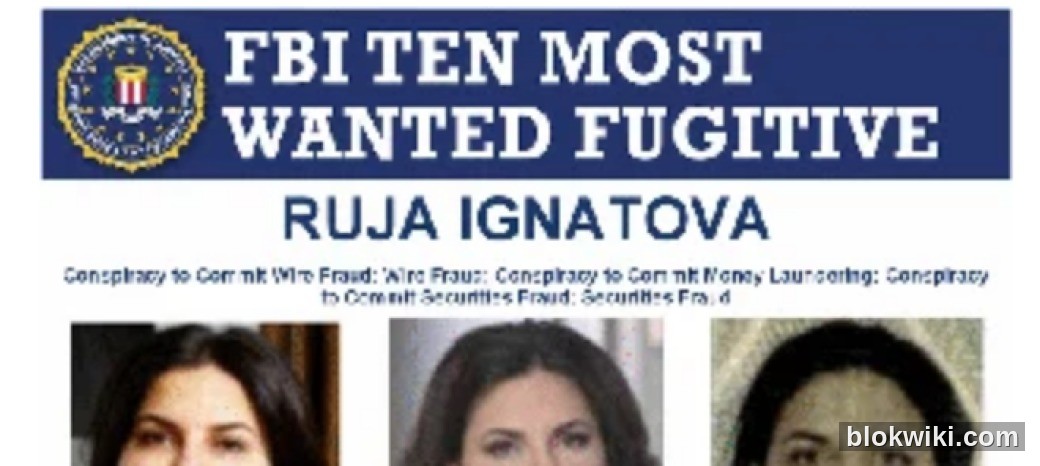
- June 2022: Ignatova is added to the FBI Ten Most Wanted Fugitives list;
- September 2023: Greenwood is sentenced to 20 years in prison;
- Today: Ignatova remains at large, with the reward raised to up to $5 million (it was $100,000 when first announced). Germany has also filed criminal charges against her.
How much did she actually take?
The US Department of Justice and IRS Criminal Investigation describe the losses as “billions of dollars” and call it one of the largest fraud schemes ever prosecuted by the US Attorney’s Office for the Southern District of New York. Estimates reported in the media vary; a figure around $4 billion is commonly cited, and Chinese-language outlets often use roughly 26.8 billion yuan.
Because OneCoin’s membership spanned many emerging markets and most victims never reported to any regulator, the true total will probably never be known precisely. That is typical of cases like this: victims are scattered, cross-border, and face enormous costs to pursue a claim. By contrast, an exchange hack such as Mt. Gox at least left identifiable creditors and a formal claims process.
What happened to everyone else involved
- Karl Sebastian Greenwood (co-founder): pleaded guilty; sentenced to 20 years in prison in September 2023;
- Konstantin Ignatov (her brother): pleaded guilty, cooperated, and testified as a government witness;
- Mark Scott (lawyer): convicted for laundering roughly $400 million;
- Irina Dilkinska (head of legal): arrested and sentenced (as widely reported);
- Ruja Ignatova herself: still a fugitive — the only principal who got away with the money.
The contrast is brutal: the people who worked for her went to prison, and the only one who walked off with the cash was her.
Why she has not been caught in eight years
Public information offers no definitive answer, which is part of what keeps the case alive. Several practical obstacles are clear:
- Cross-border identity complexity: she has lived and studied in several countries including Bulgaria and Germany and has used multiple sets of identity documents, complicating identification;
- The money was scattered early: once funds move through layers of offshore accounts and crypto mixing, tracing becomes extremely slow;
- She barely appears in public: there has been essentially no reliable imagery or travel record since 2017 — the pictures on the FBI poster are old;
- Cross-border cooperation takes time: Bulgaria, Germany and the US opened separate cases, and information sharing plus mutual legal assistance is slow by nature.
One caution: most “possible sighting” and “confirmed dead” claims circulating online have not been confirmed by authorities. For this case, treat only official announcements from the US Department of Justice, the FBI and German prosecutors as reliable.
Three lessons this case left behind
- “Crypto” in the name does not make it a cryptocurrency. No public chain, no self-custody, and a price not set by a market means it is not a crypto asset, however many conferences say otherwise;
- “You must buy a package before you can participate” is the standard pyramid structure. A real trading platform does not make you buy a course before you can buy a coin;
- Only self-custody is real ownership. Even with genuine coins, leaving them on someone else’s books means taking counterparty risk. The basics are in how to choose a wallet and our seed phrase and private key safety guide.
Frequently asked questions
Is anyone still using OneCoin?
As a “cryptocurrency” it is meaningless now: core members were convicted, the founder is a fugitive, and the coin has no public chain behind it. The real risk is that the same script returns under a new name — an “ecosystem” or a “public chain” that still requires buying a package and recruiting people.
Has Ruja Ignatova been caught?
No. She has not appeared publicly since October 2017, was added to the FBI Ten Most Wanted Fugitives list in June 2022, and now carries a reward of up to $5 million. Any claim that she has been arrested should be checked against official announcements.
Did she really take $4 billion?
The DOJ and IRS Criminal Investigation describe it as “billions of dollars” and one of the largest fraud schemes prosecuted in the Southern District of New York. Reported estimates vary; around $4 billion is the commonly cited order of magnitude. Because victims are spread across many countries and mostly unreported, the exact total cannot be fixed.
Why are schemes like this so common in emerging markets?
Usually three conditions overlap: crypto literacy is still early, the “get rich overnight” narrative travels fast, and cross-border regulation and redress channels are weak. That is why, for readers in those markets, knowing the three tests — verifiable on-chain, self-custodiable, market-formed price — matters more than remembering any single project name.
Risk notice
Risk notice: cryptocurrencies are extremely volatile, and scams marketed as “crypto” are persistent; trading and holding can result in the total loss of your capital. This article is a historical review and educational explainer only, and is not investment advice. Case details follow public announcements by the US Department of Justice, IRS Criminal Investigation, the FBI and German prosecutors, current as of October 2026. Before joining any project, confirm that it has a publicly verifiable chain, that you can self-custody, and that its price is formed by market matching.