The LUNA Collapse: $40B to Zero in 5 Days and Do Kwon's 15-Year Sentence
In May 2022, the $40 billion Terra ecosystem went from the UST de-peg to LUNA zero in a single week: the bubble inflated by Anchor's subsidized 20% yi…
In May 2022, the largest single-project collapse in crypto history unfolded: the Terra ecosystem, once worth more than $40 billion, went from the UST stablecoin losing its peg to LUNA hitting zero in less than a week. Over a million investors were wiped out, and the contagion went on to sink Celsius, Three Arrows Capital and a string of other firms. Three and a half years later, on December 11, 2025, founder Do Kwon was sentenced to 15 years in a New York federal court — prosecutors had asked for 12; the judge decided that was too lenient and added three himself.
The verdict first: this wasn't an "attack" — the mechanism was doomed by design
Many people remember the LUNA collapse as "Wall Street shorting a crypto project." The short sellers were only the trigger. The fatal flaw was built into the mechanism itself: UST wasn't a reserve-backed stablecoin like USDT. It was an "algorithmic stablecoin" — collateralized by nothing, holding its $1 price purely through a mint-and-burn arbitrage rule:
- Anyone could redeem 1 UST for $1 worth of LUNA (burning UST, minting LUNA);
- And anyone could mint 1 UST by burning $1 worth of LUNA.
When UST traded above $1, arbitrageurs minted UST and sold it, pushing the price back down. When it dipped below $1, they bought UST, redeemed it for LUNA and sold the LUNA, pushing the price back up. The whole design rests on one hidden assumption: someone must always be willing to buy LUNA. Once confidence in LUNA cracks, redemptions mint mountains of new LUNA, the minting crashes the price, and the lower price means the next redemption mints even more — the "death spiral."
How the empire was built (2018–2022)
In 2018, Do Kwon and Daniel Shin founded Terraform Labs in South Korea. Kwon, a Stanford computer science graduate, was famous on Twitter for his arrogance — he once publicly dismissed a critic of algorithmic stablecoins with "I don't debate the poor."
The ecosystem's core product, UST, launched in September 2020. What truly propelled it was the Anchor protocol: deposit UST into Anchor and earn roughly 20% APY. Note — that yield didn't come from organic lending demand; most of it was subsidized with the project's own fundraising war chest.
A "risk-free" 20% is irresistible to ordinary savers. At its peak, Anchor held about 14 billion UST — roughly 70% of all UST in circulation. In other words, most of the demand for UST was manufactured by subsidized yield. In April 2022, LUNA hit an all-time high around $119, with a market cap above $40 billion, ranking among the top five crypto assets.
Zero in five days: the death spiral timeline
- May 7: UST pools on Curve were hit by several large sales; UST slipped slightly off-peg to around $0.98, and the community grew uneasy;
- May 8: panic spread, and Anchor deposits began fleeing in batches — billions of UST left in a single day;
- May 9: UST briefly fell below $0.70 before recovering; the Luna Foundation Guard (LFG) announced it would deploy its bitcoin reserve to defend the peg, and Kwon tweeted "deploying more capital — steady lads";
- May 10–11: the arbitrage engine ran at full speed — every redeemed UST minted fresh LUNA, and LUNA's supply exploded from about 350 million to trillions of tokens within days, crushing the price through multiple decimal places;
- May 13: Binance and other major exchanges delisted LUNA/UST pairs, the Terra blockchain halted twice, and LUNA was effectively worth zero.
From de-peg to zero took under a week; more than $40 billion in market value evaporated. People posted on forums about losing their entire home down payments; suicide-prevention posts appeared in multiple countries, and South Korea opened psychological support hotlines for LUNA investors.
Why 80,000 bitcoins of reserves couldn't save it
In early 2022, the ecosystem set up the Luna Foundation Guard (LFG) and loudly announced it had accumulated roughly 80,000 BTC (worth about $3 billion at the time) as a "foreign exchange reserve" for UST. The community treated this as proof that UST had real backing.
But when the de-peg hit in May, the reserve was a drop in the bucket against a redemption wave running at billions of dollars per day — $3 billion was exhausted within days. Worse, the deployment was far from transparent: post-mortem on-chain analysis showed most of the BTC was moved or sold during the panic, and its exact flow has never been fully accounted for. The "bitcoin reserve" reassurance ended up delivering the final blow to confidence — because dumping BTC to defend the peg dragged the entire market down with it.
Contagion: the first domino
LUNA wasn't an isolated event — it directly triggered the 2022 crypto winter:
- Celsius: froze user withdrawals in June 2022, then went bankrupt;
- Three Arrows Capital (3AC): the hedge fund that once managed $10 billion was heavily long LUNA; it filed for bankruptcy in July 2022, and its fall took down a chain of lenders that had extended it credit;
- Voyager, BlockFi and other lending platforms fell one after another (BlockFi was later finished off by the FTX collapse);
- At the market level, bitcoin slid from the $40,000 range to about $16,000 by year-end.
In hindsight, the epicenter of the institutional blow-ups through late 2022 was LUNA. Unlike the Mt. Gox hack — a single exchange getting robbed — an algorithmic stablecoin collapse destroyed something the whole industry had come to treat as infrastructure.
Kwon's flight and arrest
Around the collapse, Do Kwon left South Korea for Singapore, and his whereabouts became a mystery:
- September 14, 2022: a South Korean court issued an arrest warrant for Kwon;
- September 26, 2022: Interpol issued a Red Notice at Korea's request, and his Singapore residency was cancelled. All the while he kept tweeting that he was "not on the run";
- He moved through Serbia and other locations;
- March 23, 2023: he was arrested at Podgorica airport in Montenegro while trying to board a flight to Dubai with a forged Costa Rican passport; a Belgian fake passport and several laptops were found in his luggage;
- Montenegro first sentenced him to four months for document forgery. Then the United States and South Korea fought over extradition, with Montenegrin courts flipping between the two for over a year;
- December 31, 2024: Kwon was finally handed over to U.S. law enforcement.
The sentence: prosecutors asked for 12 years, the judge made it 15
The U.S. judicial process unfolded in stages:
- January 2024: Terraform Labs filed for bankruptcy protection in the U.S.;
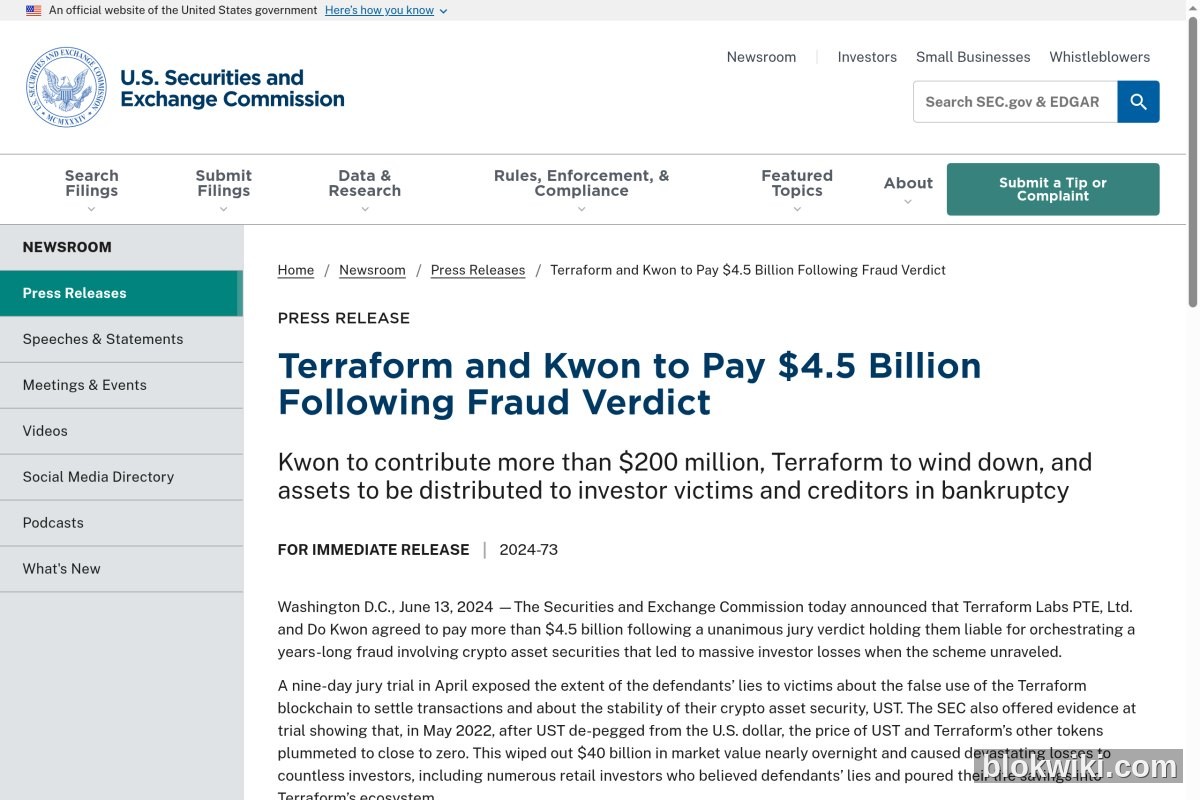
- April 2024: in the SEC's civil case, a jury found Kwon and Terraform liable for fraud; a settlement of roughly $4.5 billion followed;
- August 2025: Kwon pleaded guilty to two counts — conspiracy to defraud and wire fraud;
- December 11, 2025: sentencing in the Southern District of New York. Prosecutors sought 12 years, but the presiding judge said that for a case with roughly $40 billion in losses and more than a million victims, 12 years was too light. The final sentence: 15 years in prison, plus forfeiture of about $19.3 million in assets.
From the Twitter personality who "doesn't debate the poor" to a defendant in prison garb hearing his sentence — it took just three and a half years.
Three lessons the case leaves behind
- "Algorithmic stability" is circular reasoning. A stablecoin backed by its own sister token is a stablecoin in calm times and a double-kill machine in a bank run. For any stablecoin, ask one question first: if it de-pegs, what exactly will be used to pay redemptions?
- A "risk-free" 20% APY doesn't exist. Anchor's yield came from project subsidies; once the subsidy stops, the structure is a Ponzi. When a yield looks implausibly high and its source is unclear, the yield itself is the price of the risk. See our checklist in 10 common crypto scams beginners must avoid;
- Nothing in crypto is "too big to fail". $40 billion, a top-five ranking, celebrity backers — gone in five days. Position sizing and self-custody are the only moats ordinary investors have. The basics: how to choose a wallet and seed phrase and private key security.
FAQ
What's the difference between UST and USDT?
USDT (Tether) is a collateralized stablecoin — the company claims every token is backed by equivalent dollar-denominated assets (the quality of those reserves has long been debated, but at least there is a redemption source in principle). UST was an algorithmic stablecoin with no external reserves at all, holding its peg purely through two-way conversion with LUNA — so when the run came, there was no real money to pay out. That's the fundamental reason UST went to zero in five days while USDT has recovered from every de-peg scare.
Does the project still exist after LUNA went to zero?
Nominally, yes. After the collapse the community voted to launch a new chain — the new token is also called LUNA ("LUNA 2.0"), while the original chain's token was renamed LUNC (Luna Classic). Both are worth a tiny fraction of the peak, Do Kwon was not involved in the new chain, and the ecosystem is a shadow of itself. Treating a "restart by the same community" as a chance to break even is essentially betting on the same horse twice.
Kwon got 15 years — will victims get their money back?
The odds are slim. A criminal sentence settles prison time, not restitution; Terraform's bankruptcy liquidation and the $4.5 billion civil settlement sit behind a long queue of creditors, and recoverable assets are far smaller than the $40 billion lost. The reality is that most retail losses are permanent — the same situation victims of the OneCoin scam and the Squid Game coin rug pull found themselves in.
Do algorithmic stablecoins still exist?
Yes, but the industry consensus has shifted: the purely algorithmic, uncollateralized model was effectively pronounced dead after LUNA. Surviving projects mostly moved to over-collateralization (like DAI) or hybrid reserve models, and regulators worldwide have put reserve-free algorithmic stablecoins on their restriction lists. If a new "algorithmic stablecoin" shows up advertising high yields, remember that one week in May 2022.
Risk notice
Risk notice: Crypto asset prices are extremely volatile, and experimental mechanisms such as algorithmic stablecoins can go to zero within days; trading and holding can result in the loss of your entire principal. This article is a historical review and educational material only, not investment advice. Case information is based on public announcements by the U.S. Department of Justice, the U.S. District Court for the Southern District of New York, the SEC, and the judicial authorities of South Korea and Montenegro, current as of October 2026. Before participating in any project, make sure you understand where its redemption money comes from, where its yield comes from, and what the worst case looks like.