Is HTX Safe in 2026? UK/EU Sanctions, the 2023 Hacks and Proof of Reserves
HTX still trades, but in 2026 it gained a new identity: a sanctioned exchange. The UK designated Huobi Global S.A. in May and OFSI says the HTX exchan…
The short answer: HTX still trades, but in 2026 it gained a new identity — a sanctioned exchange
Search "is HTX safe" or "is Huobi safe" and most older articles tell you the same story: legacy platform, well-funded reserves, hacked twice but reimbursed in full. All still true. But something bigger happened in 2026 that much of the coverage has not caught up with:
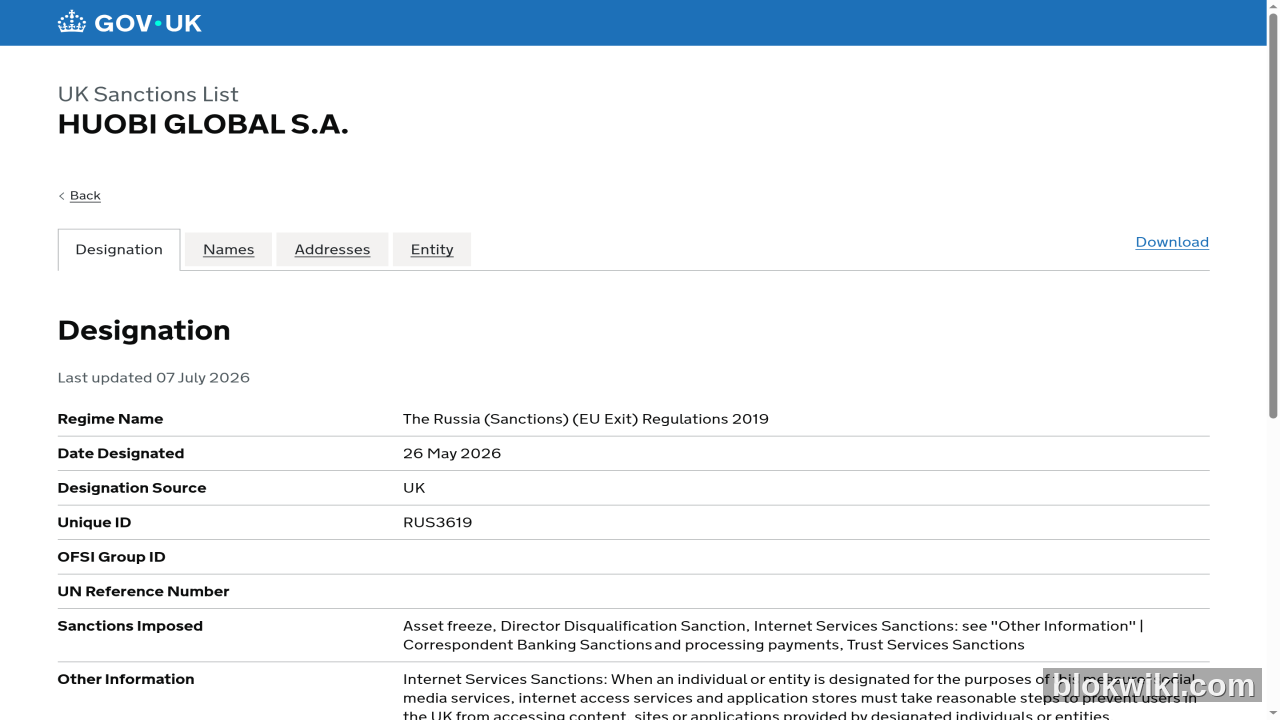
- On 26 May 2026 the UK designated Huobi Global S.A. under its Russia sanctions regime (asset freeze), and the Office of Financial Sanctions Implementation (OFSI) subsequently stated that the HTX exchange itself is captured by UK financial sanctions because it is owned or controlled by Huobi;
- On 23 July 2026 the EU added HTX to its transaction-ban list, effective 23 August 2026; from the same date, Binance and other major venues began restricting transactions involving HTX and ten other platforms;
- HTX denies the allegations, saying the designated entity is separate from the online exchange. But the legal force of sanctions does not depend on the target's denial — in the UK and EU, serving transactions involving HTX is restricted.
This is unprecedented: the first time a major crypto exchange has been directly sanctioned by major Western economies. So the verdict here has to be more cautious than in the rest of this series:
HTX's reserves and operations have not shown a failure, but its regulatory and geopolitical risk is now materially higher than its peers. UK and EU users should treat it as unavailable; elsewhere, if you use it, keep it small and short-term rather than large and long-term.
What HTX (formerly Huobi) is
HTX began as Huobi, founded by Leon Li in 2013, and was once the highest-volume exchange in the Chinese-speaking market. It rebranded to HTX in September 2023. Justin Sun, founder of TRON, sits on HTX's global advisory board and is closely tied to the platform.
| Item | Detail |
|---|---|
| Founded | 2013 as Huobi; renamed HTX in September 2023 |
| Founder and affiliations | Founded by Leon Li; Justin Sun on the global advisory board, deeply tied to the TRON ecosystem |
| User base | Company-claimed 58 million as of January 2026 (not independently verified) |
| Signature products | Futures, C2C/OTC fiat on- and off-ramps, legacy spot |
| Exchange token | HT |
| Proof of reserves | Merkle-tree PoR, 43-plus consecutive months (company-claimed) |
The official site is htx.com (huobi.com also redirects). The brand and domains have changed repeatedly, so verify the domain before registering and never click a search ad.
The biggest safety variable in 2026: dual UK and EU sanctions
This section is the one you need to finish, and it is what separates this article from every other "is X safe" piece.
The UK side. On 26 May 2026 the UK designated HUOBI GLOBAL S.A. under the Russia (Sanctions) (EU Exit) Regulations 2019, with an asset freeze. OFSI's published position is that because the entity owns or controls the HTX exchange, HTX itself is captured by UK financial sanctions. In practice, moving funds involving HTX-related entities inside the UK may constitute a sanctions breach.
The EU side. On 23 July 2026 the EU added HTX to its transaction-ban list, effective 23 August 2026. From that date, Binance and other major platforms began restricting transactions involving HTX and ten other venues.
The platform's position. HTX rejects the allegations and says the sanctioned entity is separate from the online exchange; Justin Sun has publicly said Binance's restrictions affect only UK and EU users and leave other regions unaffected.
How to read this. Three points:
- Sanctions bite by jurisdiction. If you are in the UK or EU, treat HTX as unavailable and do not assume that "the website still loads" means you are fine;
- Even outside the UK and EU, being sanctioned by major economies means the platform's counterparty risk, banking-rail risk and fiat on/off-ramp risk have all risen sharply — being able to deposit today does not mean you can next month;
- A regional restriction, an account restriction and a platform outage are three different kinds of "it will not open" — do not conflate them, and see our access troubleshooting guide for the fixes.
This is the first time a mainstream exchange has been directly sanctioned by the West, with no precedent to model — caution is the only defensible stance.
Security record: two 2023 breaches, both reimbursed in full
Sanctions aside, HTX's exchange-side security history is on the record:
- 24 September 2023: about 4,999 ETH (roughly $8 million at the time) left a hot wallet; the attacker returned the funds the following month;
- 22 November 2023: about $30 million was taken from a hot wallet, and on the same day the linked HECO cross-chain bridge lost roughly $87 million — about $115 million combined. The exchange suspended deposits and withdrawals that day, resumed on 25 November, and publicly pledged full reimbursement to users.
To be fair: the platform honoured compensation both times and no user funds were permanently lost, which counts in its favour. But two breaches in the space of two months, with attackers tied to the platform's own ecosystem, points to clear weaknesses in its wallet architecture and risk controls at the time — in contrast to OKX, whose exchange wallets have not been breached.
A note for context: legal news such as a former Huobi executive being acquitted sits at the corporate-governance layer, not user-fund security — useful background, but not a safety rating input.
Proof of reserves: 43 consecutive months, but note how it is disclosed
HTX is among the industry's earliest continuous publishers of Merkle-tree proof of reserves. By its own figures it had published 43 consecutive monthly reports as of May 2026, and its September 2026 update showed reserves above 100% across major assets including BTC, ETH, TRX and USDT, alongside a 1:1 reserve pledge and a promise that users can trade and withdraw at any time.
Two caveats. First, HTX's PoR is largely self-published, and its independent third-party assurance is weaker than OKX's (which has Hacken audit monthly with open-source verification code). Second, its claimed "zero freezes on C2C" is a company statement with no independently verifiable public data source. PoR proves that assets covered liabilities at the moment of the snapshot; it cannot offset a risk like sanctions, which sits outside the asset layer.
Zoom out: TRON (TRX) is tightly bound to the HTX ecosystem, and the token HT is bound to the platform's fate. Loading up on HT is doubling your bet on this venue, and under sanctions that deserves extra caution.
Licences: a very thin page
This is where HTX is weakest on compliance. It holds no full licence in any major jurisdiction:
| Jurisdiction | Status |
|---|---|
| Lithuania | VASP registration (an AML registration, weaker than a full licence) |
| Dubai | Provisional VARA approval, not a full licence |
| British Virgin Islands | SIBA licence |
| Gibraltar | DLT licence |
| Seychelles | The Seychelles FSA has publicly warned that HTX holds no local VASP licence |
| UK / US / EU | No FCA, no FinCEN, no MiCA authorisation — and sanctioned by the UK and EU in 2026 |
For comparison: OKX and Gate hold EU MiCA licences, and Coinbase and Kraken are listed or long-established compliance-first venues, while HTX remains thinly regulated — a clear negative in any safety rating.
Who it suits, who it does not
Not suitable for: UK and EU users (sanctions apply — do not use it); anyone parking large, long-term capital on an exchange; users whose first priority is regulated custody; mainland China users (also unserved).
Relatively suitable for: experienced users who already know Huobi, trade small C2C/OTC or short-term futures, and live outside sanctioned regions — but keep fund dwell-time short and treat it as a tool, not a vault.
If you want a steadier alternative: the most complete licensing path is OKX (EU MiCA licensed), the deepest and largest is Binance, and the widest coin coverage is Gate. Where funds allow, do not put everything in one basket.
If you decide to use it, these risk rules are mandatory
- Confirm the legality in your jurisdiction first: UK and EU users should simply stop; elsewhere, check your local rules and platform access yourself;
- Shorten dwell-time: do not store funds long-term — withdraw or move to self-custody after trading to cut exposure to a sudden "platform unavailable" event;
- Turn on Google Authenticator (2FA), an anti-phishing code and a withdrawal whitelist: all three matter more after two breaches;
- Keep a fiat-rail backup: sanctions can hit banking rails, so have a second platform ready and do not compress your on-ramp into one venue;
- Test small first: run a small deposit and withdrawal before scaling up;
- Watch for DMs and fake support: anyone who messages you as "support" or a "trading mentor" is a scammer — official teams never ask for codes or offer remote help.
FAQ
Is HTX (Huobi) safe?
Two layers. On assets: monthly reserve disclosure, both breaches reimbursed in full, no repayment failure exposed so far. On compliance and geopolitics: dual UK and EU sanctions in 2026 are the single biggest negative in its safety rating. The verdict is "caution" — unavailable to UK and EU users, and small and short-term only elsewhere.
HTX is sanctioned — can I still use it?
It depends where you are. UK and EU users should not (covered by the asset freeze and transaction ban); the platform says other regions are unaffected, but the real spillover — banking rails and counterparty risk — is yours to assess.
Are HTX and Huobi the same?
It is a rebrand of the same platform: founded as Huobi in 2013 and renamed HTX in September 2023, with a continuing operating entity — so tracing Huobi's history (including the two 2023 breaches) back to HTX is fair.
Could HTX run away with the money?
From what is public, the platform is still operating and disclosing reserves. But being sanctioned means its exposure is not liquidity or technology but regulatory and geopolitical risk, and that kind of risk tends to surface as a sudden "unavailable" rather than a slow insolvency — which is exactly why you manage it by shortening dwell-time.
Are HTX withdrawals safe? What if I cannot withdraw?
In normal times, withdrawal is no different from any other venue — test small, check the network and the whitelist. If withdrawals get stuck, work through access and route troubleshooting to tell a local network problem, an account restriction and a platform-side issue apart; once a regional restriction applies, there is usually no appeal.
Risk notice, sanctions disclosure and affiliate disclosure. Crypto trading and leveraged futures carry high risk and can lose your entire principal; nothing here is investment advice. This article covers UK and EU sanctions: UK and EU users should not use HTX through any link in this article, and users elsewhere must verify their own local rules. This article contains affiliate links (register on HTX through our link); we may earn a commission from registrations through it, at no extra cost to you and without affecting our conclusions. Regulatory, sanctions and incident details are current as of October 2026 — check HTX's announcements and the UK OFSI and EU official lists.