Malaysia MYR Deposit 2026: FPX vs DuitNow, P2P vs Direct, SC Rules
If you are in Malaysia and want to convert ringgit (MYR) into crypto, you have two distinct routes. International exchanges use P2P — MEXC has the dee…
FPX vs DuitNow: Which Payment Channel Are You Actually Using?
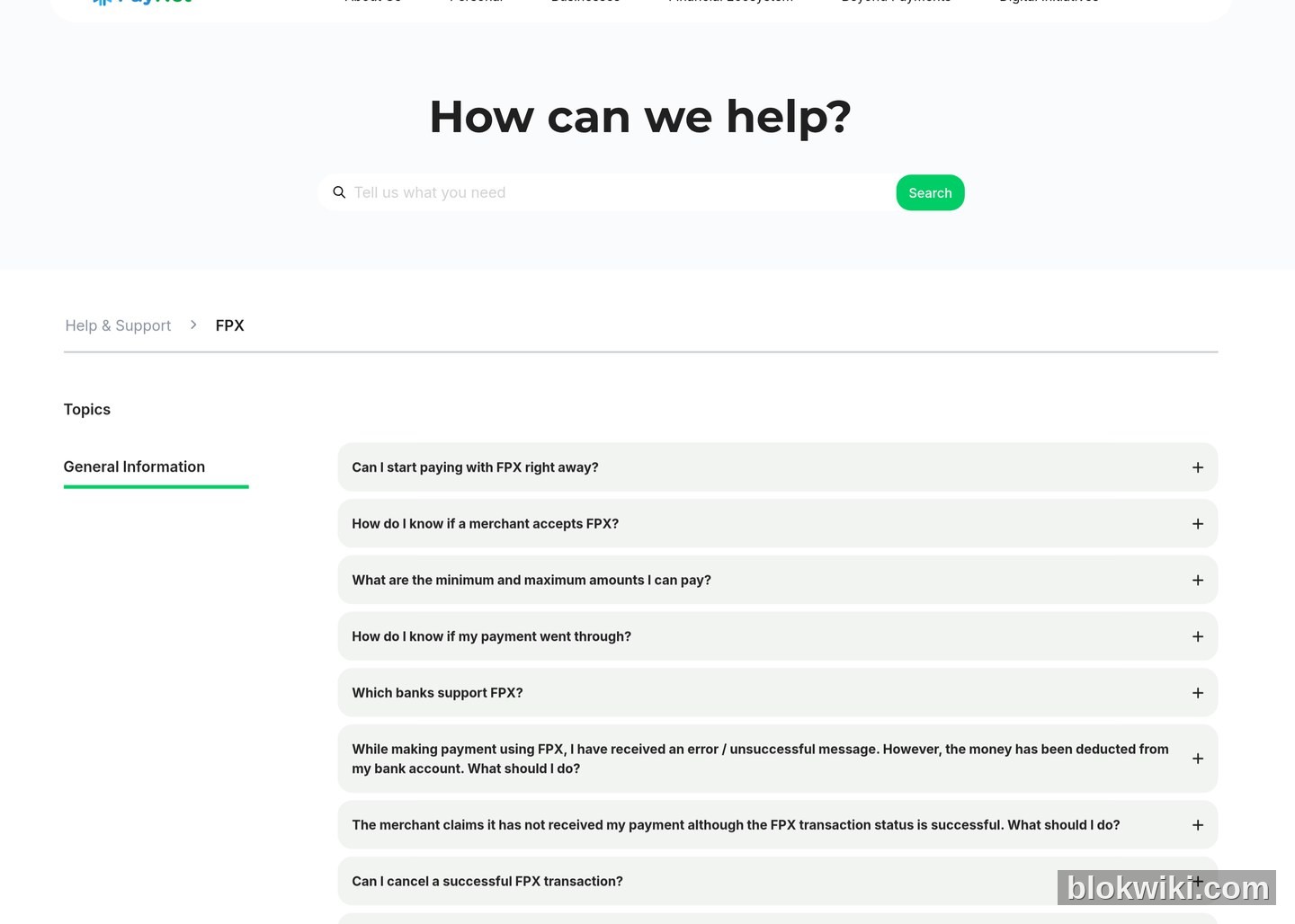
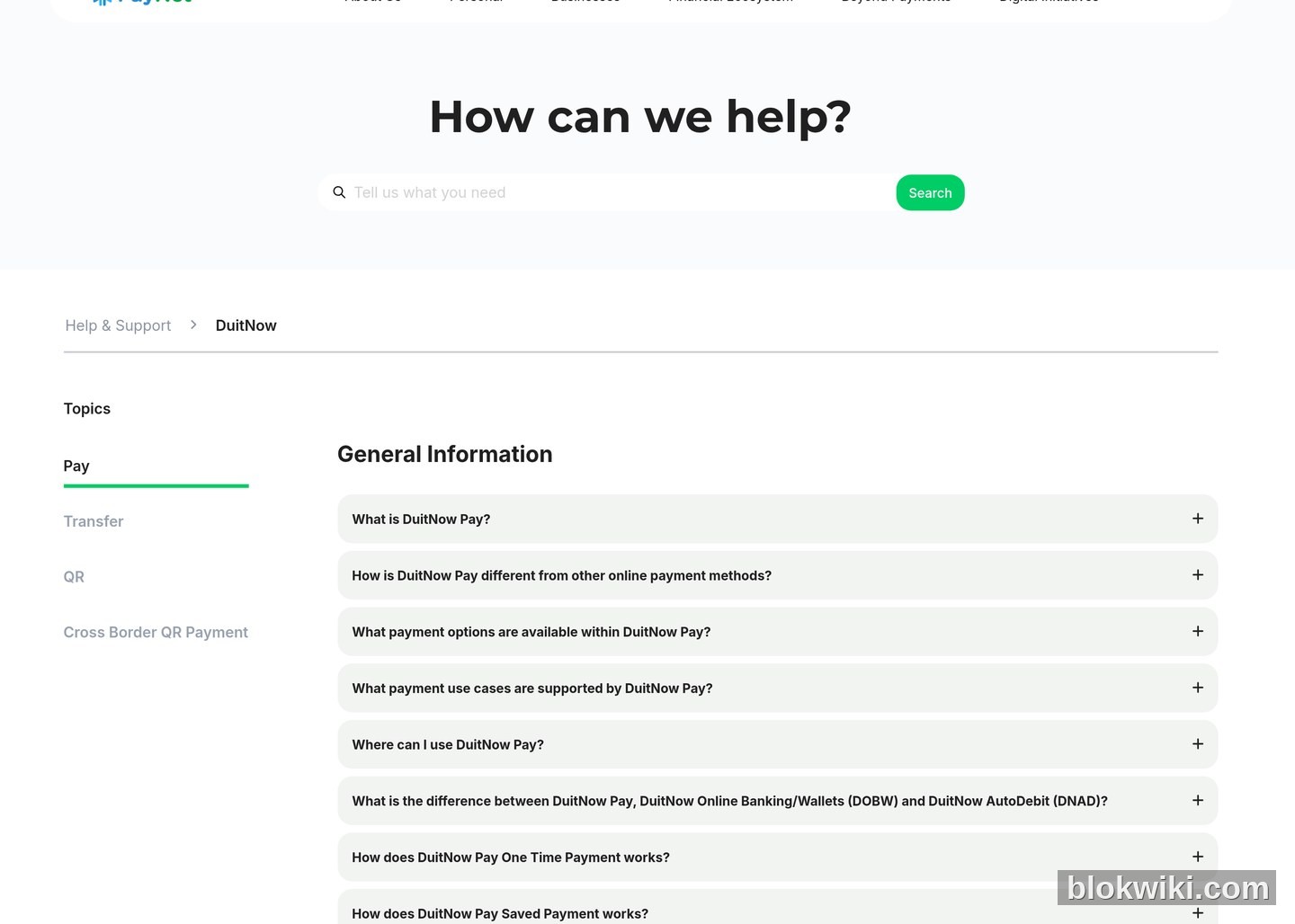
In Malaysia, there are two fundamentally different technical paths to transfer Ringgit (MYR) into crypto exchanges — FPX and DuitNow. Most Chinese-language content conflates them, but they are two separate products operated by PayNet (Payments Network Malaysia Sdn Bhd), with vastly different capabilities and limits. Let's start with their official pages:
FPX (Financial Process Exchange)
FPX is PayNet's bank-to-bank real-time gateway, launched in 1998, covering all 24 commercial banks + 14 e-wallets + 8 digital banks in Malaysia. Key parameters from PayNet's official FAQ:
- Per-Transaction Limit: RM30,000 (single transaction), no explicit cumulative cap within 24 hours
- Supported Banks: Maybank, CIMB, Public Bank, RHB, AmBank, Hong Leong, OCBC, HSBC and 16 others + Maybank2u M2U e-banking
- Core Mechanism: You click "Pay with FPX" on the merchant page → redirected to your bank's app → bank debits your account in real time → merchant bank receives funds instantly. No manual bank account entry required throughout — similar to UnionPay Online Payment in China.
- Settlement Time: Typically under 10 seconds, maximum 1 minute
DuitNow
DuitNow is PayNet's three-in-one instant payment system launched in 2019, integrating three sub-products:
- DuitNow Transfer: Similar to "mobile banking transfer" in China — you can send funds directly to someone using their phone number, ID card number, or company registration number without knowing their bank account number.
- DuitNow QR: Similar to WeChat / Alipay payment codes — complete payment by scanning a QR code, almost universally accepted by offline merchants in Malaysia.
- DuitNow AutoDebit (DNAD): Similar to auto-debit agreements in China — allows merchants to auto-charge your bank account periodically for subscriptions, utilities, etc.
Key differences summarized:
| Feature | FPX | DuitNow |
|---|---|---|
| Positioning | Bank-to-bank real-time gateway | Three-in-one instant payment system |
| Limits | RM30k/transaction | RM10k/transaction (Transfer/QR), AutoDebit set separately |
| Use Cases | Merchant payments (e-commerce, travel bills, direct crypto exchange deposits) | Person-to-person transfers, QR payments, subscription auto-debits |
| Primary Use on Crypto Exchanges | Direct MYR deposits on local DAX (Luno/Hata/MX Global) | Preferred channel for P2P sellers on international exchanges (MEXC/Binance/OKX) |
| Settlement | Under 10 seconds | Instant (Transfer/QR), AutoDebit follows set cycles |
International Exchanges: MYR P2P Side-by-Side Comparison
International exchanges do not hold a Malaysian SC license, so they cannot offer direct MYR bank transfer deposits — the only channel is the platform's internal P2P (peer-to-peer) marketplace. P2P works like this: you find a counterparty selling USDT in the exchange's P2P market; they offer local payment methods like DuitNow / FPX / Touch 'n Go / Maybank2u; you transfer MYR to them; their USDT is automatically allocated to you via the exchange's escrow system. Exchanges charge no platform fees on P2P, but the buy-sell spread is the actual cost.
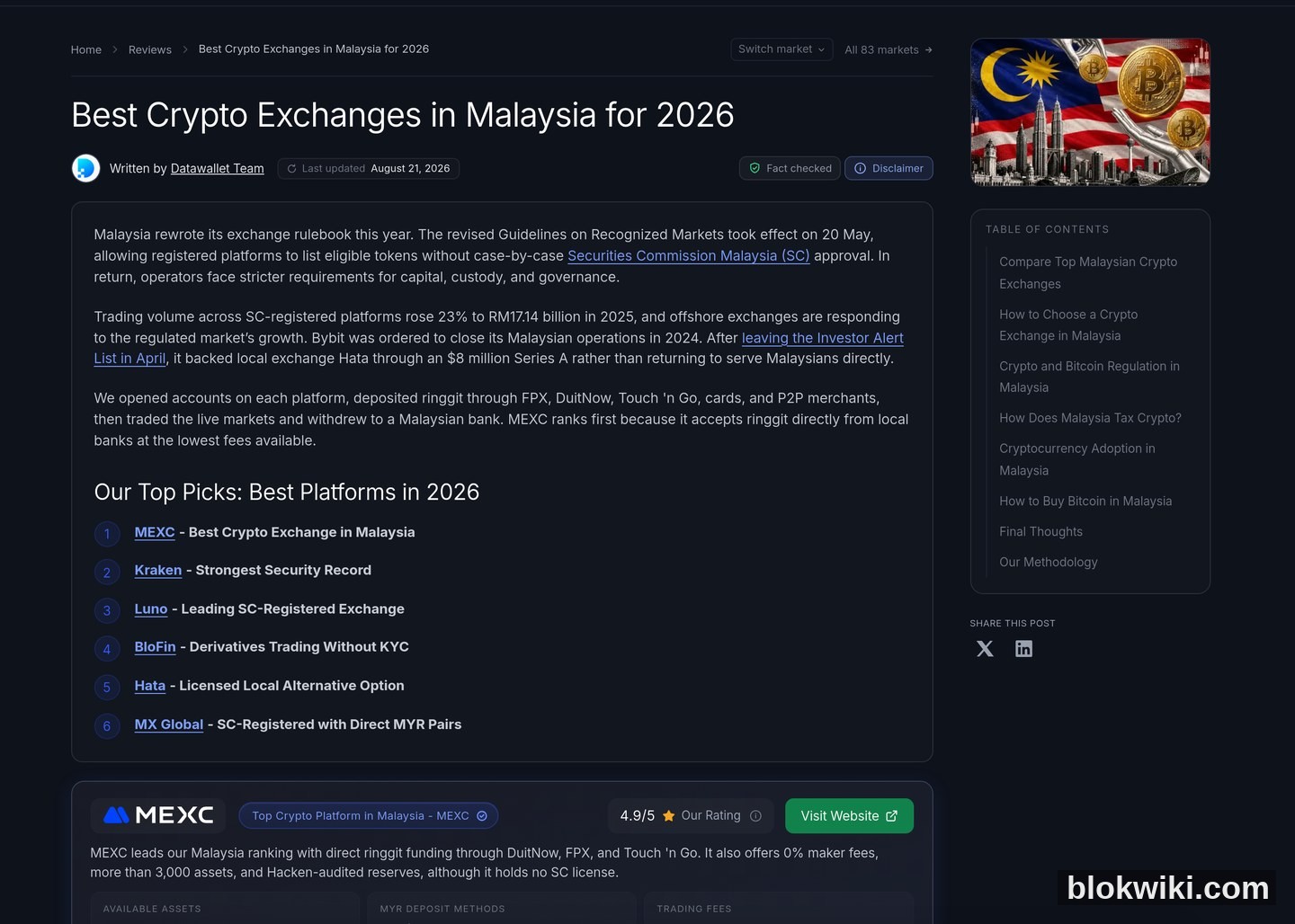
Datawallet conducted a full end-to-end test of 6 Malaysian exchanges in August 2026: real account opening, real FPX/DuitNow deposits, real P2P trades, real withdrawals back to Malaysian banks. Here are the key findings:
| Exchange | MYR P2P Support | Fees | SC License | Guardian Fund / POCR | Notes |
|---|---|---|---|---|---|
| MEXC | DuitNow / FPX / TnG / Maybank2u / Credit Card (Deepest Liquidity) | Spot Maker 0% / Taker 0.05% | None (SC Investor Alert List) | Hacken-audited Proof of Reserves + $100M Guardian Fund | 3,000+ assets, full Futures + Copy Trading; P2P spread typically 0.5–1.5% |
| Binance | DuitNow / FPX / TnG / GrabPay / Credit Card (second-deepest liquidity) | Spot 0.075% (regular users) | None (SC Investor Alert List) | SAFU Fund + periodic POCR | Less P2P order book depth than MEXC; some users report occasional risk-control rejections from P2P counterparties |
| OKX | DuitNow / FPX / TnG (third liquidity depth) | Spot 0.08% (regular users) | None (SC Investor Alert List) | OKX Reserve certification + periodic external audit | Full feature set, but MYR P2P depth is moderate — split large amounts into multiple smaller orders |
| Bybit | DuitNow / FPX / TnG (reopened after leaving SC Alert List in April 2026) | Spot 0.10% (unified Maker/Taker) | None (invested Hata $8M USD) | Bybit Protection Fund | Bybit indirectly re-entered the Malaysian market via an $8M Series A investment in Hata (2026-04); independent MYR P2P offering is still being finalized |
| Bitget | No longer serving Malaysian users since 2026 | — | — | — | Bitget has added Malaysia to its restricted service regions clause |
| Kraken | No MYR P2P (credit card deposits only) | Spot 0.40% / 0.80% | None | 100% cold storage + periodic POCR attestation | Best security track record, but MYR users must first buy USDT and transfer to Kraken |
P2P Safety Rules: Trade only within the platform's escrow; trade only with counterparties with both high volume AND high positive ratings; keep all messages and payment receipts inside the exchange app (do not switch to WhatsApp / Telegram); only "release" crypto assets after MYR has arrived in your own bank account; split large amounts into multiple smaller orders (RM5k or less per order is easier to match and reduces risk-control risk).
Licensed Local DAX: Direct MYR Deposits (Free, Instant, SC-Regulated)
If you want nothing to do with P2P — or you have large amounts of MYR to transfer legally and compliantly in one shot — Malaysia has 5 Digital Asset Exchanges (DAX) holding Securities Commission Malaysia (SC) licenses: Luno, Hata, MX Global, SINEGY, Kinetic DAX. Luno and Hata are the two with the largest user bases and most complete feature sets.
Luno (First SC-Approved DAX in 2019)
- Founded: Became Malaysia's first SC-approved DAX in 2019; holds the largest market share
- Deposit Methods: FPX free (RM100+) + instant settlement, Touch 'n Go eWallet free
- Withdrawal: FPX withdrawal RM0.10, same-day settlement
- Fees: Spot Maker 0.35% / Taker 0.60%, Instant Buy 2% (recommended to use Luno Exchange for half the fees)
- Assets: Approximately 50 crypto assets (primarily BTC, ETH, SOL, ADA)
- Extra Features: Staking (ETH ~3% APY), Bundle (auto-rebalanced basket of large-cap coins), Recurring Buy
Hata (SC + Labuan Dual License)
- Founded: Founded in 2023 by David Low, former Luno Asia-Pacific head; holds both SC DAX license + Labuan FSA international business license
- Deposit Methods: FPX + DuitNow, free, instant
- Withdrawal: FPX + DuitNow, instant settlement (Luno is same-day; Hata is instant)
- Fees: Spot Maker 0% / Taker 0.10–0.40%, Instant Buy 1% (half of Luno's)
- Assets: Approximately 20 (fewer than Luno, but Maker 0% fees + instant two-way deposit/withdrawal are the biggest selling points)
- Extra Notes: Bybit invested $8M Series A in Hata in April 2026 — this is how Bybit indirectly returned to the Malaysian market after leaving the SC Alert List; UNCONFIRMED: whether Bybit's investment means Hata will expand its asset listings (regulatory text does not explicitly state this)
Why Do Some Users Prefer P2P Over SC-Licensed DAX?
Three core reasons:
- Asset Selection Gap: MEXC has 3,000+ assets; Luno has only 50, Hata only 20 — small-cap coins and altcoins can only be found on international exchanges.
- Fee Gap: MEXC Maker 0% / Taker 0.05% vs Luno Maker 0.35% / Taker 0.60% — Luno's fees are 10–12x higher than MEXC's.
- Futures / Copy Trading: Only international exchanges offer derivatives trading, copy trading, quantitative bots, and similar features.
In practice, many Malaysian users adopt a hybrid strategy: Luno/Hata for MYR deposit + compliant storage, MEXC for active trading and small-cap investments — using USDT as the bridge between the two ecosystems.
2026 SC Regulatory Update: Token Listing Liberalization + Two-Year Transition
On May 20, 2026, the SC revised the Recognized Markets Guidelines — the most significant regulatory change since the DAX framework was established in 2019. Core changes:
- Token Listing Liberalization: Registered DAX can now independently decide which qualifying tokens to list, without requiring SC case-by-case approval — meaning Luno and Hata may list more assets in the future, though the SC retains ex post oversight authority.
- Higher Capital Requirements: DAX minimum paid-up capital raised from RM1M to RM5M; existing DAX have a two-year transition period (May 2026 – May 2028).
- Mandatory Ombudsman Membership: All DAX must join the Financial Markets Ombudsman Service — users can now file complaints through an independent channel (previously only internal complaints were available).
- Institutional Shareholder Requirement: DAX must have at least one institutional shareholder.
Separately, LHDN (Malaysian Inland Revenue Board) revised the Digital Currency Transactions Tax Treatment in December 2025 — key changes:
- Passive Investment Returns Not Taxed: Capital gains from holding crypto assets long-term and selling are not taxed (Malaysia's 2024 CGT introduction does not cover digital assets).
- Active Trading Taxed as Income: Profits from frequent trading or short-term holdings are taxed under personal income tax progressive rates of 0–30%.
- Crypto-to-Crypto Swap = Disposal: crypto-to-crypto swaps are treated as a "disposal" of the first asset and may trigger a taxable event.
- Crypto Earn / Staking: Periodic income is fully taxed as income in the year received.
Malaysia Crypto Regulatory Timeline (Key Milestones):
| Date | Event |
|---|---|
| 2019-01 | Capital Markets and Services Order takes effect; crypto assets fall under SC regulation; Luno becomes the first DAX. |
| 2020-10 | Digital Asset Guidelines introduces IEO rules + licensed custodian requirements. |
| 2021-06 | SC Shariah Advisory Council rules: crypto trading on registered DAX is Shariah-compliant. |
| 2025-06 | BNM launches Digital Asset Innovation Hub (stablecoin sandbox). |
| 2026-03 | SC revises ETF guidelines, approves cryptocurrency ETFs; Bursa begins considering listing rules. |
| 2026-05 | SC Recognized Markets Guidelines revision takes effect — token listing liberalization + two-year transition. |
| 2026-07 | SC re-adds Binance, MEXC, OKX to Investor Alert List; Bybit has been removed (following Hata investment). |
Implementation Roadmap Recommendations: Which Path Should You Take?
Based on your needs and risk tolerance, three recommended paths:
Path A: Fully Compliant Conservative
- Deposit: Luno or Hata, direct FPX MYR deposit, free and instant
- Trading: Only buy large-cap coins like BTC / ETH / SOL, spot trading only
- Cost: Luno Exchange Maker 0.35% / Taker 0.60%, or Hata Maker 0% / Taker 0.1–0.40%
- Best For: First-time crypto users, anyone wanting to avoid "gray areas," users needing Ombudsman protection
- Drawbacks: Fewer assets, higher fees, no derivatives
Path B: Compliant Deposit + P2P Active Trading (Most Common)
- Deposit: Luno FPX direct deposit → buy USDT → transfer to MEXC address
- Active Trading: MEXC P2P — direct DuitNow / FPX / TnG for USDT top-ups; direct withdraw back to MYR bank
- Cost: MEXC Maker 0% / Taker 0.05% + P2P spread 0.5–1.5%
- Best For: Users wanting to trade altcoins, use Futures / Copy Trading, minimize fees
- Key Risk: MEXC has no SC license (SC Investor Alert List), not covered by Malaysia's domestic Ombudsman — for large MYR deposits/withdrawals, still recommend going through Luno/Hata directly.
Path C: Pure P2P International Player
- Deposit: Directly post orders on MEXC / Binance P2P market, receive via DuitNow
- Trading: Complete all operations directly on international exchanges
- Cost: MEXC Maker 0% / Taker 0.05%, P2P spread 0.5–1.5%
- Best For: Experienced users comfortable with international exchange interfaces, trading only USDT pairs, splitting large orders to reduce risk-control risk
- Additional Note: LHDN taxes "active trading" as business income — crypto trading profits must be declared in Form B submitted annually in April.
Risk Notice: Crypto assets are highly volatile and Malaysia's regulatory framework is still evolving rapidly — all SC / PayNet / LHDN / Datawallet information cited in this article is accurate as of October 30, 2026. Specific exchanges (MEXC, Binance, OKX, etc.), although they have active users in Malaysia, remain on the SC Investor Alert List and are not protected by Malaysia's domestic Ombudsman. Luno, Hata, and MX Global hold SC DAX licenses but have limited asset selection. All UNCONFIRMED items (such as the follow-up arrangements after Bybit's Hata investment) have been explicitly marked in the text. LHDN tax rules classify income as active or passive — frequent trading is considered business income and must be self-declared. Any bank transfers involving crypto may trigger bank risk-control reviews (PayNet 2026 data shows crypto-related FPX / DuitNow transactions account for 11% of the total). This article does not constitute investment or tax advice; please verify local compliance requirements independently before taking any action.