CLARITY Act Fails 49-50: SEC vs CFTC, DeFi and Stablecoin Yield Explained
On 15 September 2026 the US Senate voted 49-50 on a cloture motion to advance the Digital Asset Market Clarity Act (H.R. 3633), short of the 60 votes …
On 15 September 2026, the US Senate voted on a cloture motion to advance the Digital Asset Market Clarity Act (H.R. 3633). The result was 49 in favour, 50 against — 11 votes short of the 60 required. Procedurally the bill was not killed (Republican Senator Tillis then filed a motion to reconsider), but the Senate immediately entered a state work period from 5 October to 6 November, running straight into November's midterms and leaving an extremely narrow window to finish the legislation in 2026.
The news matters because it determines whose rules the US crypto industry will follow over the next few years — the Securities and Exchange Commission (SEC) or the Commodity Futures Trading Commission (CFTC). This article lays out the bill's legislative timeline, the core provisions of its four main parts, and the real arguments on both sides, and clears up a few common misconceptions.
Why the vote failed: 49 to 50 — and the gap isn't 11 votes
First, the key milestones in chronological order (all traceable to official pages or the Congressional Record):
- 29 May 2025: The bill is introduced in the House as H.R. 3633, titled the Digital Asset Market Clarity Act of 2025.
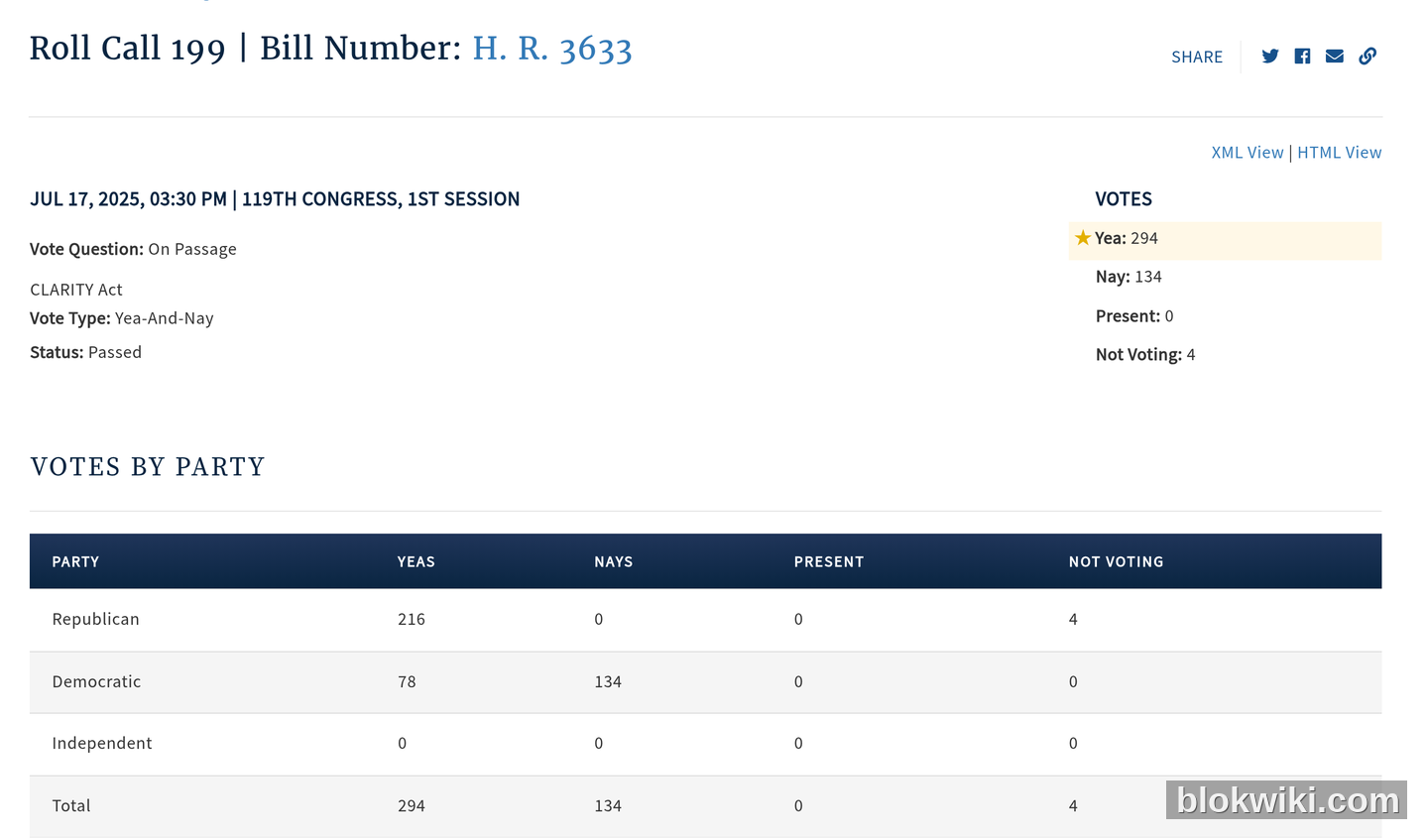
- 17 July 2025: The House passes it 294 to 134 (House Roll Call No. 199) — a notably high bipartisan tally.
- 14 May 2026: The Senate Banking Committee passes it 15 to 9 on a bipartisan vote, sending it to the full Senate.
- 1 June 2026: Placed on the Senate Legislative Calendar as Calendar No. 423.
- 7 August 2026: The Senate files a cloture on the motion to proceed, co-sponsored by 17 Republican senators including Thune.
- 14 September 2026: Senators Lummis, Boozman and Scott release the final substitute text, with 126 changes made at Democratic request, plus a new Tillis–Gallego ethics provision and authority for the Treasury Secretary to prevent stablecoin deposit flight.
- 15 September 2026: The cloture vote is 49 to 50, short of the 60-vote threshold (Senate Roll Call No. 234).
Note the composition of the no votes: beyond Democrats opposing the bill as a bloc, 4 Republican senators voted against it (Collins, Hawley, Moran, Tillis). Analyses across several outlets point to the same trigger — not the SEC/CFTC jurisdictional split itself, but the ethics provision on public officials' crypto holdings. That's why an ethics provision added on 14 September still didn't get the bill through on 15 September.
One more thing to keep in mind: a failed cloture vote doesn't mean the bill is dead. Tillis filed a motion to reconsider, so the bill is still procedurally alive — it's just stuck behind the midterm calendar.
The core problem the bill addresses: drawing a line between the SEC and the CFTC
The long-standing contradiction in US crypto regulation is that "the same token is a security to the SEC and a commodity to the CFTC." Title I of the CLARITY Act (titled "Responsible Securities Innovation") is meant to do exactly that: divide jurisdiction over digital assets between the two regulators — "digital commodities" go to the CFTC, "digital securities" to the SEC.
Three features of the design are worth remembering:
- Defining "ancillary assets / network tokens": These tokens derive value from the "entrepreneurial or managerial efforts" of others. The bill treats the token itself as a commodity and sets up a rebuttable presumption — it is treated as a commodity unless the issuer or intermediary proactively files a "non-ancillary asset" certification with the SEC.
- A "Regulation Crypto" exemption channel: It provides a registration exemption for ancillary assets tied to investment contracts, with issuance capped at $50 million per calendar year (over 4 years), or 10% of circulating value — whichever is higher — with cumulative gross fundraising not exceeding $200 million.
- Insider resale restrictions: No resale for 12 months; it also clarifies that DAOs and decentralised governance are not deemed "centralised control" merely for routine operations.
A note: these provisions come from the Senate's official Section-by-Section document, the most authoritative summary currently available; the bill is still being amended, and the final text is subject to the version Congress formally publishes.
The four parts: from token exemptions to DeFi and stablecoin yield
Beyond the jurisdictional split, the bill has three substantive titles, each addressing a concrete issue the industry has argued over for a long time:
- Title II — Countering illicit finance: Treats brokers, proprietary traders and trading platforms for digital commodities as financial institutions under the Bank Secrecy Act, subject to AML, KYC and customer due diligence duties; creates a federal regulatory framework and transaction limits for crypto ATMs (kiosks); and requires the Treasury to study mixers/tumblers.
- Title III — DeFi: Defines the conditions under which a DeFi trading protocol counts as "non-decentralised" (judged by control, discretion, and whether transactions can be altered or censored); provides sanctions and AML guidance for front-end "distributed ledger messaging systems"; adopts a voluntary NIST cybersecurity programme; and sets risk management standards for digital asset intermediaries.
- Title IV — Banking and stablecoins: Allows banks to use blockchains for activities they are already licensed to conduct; this title deals specifically with "stablecoin yield" — precisely where banking and crypto clash hardest.
In addition, per the bill summary in the Congressional Record, the bill amends the Federal Reserve Act to bar Reserve Banks from offering certain products and services directly to individuals and prohibit the use of central bank digital currency (CBDC) for monetary policy. This is usually read as an explicit limit on the "digital dollar" path.
Who opposes it, and on what grounds
The opposition isn't "opposition for its own sake." A Fact Sheet released by the minority (Democratic) staff of the Senate Banking Committee lists five "minimum standards" it says remain unmet, and it's worth reading in full:
- Backdoor for securities law: They see the self-certification mechanism for "ancillary assets / network tokens" as a loophole.
- National security and illicit-finance gaps: They say it fails to close the Tornado Cash and mixer gaps, exempts DeFi from AML obligations, and does not address foreign actors evading sanctions.
- Banking risks: They argue banks could use digital assets to evade century-old bans on high-risk investments, and use deposits for hedging trades like those banned under the Volcker Rule.
- Conflicts of interest: They explicitly demand that conflicts of interest involving public officials' and their families' crypto holdings be addressed.
- Insufficient investor protection: They argue it weakens the SEC's anti-fraud disclosure role, pre-empts state law, and grants investors no private right of action.
Beyond the Democrats, the AFL-CIO explicitly urged a no vote on CLARITY and the stablecoin bill in the Congressional Record, and Senator Warnock issued a statement on 15 September explaining his opposition. These objections set the bar any later revision must clear.
FAQ
Is the CLARITY Act completely dead now?
No. The failed cloture vote merely meant "debate couldn't be closed to move into formal consideration." Tillis then filed a motion to reconsider, and the bill remains on the Senate's legislative calendar (Calendar No. 423). But with the Senate in a state work period from 5 October to 6 November 2026 and the midterms right after, completing the legislation within 2026 is unlikely, and the more realistic window is the next Congress.
How does it relate to the GENIUS Act and FIT21?
The three do different jobs. The federal framework for stablecoins is already handled by the GENIUS Act, signed into law on 18 July 2025 — the first US federal law on payment stablecoins. FIT21 (H.R. 4763) is a market-structure bill passed by the House on 22 May 2024, an earlier version of the same subject. CLARITY handles what FIT21 didn't cover or that needs updating (exchange registration, DeFi, the SEC/CFTC split, and stablecoin yield). One caveat: the two are "same subject, CLARITY later," and we could not verify from official texts whether there is any provision-by-provision inheritance.
Does the bill's failure mean US crypto regulation has stalled?
No. Two days after the vote failed (17 September 2026), the SEC issued an "innovation exemption" (Release No. 34-106402), temporarily exempting "tokenised securities venues (TSVs)" from the Exchange Act's definition of "exchange" to support matching of tokenised NMS stocks. Earlier, on 18 August 2026, the SEC also proposed a "Regulation Crypto Assets" rule (Release 33-11434) with two exemptions (up to $5 million over 4 years, and up to $75 million per 12 months). When legislation stalls, regulators move on their own — the most easily overlooked thread in this story.
What does this mean for ordinary holders?
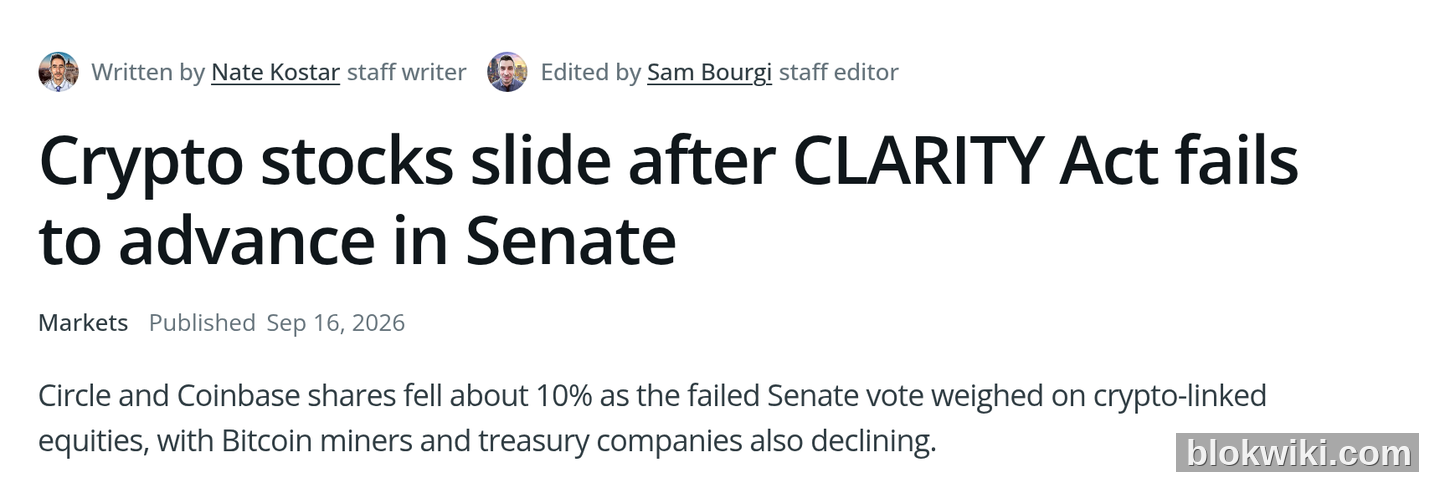
It bites on two levels. First, the market level: on the day of the 15 September vote, crypto-related stocks fell sharply — Coinbase and Circle dropped about 10%, while unrelated names like AMD were untouched, and miners Riot fell about 6%, CleanSpark about 5% and Hut 8 more than 4%, while BTC briefly dropped below $75,000. Second, the rules level: if the bill passes, there will be clear answers on exchanges' registration path, token listing standards and whether stablecoins can pay yield; if it stays stuck, the rules will be pieced together from regulators' enforcement actions and exemption documents, which is worse for small projects.
What dates should I watch next?
Three observable signals: ① whether the Senate re-schedules the bill after its state work period ends (6 November 2026); ② whether Tillis's motion to reconsider gets a vote; ③ the public comment results on the SEC's "Regulation Crypto Assets" rule and the 17 September innovation exemption — regulators moving on their own often change the industry's de facto rules faster than Congress does. To see institutional moves, compare product progress like BlackRock's filing for a bitcoin "downside protection" ETF; and the case of Coinbase winning CFTC clearinghouse registration shows exactly how "getting a licence" and "waiting for legislation" can run in parallel.
Risk notice: Cryptoasset prices are highly volatile and you may lose your entire principal; this article does not constitute investment advice. The bill's provisions and legislative progress are subject to the text Congress formally publishes, the official vote records of the House and Senate, and regulators' press releases; the media reports and anonymous sources cited here may be inaccurate. Legislative outcomes are highly uncertain; any investment decision based on policy expectations should be independently judged, and you should verify the original documents yourself.