Binance bStocks Collateral: Tokenized Stocks Are Not Shares, Sector Is ~$3.74B
On 28 October 2026 Binance added five new bStocks to eligible collateral on Cross Margin, Portfolio Margin and Portfolio Margin Pro. Yet in Binance's …
On 28 October 2026, Binance announced that it would add five new bStocks (Bending Spoons, two 2x leveraged SK Hynix ETFs, GE Vernova and Applovin) to the eligible collateral set for Cross Margin, Portfolio Margin and Portfolio Margin Pro, while opening margin trading for the corresponding pairs. This is not an ordinary listing announcement: it means that for the first time a major exchange is treating "stock tokens" as collateral that can be leveraged.
But there is a key fact that almost every Chinese-language report skips: in Binance's own wording, bStocks are "not stocks or shares". A bStock is a certificate representing a financial instrument, and the holder does not directly own shares in the underlying listed company. This article breaks tokenized stocks into three layers: what the legal structure actually is, how large the market really is in 2026, and what extra risks arise when you use it as collateral.
First, the legal nature: what you buy is not a stock
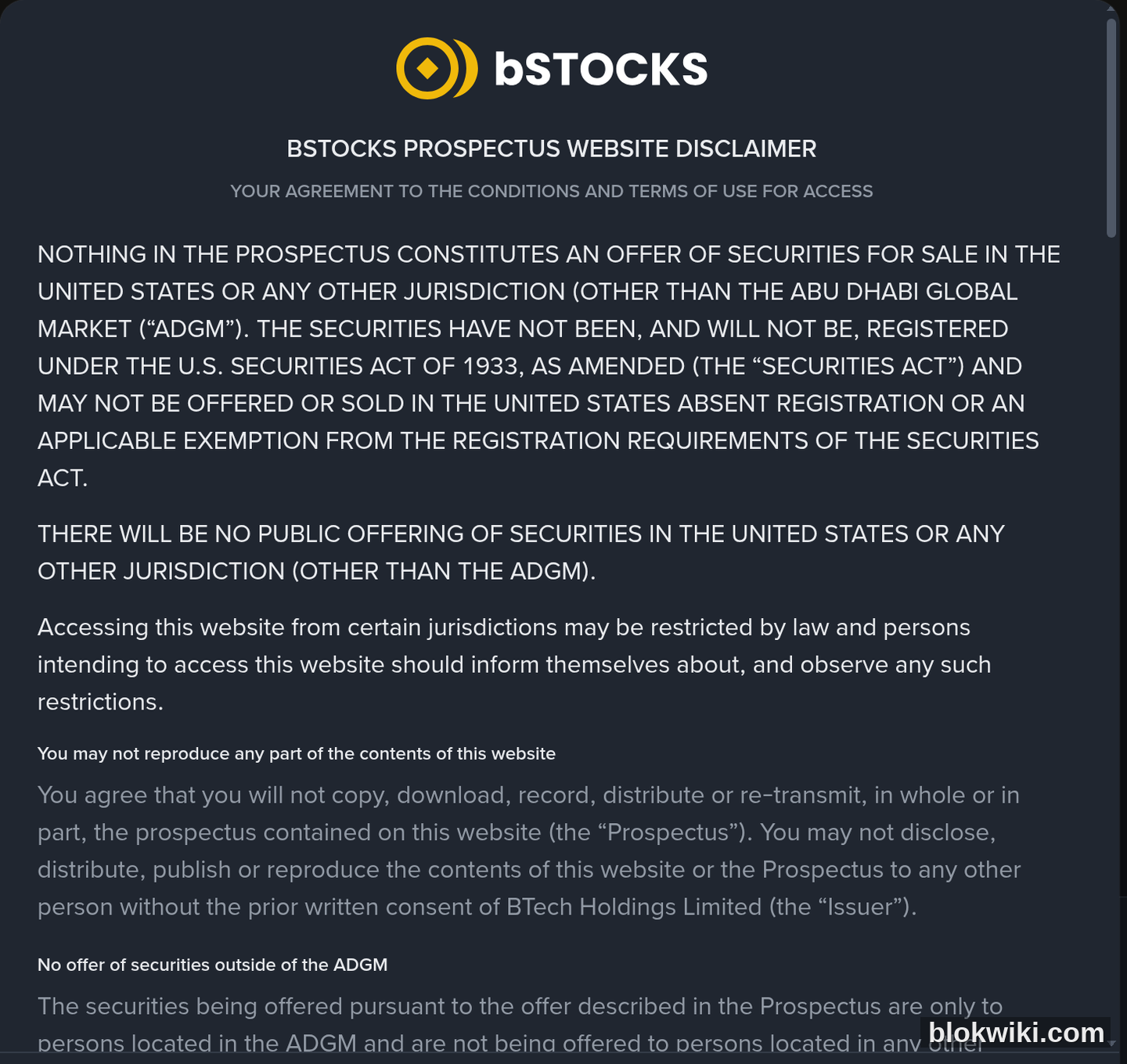
This is the premise for understanding the whole sector. Binance puts it plainly in the bStocks announcement: bStocks are "Certificates representing certain Financial Instruments" (FSMR Schedule 1, paragraph 92), and it explicitly declares that "bStocks are not stocks or shares". Holders cannot directly own shares of the underlying listed company, and bStocks do not represent any affiliation with the issuer of the underlying instrument.
The same structure shows up at peers:
- Robinhood Stock Tokens are issued by Robinhood Assets (Jersey) Limited. The official documentation states that they are "tokenised debt securities" and that the token "does not grant investors any legal or beneficial rights in, or against the issuer of, those underlying securities".
- Ondo takes the structured note route. Its legal documents make clear that the tokens do not appear on the shareholder register and carry no voting rights; the Broadridge channel it offers is only a governance feature for expressing voting preferences, not shareholder rights.
- xStocks (Backed) is legally a tracker certificate, likewise with no shareholder voting rights, and dividends are passed through via a rebasing mechanism.
Only two products are genuinely "closer to real share ownership": Dinari claims to preserve economic rights and to vote "where applicable"; Backpack Securities lets registered eligible holders redeem tokens into real shares via ACATS/DTCC, but that channel is open to very few people.
In other words, the vast majority of "stock tokens" on the market give you economic exposure, not equity ownership. The distinction is almost imperceptible while prices rise, but it suddenly matters in bankruptcy, dividends, voting and tender offers.
Where regulation stands in 2026
The US track has three clear milestones in 2026, but note that none of them is an "approval of Binance bStocks":
- 2026-01-28, SEC staff "Statement on Tokenized Securities": it divides tokenized securities into "issuer-sponsored" and "third party-sponsored" categories, and states that third-party tokenized securities "may or may not confer upon the holder any rights as a holder of the underlying security", with holders potentially exposed to risks such as third-party bankruptcy. Note that this is a staff statement with "no legal force or effect".
- 2026-08-18, proposed "Regulation Crypto Assets" (Release Nos. 33-11434 / 34-106150): it designs two registration exemptions for "covered investment contracts", a one-time $5 million (over 4 years) and $75 million every 12 months. This is a proposed rule, not a final one, with a 60-day public comment period.
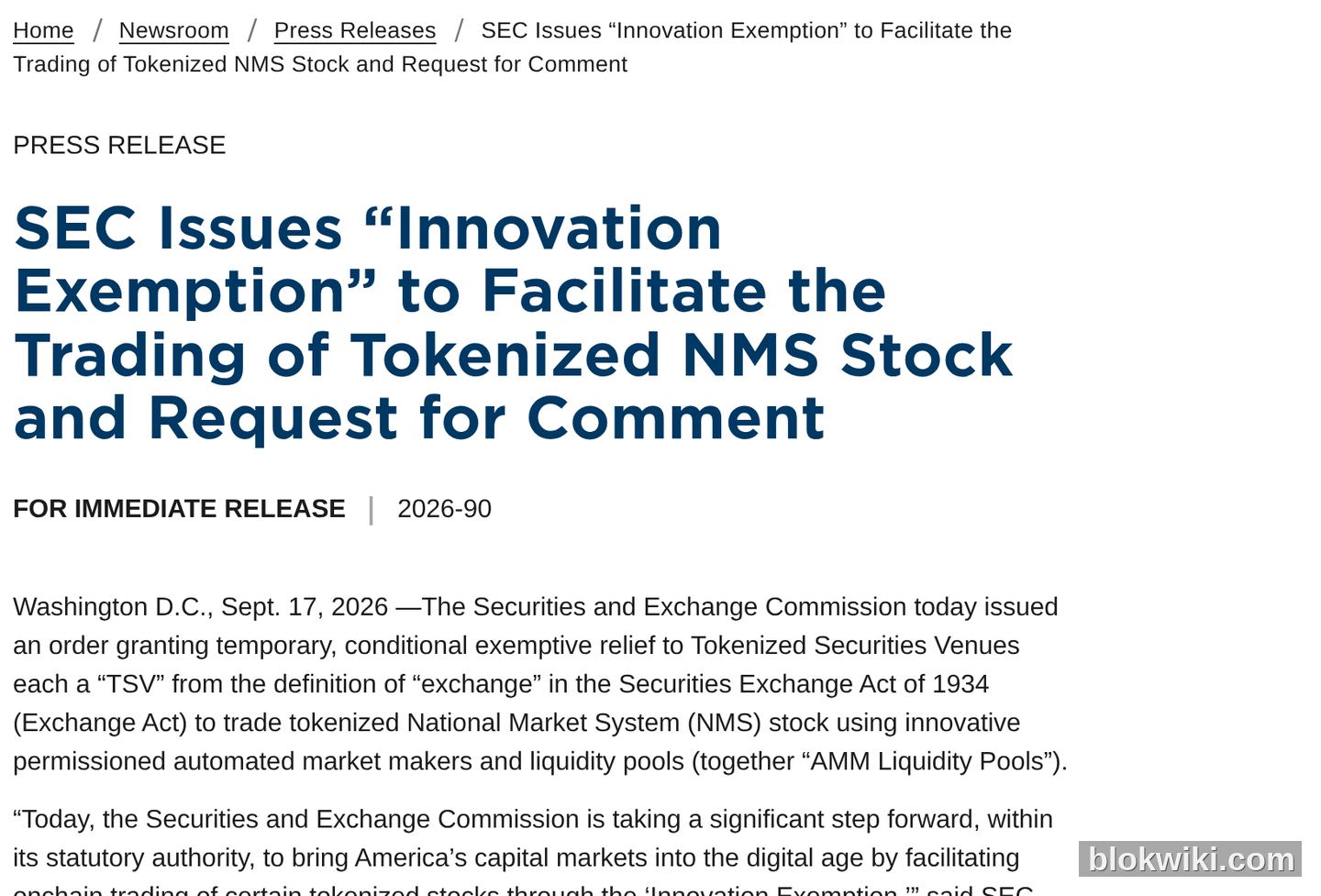
- 2026-09-17, "Innovation Exemption" (Release No. 34-106402): it temporarily and conditionally exempts TSVs from the "exchange" definition and allows them to trade tokenized NMS stocks; the exemption expires 5 years after publication in the Federal Register, and a TSV must publish public notice at least 30 calendar days in advance.
The conditions of this exemption are quite specific and worth reading one by one, because they reveal in reverse what regulators worry about most: limits on the number of underlying instruments and on trading volume; a TSV must verify that token holders enjoy "same rights and privileges" as holders of traditional NMS stocks; for stocks tokenized by an unaffiliated third party, it must notify the underlying issuer in writing and give it an opportunity to object; smart contracts must be auditable, public and deployed on a public permissionless ledger; and when the underlying stock is halted on its primary exchange, the TSV must halt trading as well.
As of the SEC page update on 2026-10-21, only three entities have submitted TSV notifications: TSV LLC (2026-09-23), OKXICE TSV (2026-10-04), Kephas Corporation d/b/a Perpetuals.com (2026-10-14). The SEC explicitly states that "inclusion does not mean" they meet the TSV definition or the exemption conditions.
bStocks takes an entirely different path: it is offered under an Approved Prospectus in ADGM (Abu Dhabi Global Market), and the announcement states that they "are not offered in any other jurisdiction" and that they are "not offered, sold, distributed, made available, or accessible in the United States or to, or for the account or benefit of, U.S. persons"; they are also not registered under the Securities Act of 1933 or any state securities law.
Using it as collateral: the haircut is the real risk pricing
The technical details of this announcement matter far more than "five new underlying assets":
- Only three margin systems: Cross Margin, Portfolio Margin and Portfolio Margin Pro. The announcement also states "Borrowing is not currently supported", meaning you cannot yet borrow against it.
- There is an access threshold: Regular, VIP 1 and VIP 2 users must first complete a suitability assessment questionnaire.
- What happens when US markets are closed: according to media reports, the rules will freeze the index price at the US close and apply a discount to collateral value. That detail comes from secondary reporting; we could not obtain Binance's official "bStocks Margin Collateral Risk Controls Guide".
- Haircut: only second-hand numbers available. According to The Defiant, the collateral ratio for Cross Margin and Portfolio Margin is about 50%, so $10 of market value counts as only about $5 of margin; Portfolio Margin Pro has a separate tiered table. We could not verify this figure on Binance's official pages, so treat it as a reference value when citing it.
The order of 50% is itself a form of risk pricing: the exchange considers stock tokens clearly less safe as collateral than cash and major stablecoins. By comparison, when Aave V4 accepted seven Coinbase tokenized stocks as USDC collateral on Base, LlamaRisk assigned a collateral factor of 65%–79% and an initial collateral cap of about $29 million. Also a discount, and also a sign that such assets are treated as high-risk collateral.
There is an easily overlooked mechanism detail: tokenized stocks trade 24/7, but the underlying US stocks do not. At weekends and during market closures the token is still matching, with prices set by on-chain supply and demand, so it trades at a premium or discount to the real share price. A 2026 study by the Bank of Finland (sample 2025-07 to 2026-05) found that Ondo token prices that open in sync with US markets track net asset value more closely, while 24/7 products priced by crypto supply and demand during closures see wider premiums and discounts. For collateral, this means your margin level may drift passively over the weekend.
The real size in 2026: about $3.74 billion, not "trillions"
The most exaggerated thing about this sector is its size. According to the Tokenized Stocks page on RWA.xyz (page snapshot of 2026-10-28):
| Metric | Value | Definition |
|---|---|---|
| Distributed Value | about $3.74 billion | value of natively issued on-chain tokens, +1779% versus 30 days earlier |
| 30-day transfer volume | about $10.14 billion | on-chain transfer value, not holdings |
| Holders | 4.51 million | +12.14% versus 30 days earlier |
| Monthly active addresses | 2.12 million | −39.68% versus 30 days earlier |
Note the divergence of "holders rising, active addresses falling": there are many new holders, but fewer people actually transacting on-chain. That suggests a fair share of buyers simply stop moving their tokens after purchase, which is closer to "buy and hold" than to high-frequency trading.
Platform distribution (2026-10-21 snapshot, a different day from the total above and used only for ranking): bStocks about $1.2 billion, Ondo about $885 million, xStocks about $596 million, Securitize about $309 million, Robinhood about $145 million, Dinari about $11.5 million.
But please pay close attention to the definition: $3.74 billion is "distributed value of natively issued on-chain tokens", and it is not the total market value of the underlying stocks these tokens map to, nor cumulative trading volume. Any claim that "tokenized stocks have reached trillions" either includes the market value of the underlying stocks or mistakes cumulative transfers for outstanding stock. Note also that this table rolls daily: within a single month it has shown both $3.42 billion and $3.74 billion.
Five real risks, each with a source
- No shareholder rights. The official documents of bStocks, Robinhood, Ondo and xStocks all admit this directly. Dividends are usually passed through by rebasing or reinvestment, but voting rights, information rights as a shareholder and the right to participate in tender offers are essentially absent.
- Credit and bankruptcy risk of the issuer and custodian. The SEC statement of 2026-01-28 makes clear that holders of third-party tokenized securities "may be exposed to risks with respect to the third party, such as bankruptcy, to which a holder of the underlying security would not necessarily be exposed".
- Collateral may be substituted. Secondary research citing the Kraken/Bybit risk pages says xStocks collateral "may not always be the underlying stock", with other eligible assets (including cash) usable as substitutes, so holders bear Backed's credit and solvency risk. We could not verify this claim against the exchanges' original text.
- Highly concentrated liquidity. According to secondary analysis, on-chain spot volume in tokenized stocks is concentrated in a handful of names such as TSLAx, NVDAx and CRCLx, with large slippage in the long tail; in 2026-05 Solana accounted for about 97% of on-chain spot volume in tokenized stocks.
- "Fake stock tokens" go to zero. In May 2026, Anthropic and OpenAI separately stated that equity transfers made without the company's written consent (including via SPVs or in tokenized form) are invalid or unauthorized; PreStocks' Anthropic and OpenAI tokens fell about 34%–46% within days, and its Anthropic token at one point implied a valuation above $1.3 trillion while actual assets were only about $23 million, and the promised attestation report was never published. (The above is secondary reporting; we did not obtain the original statements.)
Looking back one more year, there is another case: in July 2025, OpenAI's official X account said publicly that "These 'OpenAI tokens' are not OpenAI equity. We did not partner with Robinhood, were not involved in this, and do not endorse it", directly disavowing the OpenAI stock tokens that Robinhood was then giving away to European users. Such "public disavowal by the issuer" is the most typical black swan for tokenized private shares.
Frequently asked questions
Can bStocks be exchanged for real shares?
The website says 1:1 exchange into the underlying stock is supported, but Binance's announcement also stresses that bStocks are "Certificates", "not stocks or shares", and that holders do not directly own the underlying shares. In other words, "redeemable" is a product promise, not equity ownership. The public case that can genuinely be redeemed into real shares is Backpack Securities, and only for registered eligible holders.
Do bStocks pay dividends?
The official line is that dividends are reflected through reinvestment (dividends reinvested), not paid as cash into your account. That also means you will not see a "dividend received" record on-chain; the return shows up as an adjustment to the token quantity or the net asset value.
Why does the exchange count only 50% of the collateral value?
Because stock tokens carry three layered risks that ordinary stocks do not: issuer credit, the mismatch between 24/7 trading and the underlying market's hours, and liquidity concentrated in a few names. The discount is the exchange's pricing of those risks, and also a reminder to you: an asset that is asked to take a 50% haircut is not suitable as a primary source of margin.
Can users in mainland China or the United States use it?
The announcement states clearly that bStocks are not offered to US persons ("not offered... in the United States or to, or for the account or benefit of, U.S. persons"), and are offered only under the ADGM Approved Prospectus in "permitted jurisdictions" to eligible users through the secondary market, adding that the product is "not available to users in restricted regions". The specific list of countries is not public, so it cannot be confirmed one by one.
Does the SEC's Innovation Exemption amount to approval?
No. It is a temporary, conditional exemption aimed at "trading venues for tokenized NMS stocks", valid for 5 years from publication in the Federal Register, and subject to hard conditions such as issuer notification, equal rights and synchronized halts; as of 2026-10-21 only three entities had submitted TSV notifications, and the SEC also makes clear that being "included" does not mean compliant. It is a regulatory path entirely separate from Binance bStocks.
To understand how "tokenization" lands in other asset classes, compare traditional institutional products such as BlackRock's application for a Bitcoin "downside protection" ETF, and Arthur Hayes' extrapolation of "AI asset securitization" in a review of Arthur Hayes' 2026 views. Both answer the same question: when real-world assets move on-chain, what actually changes and what does not.
Risk notice: Crypto asset prices are highly volatile and you may lose your entire principal; this article is not investment advice. The legal nature of stock tokens such as bStocks is a certificate or a debt instrument, not equivalent to shares of a listed company, and holders generally do not enjoy shareholder rights; their value depends on the issuer's and custodian's ability to perform, with risks including issuer bankruptcy, substitution of collateral and price deviation outside market hours. Figures such as the "50% collateral ratio" come from secondary media reports and could not be verified in the issuer's official documents; regulatory status and product availability are subject to the issuer's announcements and to the original texts of regulators. Any use of stock tokens as margin may result in forced liquidation due to price volatility.