Oracle Manipulation Attacks Hit 42 in 2026, Beating 2022: Data and Defences
Public DefiLlama data shows 42 oracle manipulation attacks through October 2026, above the full-year 2022 figure of 27 and the highest on record, agai…
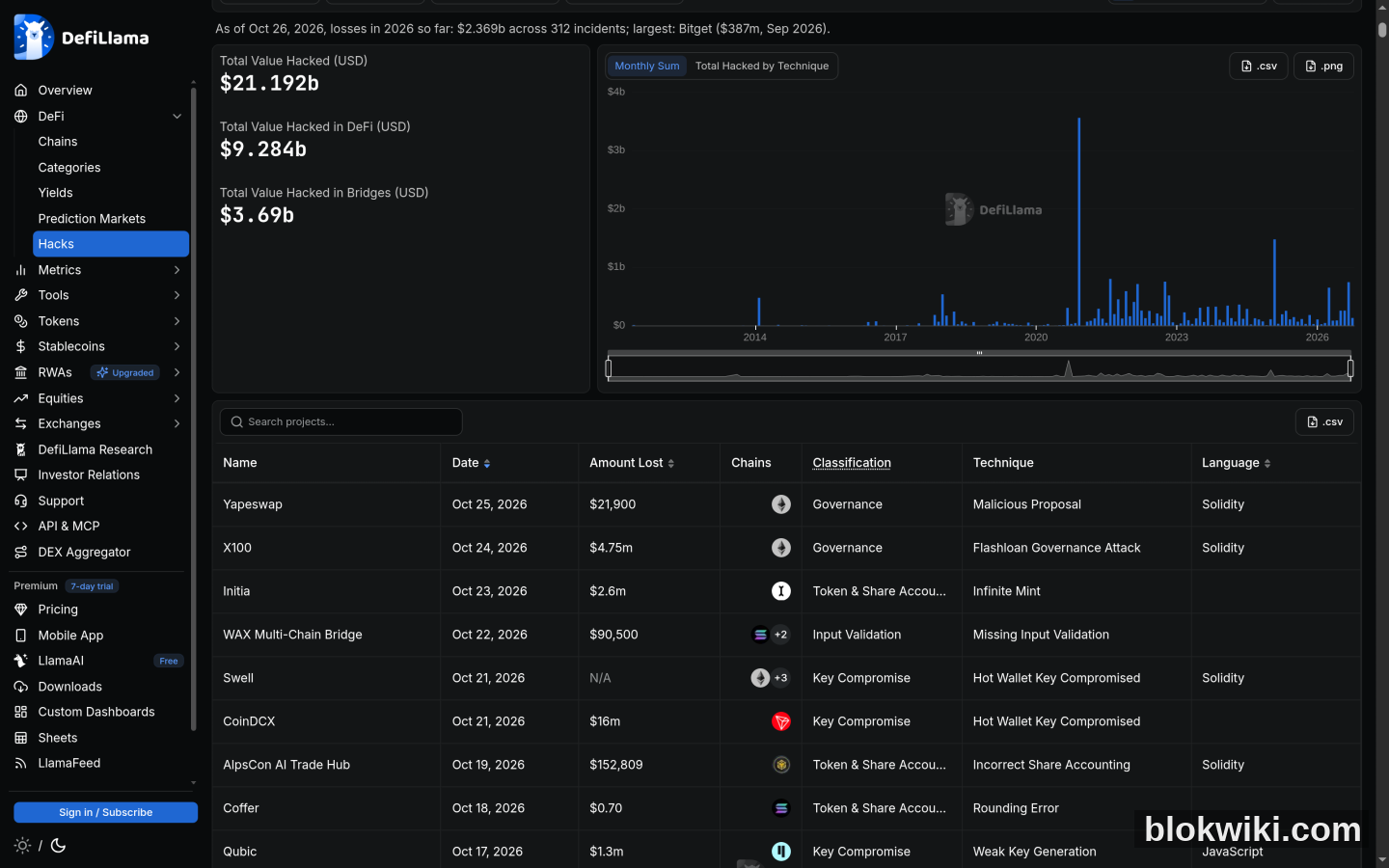
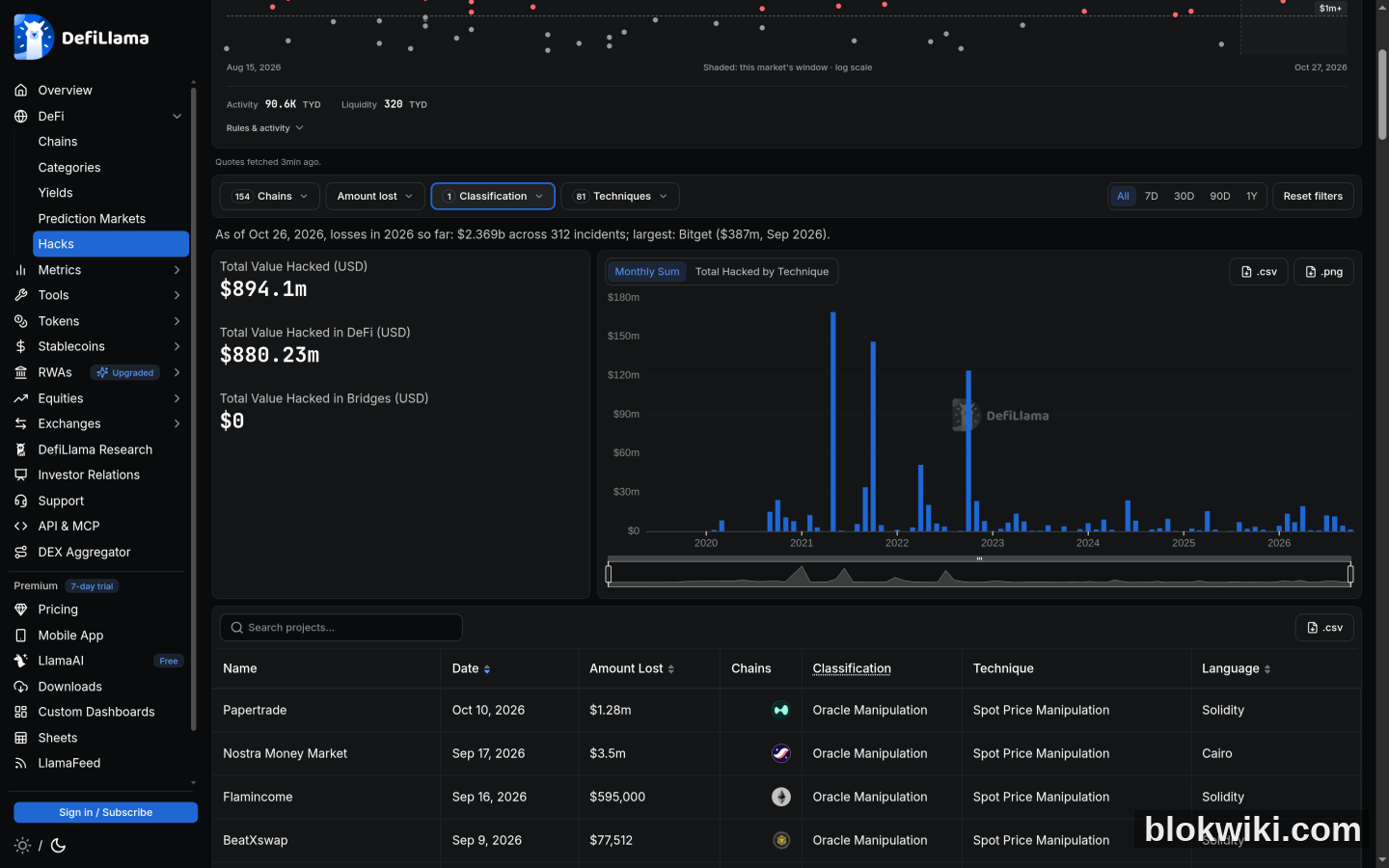
Through October 2026, DeFi has seen 42 attacks classified as "oracle manipulation," surpassing the 27 recorded in all of 2022 and setting the highest total on record — with November and December still to come. Over the same period, DeFi security incidents totaled 312, with cumulative losses of about $2.37B.
But the more notable change isn't that attacks "got more frequent" — it's that the shape of the attacks has changed: incidents hit a record high while individual losses shrank markedly. Instead of trying to drain one big protocol in a single blow, attackers now sweep small pools at high frequency.
The trend first: incidents rebound while losses shrink
| Year | Oracle / price manipulation incidents | Losses in this category | All incidents that year | All losses that year |
|---|---|---|---|---|
| 2022 | 27 | ~$241M | 185 | ~$3.63B |
| 2023 | 26 | ~$40.22M | 197 | ~$1.63B |
| 2024 | 23 | ~$63.13M | 217 | ~$1.67B |
| 2025 | 18 | ~$33.26M | 148 | ~$2.72B |
| 2026 (through Oct 26) | 42 | ~$74.65M | 312 | ~$2.37B |
Source: DefiLlama Hacks public dataset (aggregated by classification = Oracle Manipulation). From 2022 to 2025, this category fell from 27 incidents to 18, which looked like defenses improving; in 2026 it rebounded straight to 42, more than doubling.
Note on methodology: some outlets also count Tectonic's $124.5M loss on August 30 as "price manipulation," arriving at total losses of nearly $200M. But DefiLlama classifies Tectonic as "Donation Attack (token and share accounting)," which is not Oracle Manipulation. This article's $74.65M counts only the latter, so its figure differs from some reports — the numbers aren't in conflict, the classification methodology is simply different.
Put the two numbers together and the conclusion is clear: oracle-type attacks caused about $74.65M in losses in 2026, just a third of the $241M in 2022. Twice the attacks, one-third the per-incident haul — not because attackers grew weaker, but because they switched targets.
Why attackers started "sweeping small pools"
Three reasons compound:
- Defending large protocols has become expensive. After the wave of massive losses at Wormhole, Ronin, and BNB Bridge in 2022, mainstream protocols tightened multi-source oracles, time-weighted average prices (TWAP), borrowing caps, and liquidation thresholds, making it hard for a single manipulation to reach the old magnitude.
- Small protocols are "low-hanging fruit." DefiLlama records that Weft V2 was manipulated for just $47,000 on August 30, 2026, and Arrakis V1 for only $7,100 on August 23, 2026. These small protocols price with a single-source spot feed, and their pools are shallow — a few hundred dollars of buying can move the price.
- Small attacks rarely trigger coordinated defenses. At under a million dollars per hit, exchanges and ecosystem players usually don't launch an emergency response, letting attackers cash out at leisure.
The counterexamples are just as clear. The largest incidents of 2026 still targeted sizeable lending protocols:
| Date | Protocol | Technique | Loss |
|---|---|---|---|
| 2026-02-22 | Blend Pools V2 | Spot price manipulation | ~$10.97M |
| 2026-07-11 | Bonzo Lend | Spot price manipulation (oracle signature verification flaw) | ~$9.05M |
| 2026-08-27 | Moonwell Lending | Spot price manipulation | ~$8.9M |
| 2026-04-16 | Rhea Lend | Spot price manipulation | ~$18.4M |
| 2026-09-17 | Nostra Money Market | Spot price manipulation | ~$3.5M |
One detail worth remembering: Bonzo Lend runs on the Hedera network, and the attacker exploited a flaw in the signature verification of the oracle Supra, reporting SAUCE's price from a real ~$0.047 to $0.89 (an artificial markup of about 1,800%), then borrowed against the inflated collateral. The protocol's own contract was fine — the price feed it trusted had been compromised.
The three main oracle manipulation techniques
Regardless of target size, the mechanics fall into three categories:
- Spot price manipulation. The protocol reads the instant price from a DEX pool directly, and the attacker uses a flash loan or their own funds to skew the pool, making the protocol lend, liquidate, or mint at the wrong price. 32 of the 42 incidents in 2026 used this technique.
- AMM reserve abuse. Injecting or withdrawing assets from a pool to alter its "reserve ratio," affecting pricing functions that depend on it — without necessarily blowing the price up.
- Oracle misconfiguration. There were 8 of these in 2026. These aren't attacks; the protocol itself misconfigured the feed source, update frequency, or decimals, leaving the price persistently off.
How ordinary users can reduce this risk
- Look at how collateral is priced before you lend or deposit. Use protocols that rely on multi-source oracles plus TWAP; if the protocol docs list a "spot price from some DEX pool" as the price source, raise its risk level immediately.
- Prefer large-pool scenarios. For the same 10% yield, manipulating a market with hundreds of millions in daily volume costs far more than manipulating a small market with a few hundred thousand in daily volume.
- Treat "newly launched" as a negative. Most small incidents happen shortly after a protocol goes live — risk parameters haven't been stress-tested and the pool isn't deep yet.
- Cap your exposure to any single protocol. Set an amount per protocol that you could afford to lose entirely, rather than allocating by yield.
- Watch the protocol's oracle announcements. Oracle upgrades and price-feed switches are when misconfigurations are most likely — reduce positions during those periods.
FAQ
Is DeFi less safe in 2026?
Two sides. The number of incidents is indeed a record high (312, above 185 in 2022), but total losses are about $2.37B, below 2022's $3.63B. In other words, "more attacks, smaller each time." For small users, high-frequency small attacks are easier to overlook, which makes proactively screening protocols even more important.
Why do audited protocols still get hit by oracle attacks?
Because most audits focus on the contract logic itself, while oracle dependencies, parameter configuration, and governance mechanisms are "external dependencies" that typically receive only limited scrutiny. In the Bonzo Lend case, the protocol contract was normal — the problem was the verification logic of the oracle nodes it trusted.
Will oracle attacks directly affect my wallet?
They won't touch your private key directly, but they affect your assets through the protocol: collateral liquidated in error, a lending pool drained of liquidity so you can't withdraw, or a protocol token crashing. So risk control comes down to "how much money you've placed in which protocols."
Can I check this data myself?
Yes. DefiLlama's public endpoint api.llama.fi/hacks returns JSON, with each entry containing the date, project name, classification, technique, amount, and chain. Aggregate by year and classification to reproduce this article's tables without relying on secondhand reporting.
How does this differ from a governance attack?
An oracle attack targets the "price feed" link, making the protocol execute at a wrong price; a governance attack targets the "decision-making power" link, voting to move money out of the treasury directly. X100 Global falls into the latter — see the governance attack post-mortem.
Risk notice: Cryptoasset prices are highly volatile and you may lose your entire principal; this article does not constitute investment advice. The statistics here are based on DefiLlama's public dataset (2026 data through October 26) and its methodology may differ from media reporting — refer to the original dataset; loss figures may be revised as incidents are further tallied. DeFi protocols carry multiple risks including smart contracts, oracles, and governance; please assess them yourself.